







The Hidden Cost of Carrier Lock-In on a Cellular Fleet
June 1, 2026
Press Release: Simplex Wireless Introduces SimplexAI™
June 10, 2026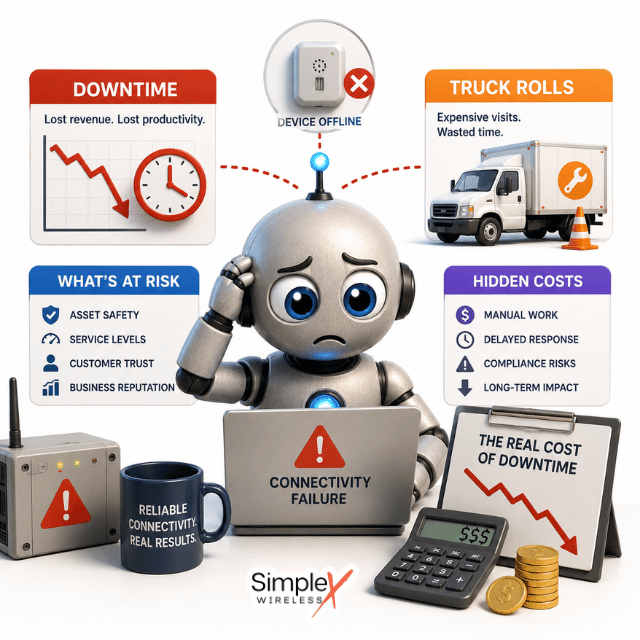
The Real Cost of IoT Connectivity Failures: Downtime, Truck Rolls, and What’s Actually at Risk
The data bill is never the problem. The problem is everything that happens after the device goes offline.
A fleet of 2,000 asset trackers. One carrier experiences a regional outage at 11pm on a Wednesday. By morning, 340 devices haven’t reported. The operations team assumes a firmware issue. An engineer spends half a day ruling that out. Someone eventually calls the carrier. The outage is acknowledged. The devices come back. Total cost of the data disruption: zero dollars. Total cost of the response: a day of engineering time, a delayed shipment investigation, and a customer who noticed the gap in tracking and started asking questions.
This is how connectivity failures actually cost money — and why the cost almost never shows up on the connectivity bill.
The four cost categories
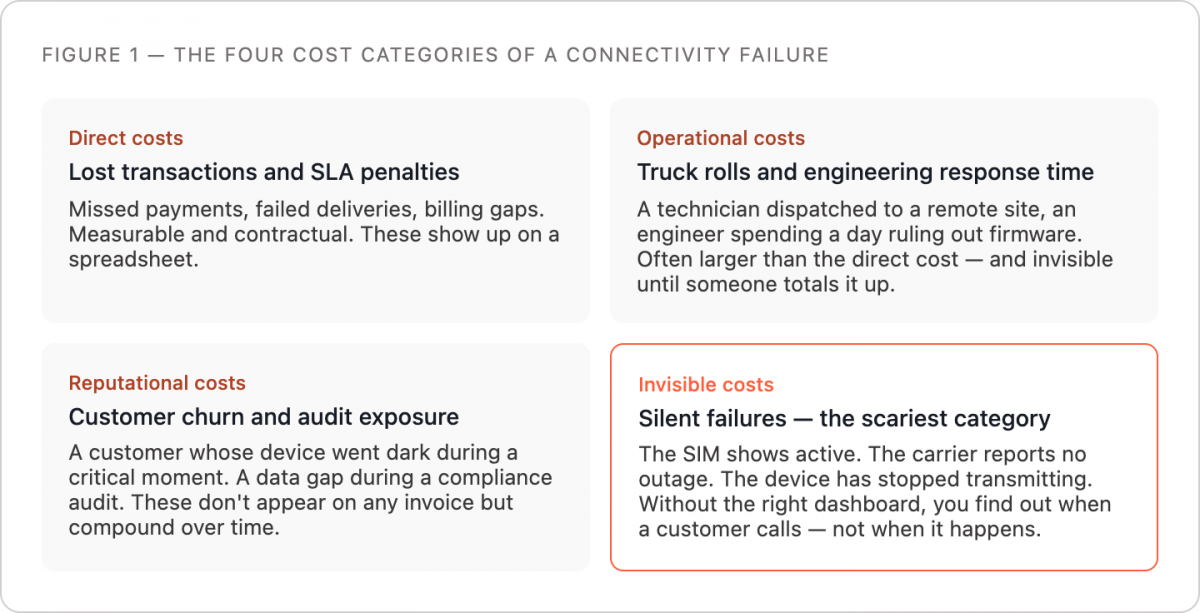
A connectivity failure has four distinct cost categories, and only one of them is the data you didn’t transmit.
Direct costs are the most obvious: lost transactions, missed SLA commitments, regulatory penalties for data gaps in metered or medical devices. For some industries these are measurable and contractual — a missed delivery window, a failed payment at an EV charger, a billing gap in a metering cycle. These show up on a spreadsheet.
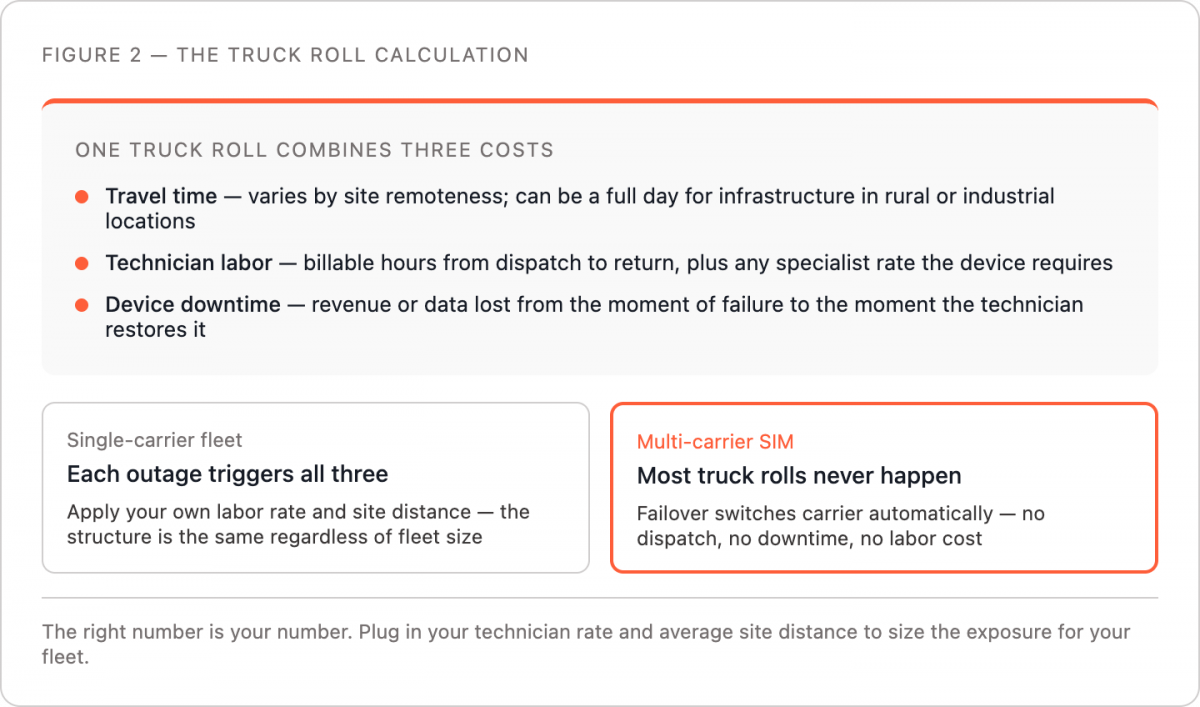
Operational costs are often larger and harder to see. A technician dispatched to reboot or swap a SIM card is the most visible form — what the industry calls a truck roll. The cost combines travel time, technician labor, and device downtime for the duration — a number that scales quickly with site remoteness and fleet size. Multiply that by the number of single-carrier failures in a year across a fleet of thousands, and it stops looking like a connectivity cost and starts looking like a staffing cost.
Reputational costs are the hardest to quantify and the longest to recover from. A customer whose GPS tracker went dark during a critical shipment doesn’t forget. A field service operator whose monitoring platform showed a gap during an audit has a conversation they’d rather not have. These costs don’t appear on any invoice.
Invisible costs are the most dangerous. A device that fails silently — where the SIM registers as active but the device isn’t transmitting — looks fine on every dashboard that doesn’t know what to look for. Your fleet shows green. Your carrier reports no outages. Your device is sitting there, doing nothing, and you don’t know.
The truck roll problem and the silent failure problem
The truck roll is the cost that gets the most attention because it’s the most visible. Someone has to physically go somewhere. That trip has a number attached: travel time, labor time, parts if needed. For a device deployed in a city, that might be a two-hour round trip. For a device on a remote utility installation, it might be half a day. Multiply by however many single-carrier outages your fleet experiences in a year — and then consider that multi-carrier failover eliminates most of those trips entirely by switching to a backup carrier automatically when the primary drops.
The silent failure problem is harder to solve because it requires active visibility, not just better hardware. A device running on a single-carrier SIM can lose signal and the SIM will show as registered. The carrier’s network accepted the SIM — it just isn’t routing traffic. Without a portal that monitors actual data transmission (not just SIM registration), this failure mode is invisible until something downstream triggers an alert: a customer complaint, a gap in a report, a missed alert that should have fired.
The difference between knowing about a silent failure in minutes versus days is the difference between a recoverable blip and an operational incident.
Where the cost is highest — and why
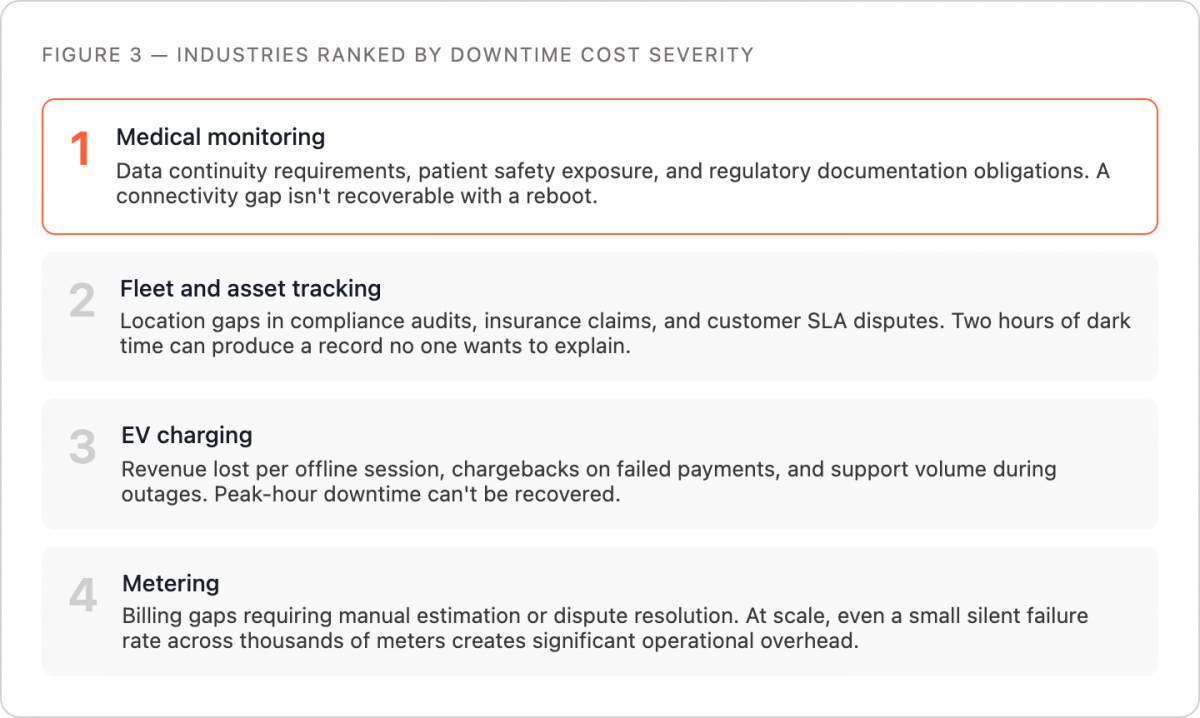
Not all IoT downtime costs the same. The industries below represent the highest downtime exposure — not because connectivity failures are more likely, but because the consequence of each failure is larger.
EV charging stations generate revenue per session. A charger that drops offline during peak hours loses those sessions permanently — they don’t queue up for later. Operators also face chargebacks and support calls when a payment fails mid-session because the device lost connectivity at the wrong moment.
Fleet and asset tracking carries liability exposure. A vehicle that goes dark for two hours may have missed location events that matter in a compliance audit, an insurance claim, or a customer SLA dispute. The device not reporting isn’t just an operational inconvenience — it’s a data gap in a record that someone may later need.
Medical monitoring is the highest-stakes category. Devices that transmit patient data or environmental readings in clinical settings are subject to regulatory requirements around data continuity. A connectivity gap isn’t a billing problem — it’s a documentation problem, and in some cases a patient safety concern.
Metering — utility meters, sub-meters, industrial consumption monitoring — depends on continuous data for accurate billing. A device that stops transmitting for 24 hours creates a billing gap that either goes unresolved or requires manual estimation — neither is acceptable at scale.
How to calculate your fleet’s downtime exposure
You don’t need an outage to know what one would cost. Run this exercise before your next deployment decision.
Count your single points of failure. How many devices in your fleet run on a single-carrier SIM? Each one is an outage waiting for a carrier to have a bad day. If that number is more than a handful, the exposure is real.
Estimate your truck roll rate. How many field dispatches in the last 12 months were connectivity-related? Multiply by your average dispatch cost — travel time, labor rate, device downtime. That’s your baseline: the cost you’re already paying.
Identify your silent failure risk. Does your current portal alert you when a device stops transmitting data — or only when the SIM deregisters? If you can’t answer that question immediately, assume the answer is no. That gap is where silent failures live undetected.
Apply your industry multiplier. A connectivity failure in an EV charging network at 6pm on a Friday costs more than the same failure on a metering device at 3am. Adjust your exposure estimate for when and where your devices run.
The Livelox team ran a version of this exercise before switching to multi-carrier SIM cards. Their GPS trackers across Nordic race venues had been dropping signal in remote forests — not because the technology was wrong, but because no single carrier covers everywhere. The switch to multi-carrier eliminated the drops. The overhead of managing fragmented carrier contracts disappeared with it.
Connectivity redundancy isn’t an insurance policy you hope never to use. For most deployed IoT fleets, it’s the cheaper option once you total up what single-carrier failures actually cost. If you’re ready to see what multi-carrier coverage looks like for your deployment, explore Simplex IoT SIM cards and request a trial SIM.
This article was curated by Jan Lattunen, CCO Simplex Wireless
About the Author: Jan Lattunen manages Sales and Marketing for Simplex Wireless. Jan has 20 years’ experience in working with SIM card technology and was involved in launching the eSIM in North America with major carriers and OEMs. His expertise in telecommunications is around SIM cards. On a personal note, Jan is a family man and avid cyclist with advocacy for safety in the roads. You can connect with Jan on https://linkedin.com/in/JanLattunen