







Webinar: The IoT is Where IT Meets OT for Industrial Agility
May 1, 2026
How to Evaluate an IoT SIM Provider: A Due Diligence Guide for Multi-Year Deployments
May 7, 2026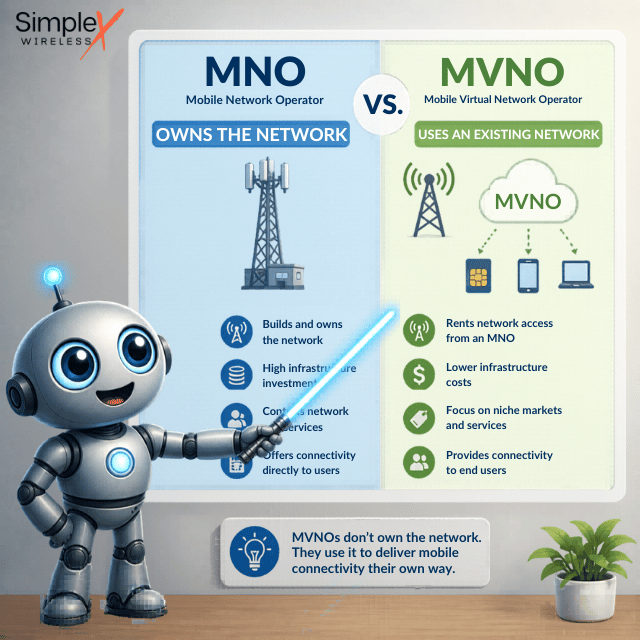
What Is an MVNO? And Why It Matters More Than You Think for IoT Connectivity
The company you buy your IoT SIM from almost certainly doesn’t own the towers your devices connect to. Here’s what that means, how it works, and why the distinction matters when you’re evaluating providers.
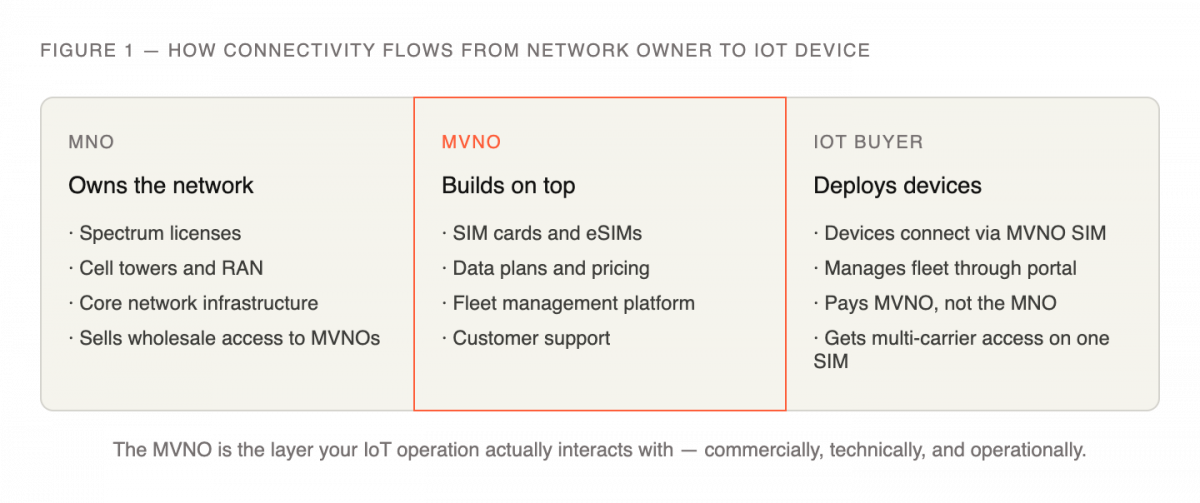
MVNO stands for Mobile Virtual Network Operator. An MVNO is a company that provides cellular connectivity without owning the physical network infrastructure — no spectrum licenses, no cell towers, no radio access network. Instead, an MVNO buys wholesale access to one or more mobile networks from the companies that do own them (called MNOs, or Mobile Network Operators), then builds its own services, pricing, and management platform on top. When your IoT devices connect to AT&T or T-Mobile through a Simplex SIM, they’re using the MNO’s towers — but the SIM, the account, the management platform, and the support relationship are all Simplex’s.
Most IoT connectivity providers are MVNOs. Understanding what that means — and what varies between them — is one of the more useful things you can know before choosing one.
MNO vs MVNO — The Infrastructure Distinction
An MNO (Mobile Network Operator) owns everything: the spectrum license, the towers, the radio access network, and the core network that handles authentication, routing, and billing. AT&T, T-Mobile, Verizon in the US; Rogers, Bell, and TELUS in Canada; Vodafone in Europe — these are MNOs. Building and maintaining this infrastructure requires enormous capital investment. It also locks each MNO into their own coverage footprint, which is why no single MNO covers every location on earth with equal reliability.
An MVNO sits above the infrastructure layer. It negotiates commercial agreements with one or more MNOs for wholesale network access, then manages everything from that point forward: SIM cards, data plans, account management, fleet dashboards, billing, and support. The devices using an MVNO’s SIM connect to the underlying MNO’s towers, but the customer relationship — and all the operational tools — belong to the MVNO.
For IoT buyers, this structure has a direct practical benefit: a well-connected MVNO can offer access to multiple MNO networks on a single SIM. Where a direct MNO relationship locks your devices to one carrier’s coverage footprint, an MVNO with agreements across multiple carriers can route your devices to whichever network has the strongest signal at a given location. That’s how multi-carrier IoT connectivity works in practice — not magic, but commercial agreements, and the MVNO is the entity that holds them.
Not All MVNOs Are the Same
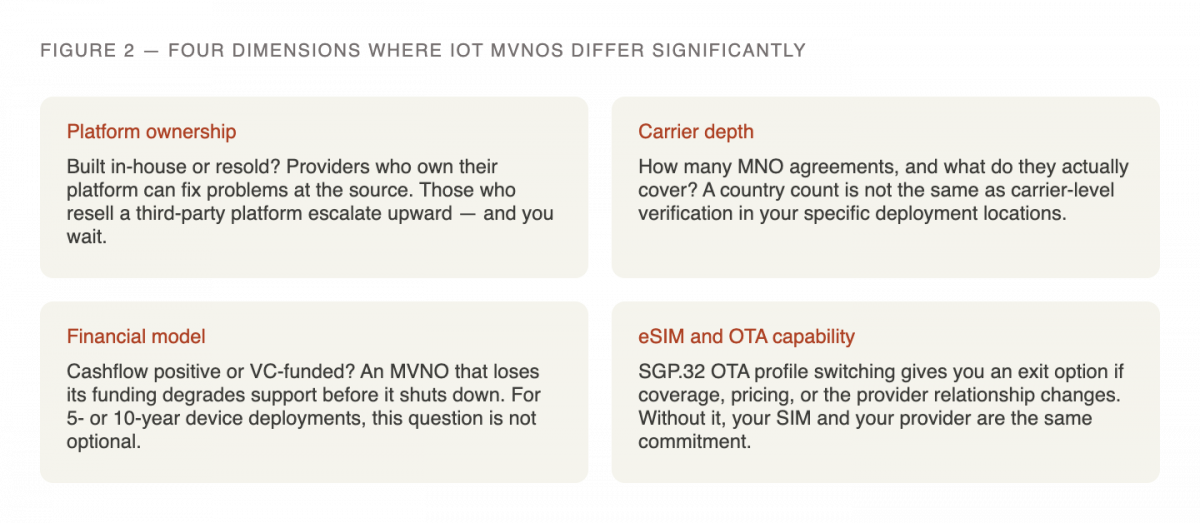
The term MVNO covers a wide spectrum, from branded resellers who do little more than put their name on another operator’s SIM, to full MVNOs who build and operate their own core network components, billing infrastructure, and service platforms. For an IoT buyer, the distinction matters in three specific ways.
What’s built in-house versus resold. A light MVNO essentially repackages another company’s platform. A full MVNO builds its own SIM management system, billing infrastructure, and network integration. The difference shows up most clearly when something goes wrong: a provider that owns its platform can diagnose and fix issues at the infrastructure level. One that resells a third-party platform escalates to their vendor, who escalates to the network, and the customer waits.
How many MNO agreements they hold — and what those actually cover. Country coverage maps are marketing. What determines whether your device connects reliably is the specific carrier agreements behind that map — which networks, under what terms, and whether permanent roaming is permitted in each market. Two MVNOs can both claim “191-country coverage” with very different carrier depth behind those claims.
Financial stability. The MVNO market has meaningful failure rates. Many operate on venture capital without clear paths to profitability. When an MVNO closes or degrades, the impact on a deployed device fleet can range from service disruption to stranded hardware — especially for MFF2 embedded deployments where physical SIM replacement is difficult. Asking whether a provider is cashflow positive isn’t an unusual question. It’s a reasonable one for anyone committing devices to a multi-year deployment.
What Varies Between IoT MVNOs
Consumer MVNOs compete primarily on price and brand. IoT MVNOs need to compete on different dimensions — and the ones that matter most aren’t always visible on a pricing page.
The management platform is often more important than the data plan itself. At small scale, logging into a portal once a week to check usage is manageable. At 50 devices, 500, or 50,000, you need API access, automated provisioning, per-SIM lifecycle control, usage alerts, and a billing structure that reflects actual consumption across a heterogeneous fleet. Some MVNOs include this as standard. Others charge for it separately or offer it only at higher tiers.
eSIM and OTA switching capability separates providers that can adapt to a deployment from those that can’t. A SIM that supports SGP.32-based over-the-air profile switching gives you options if your coverage needs change, if regulations in a market require a local profile, or if the provider relationship needs to change entirely. A SIM without OTA capability locks you into the hardware and the provider simultaneously.
Where Simplex Fits
Simplex is an IoT MVNO with access to AT&T, T-Mobile, and Verizon in the US and Rogers, Bell, and TELUS in Canada, extending to 550+ networks across 191 countries globally. The company is part of a sister company, which has more than 30 years of experience building carrier-grade software for tier-1 MNOs.
The EIM (eSIM IoT Manager) platform is built entirely in-house on Simplex’s own bare metal infrastructure — not a resold third-party system. When something needs to be diagnosed or fixed at the platform level, the people who answer the phone are the people who built it. The xoSIM platform supports SGP.32 over-the-air profile switching, which means a deployed fleet isn’t permanently locked to any single carrier profile or provider relationship..
Understanding what an MVNO is doesn’t require deep technical knowledge — but it does change the questions you ask before choosing one. The provider you buy from sits between you and the network. What they’ve built, who they hold agreements with, and how stable they are financially all determine what your devices actually experience in the field. Explore Simplex’s IoT data SIM to see how the MVNO model translates into specific plans and coverage for your deployment.
This article was curated by Jan Lattunen, CCO Simplex Wireless
About the Author: Jan Lattunen manages Sales and Marketing for Simplex Wireless. Jan has 20 years’ experience in working with SIM card technology and was involved in launching the eSIM in North America with major carriers and OEMs. His expertise in telecommunications is around SIM cards. On a personal note, Jan is a family man and avid cyclist with advocacy for safety in the roads. You can connect with Jan on https://linkedin.com/in/JanLattunen