







From Physical SIMs to SGP.32: What Changes for Your IoT Fleet
May 11, 2026
eIM Explained: The Server That Lets You Switch Carriers Without Touching the Hardware
May 18, 2026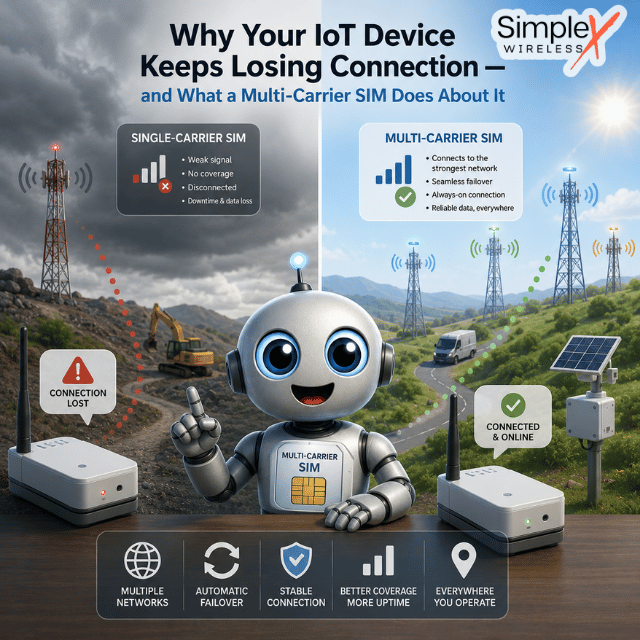
Why Your IoT Device Keeps Losing Connection — and What a Multi-Carrier SIM Does About It
Single-carrier SIMs are the hidden culprit behind most unexplained IoT outages. Here’s the failure mode, and the fix.
Your device shows a green status light. The carrier reports no outages. Your modem firmware is current. And somehow, a portion of your fleet went offline at 3 AM on a Tuesday in rural Ohio, and you found out when a customer called. If that sounds familiar, you’re probably not dealing with a hardware problem or a firmware bug. You’re dealing with a single-carrier SIM in a world that doesn’t guarantee single-carrier coverage.
The fix isn’t a signal booster or a firmware patch. It’s a different class of SIM card — and understanding why requires a quick look at how cellular IoT connectivity actually fails.
How a Single-Carrier SIM Fails
When an IoT device — a fleet tracker, a trail camera, an EV charging station, a remote sensor — powers on, the SIM card inside authenticates with a nearby cell tower and registers on a carrier’s network. From that point forward, the device stays attached to that carrier unless the connection drops, at which point the modem attempts to reconnect. To the same carrier. Because that’s the only one it’s provisioned for.
If that carrier’s tower loses power, gets overloaded, or simply doesn’t reach the specific building, field, or enclosure where your device is installed, the SIM has nowhere to go. The device goes offline and stays offline until either the carrier restores service or someone physically intervenes. No fallback. No automatic recovery. Just silence until someone notices.
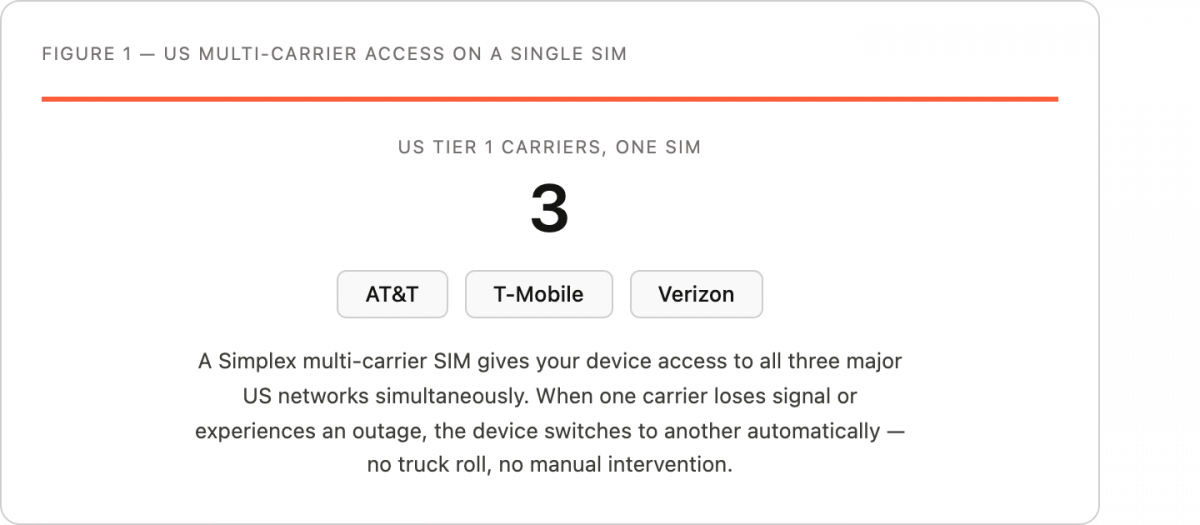
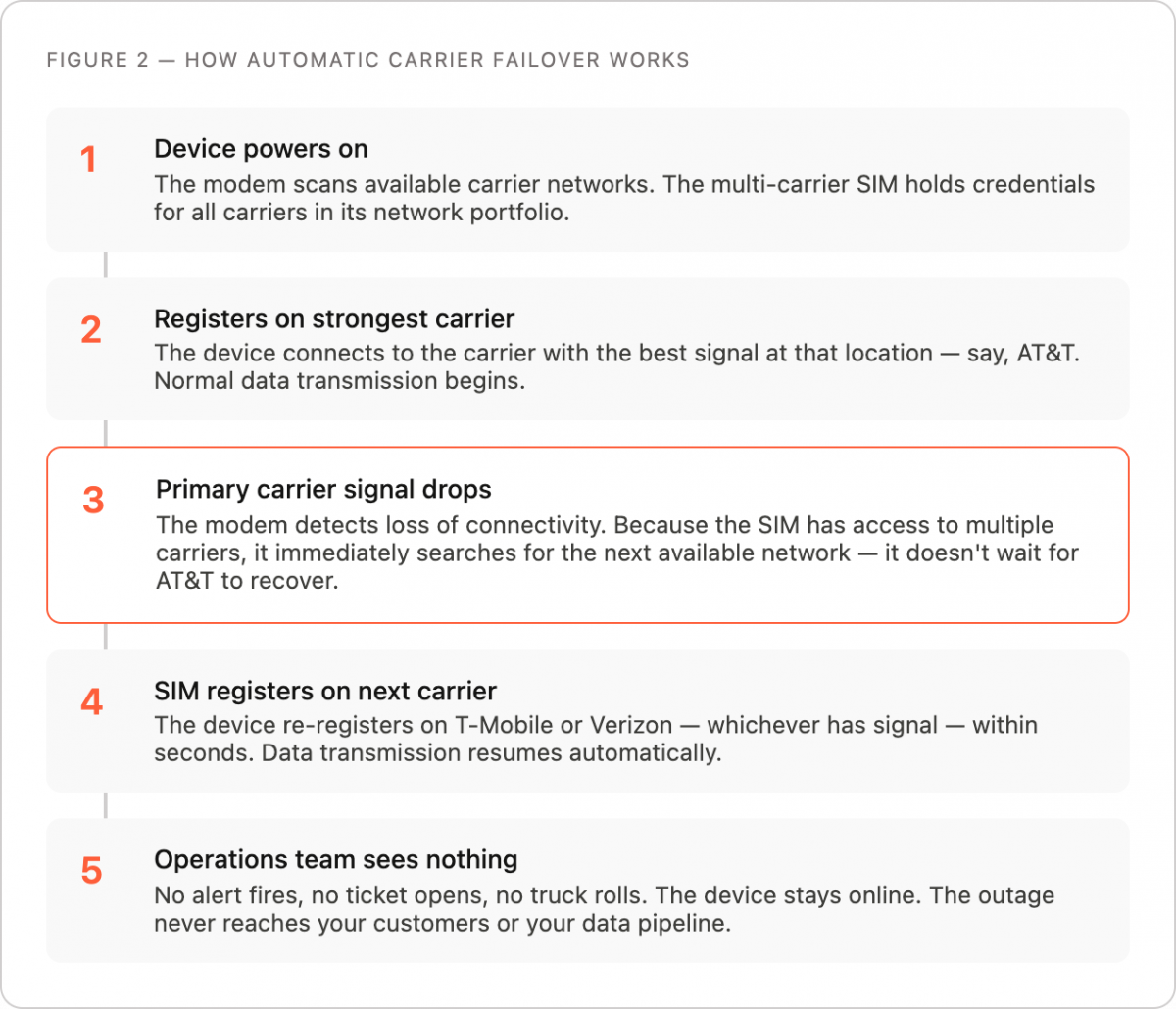
A multi-carrier SIM — also called an IoT SIM or M2M SIM (Machine-to-Machine) — works differently. Instead of being locked to one carrier, it holds network access credentials for multiple carriers simultaneously. When the primary carrier drops, the device’s modem automatically registers on the next available network. This is called failover. In a well-configured multi-carrier SIM, it happens within seconds and without any action from your operations team.
Why This Matters Specifically for IoT
Consumer devices can tolerate brief outages in ways that deployed IoT devices cannot. If your phone loses signal in a parking garage, you notice when you get outside and reopen the app. No process is broken. No data is permanently lost.
Deployed IoT devices don’t have that luxury. A fleet tracker that goes silent for two hours may miss location events that trigger a compliance audit. An EV charging station that disconnects may fail to process a payment and not report the hardware fault it was supposed to log. A metering device that stops transmitting for 24 hours may produce a data gap that invalidates an entire billing cycle.
Because these devices are unattended and often physically inaccessible, the standard response to connectivity failure — “reboot it” — isn’t an option. A field technician who has to drive to a remote installation just to swap a SIM card or reboot a modem is performing what the industry calls a truck roll. A single truck roll to a remote site can cost hundreds of dollars in labor and travel time, not counting the operational downtime. Multi-carrier failover eliminates that truck roll in most single-carrier outage scenarios.
The deeper mechanics of what M2M SIM cards are and how they differ from consumer SIMs are worth understanding before you evaluate any IoT connectivity provider.
What Goes Wrong — and Where Operators Make It Worse
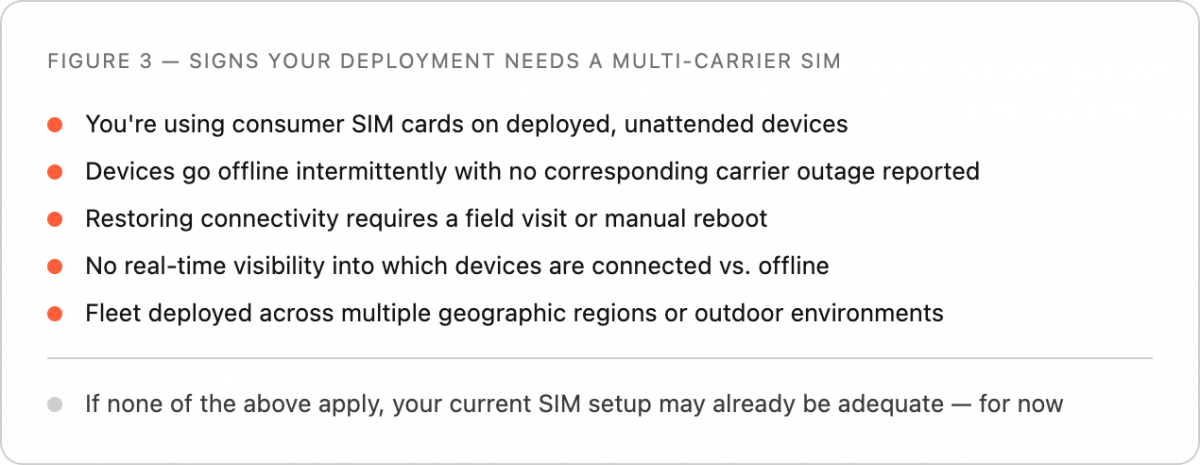
The most common mistake is running a consumer SIM card on a deployed device. Consumer SIMs are single-carrier by design, have no fleet management features, and are subject to data throttling policies written for smartphones. Carriers also terminate consumer SIM accounts much more readily when they detect sustained, non-phone usage patterns — which describes every IoT device you’ve ever deployed.
A less obvious mistake is buying a multi-carrier SIM without understanding how failover actually works. Not all multi-carrier SIMs behave the same way. Some use steering: there’s a preferred carrier, and the SIM only switches to a backup after a significant timeout — sometimes measured in minutes. Others use dynamic, unsteered carrier selection, where the modem evaluates network quality continuously and switches immediately when signal drops below a threshold. For latency-sensitive applications, the difference between 30-second failover and 3-second failover is the difference between a recoverable blip and a customer complaint.
A third failure mode: operators who buy the right SIM but skip field validation before scaling. Carrier coverage maps show theoretical signal boundaries — not actual device-level performance inside a steel enclosure in a basement, or under a bridge, or in a concrete utility vault. Validating connectivity with trial SIMs at actual deployment locations before committing a full fleet is not optional for any deployment where downtime has a measurable cost.
What to Do About It
Audit your current SIM inventory. If you’re running consumer SIMs or single-carrier IoT SIMs on deployed devices, you have a latent outage risk that compounds as your fleet grows. Pull your SIM inventory, identify the provisioned carrier for each device, and flag anything that can only access a single network. That’s your risk register.
Ask the right questions before your next SIM purchase. Which carriers are accessible on this SIM in the regions where I deploy? What is the failover mechanism and what is the expected failover time? Is carrier selection unsteered, or does the SIM have a preferred carrier that it holds onto longer than it should? If you don’t get clear, specific answers, that’s information too. The network architecture behind a multi-carrier SIM matters more than the spec sheet.
Test at actual deployment locations before you scale. Order a small batch of trial SIMs and test them where devices will actually live — not in your lab, not in a conference room. You’re validating failover behavior under real conditions, not just whether the SIM can make a connection at all.
Most IoT connectivity failures are not random. They’re the predictable result of single-carrier architecture in environments that don’t guarantee single-carrier coverage. The solution has been available for years, it works, and at scale it’s not materially more expensive than the infrastructure it replaces. If you’re ready to look at your options, start with Simplex’s IoT data SIM cards — multi-carrier access across the US, Canada, and 191 countries, with full fleet management included at no extra charge.
This article was curated by Jan Lattunen, CCO Simplex Wireless
About the Author: Jan Lattunen manages Sales and Marketing for Simplex Wireless. Jan has 20 years’ experience in working with SIM card technology and was involved in launching the eSIM in North America with major carriers and OEMs. His expertise in telecommunications is around SIM cards. On a personal note, Jan is a family man and avid cyclist with advocacy for safety in the roads. You can connect with Jan on linkedin.com/in/JanLattunen.