






eIM Explained: The Server That Lets You Switch Carriers Without Touching the Hardware
May 18, 2026
Remote SIM Provisioning Explained: What Actually Happens When You Switch Carriers Over the Air
May 26, 2026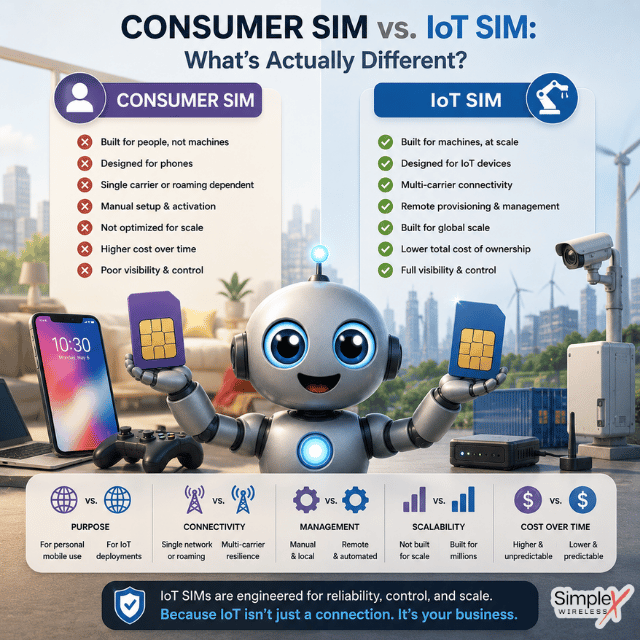
Consumer SIM vs. IoT SIM: What’s Actually Different?
They look identical. The spec sheet doesn’t.
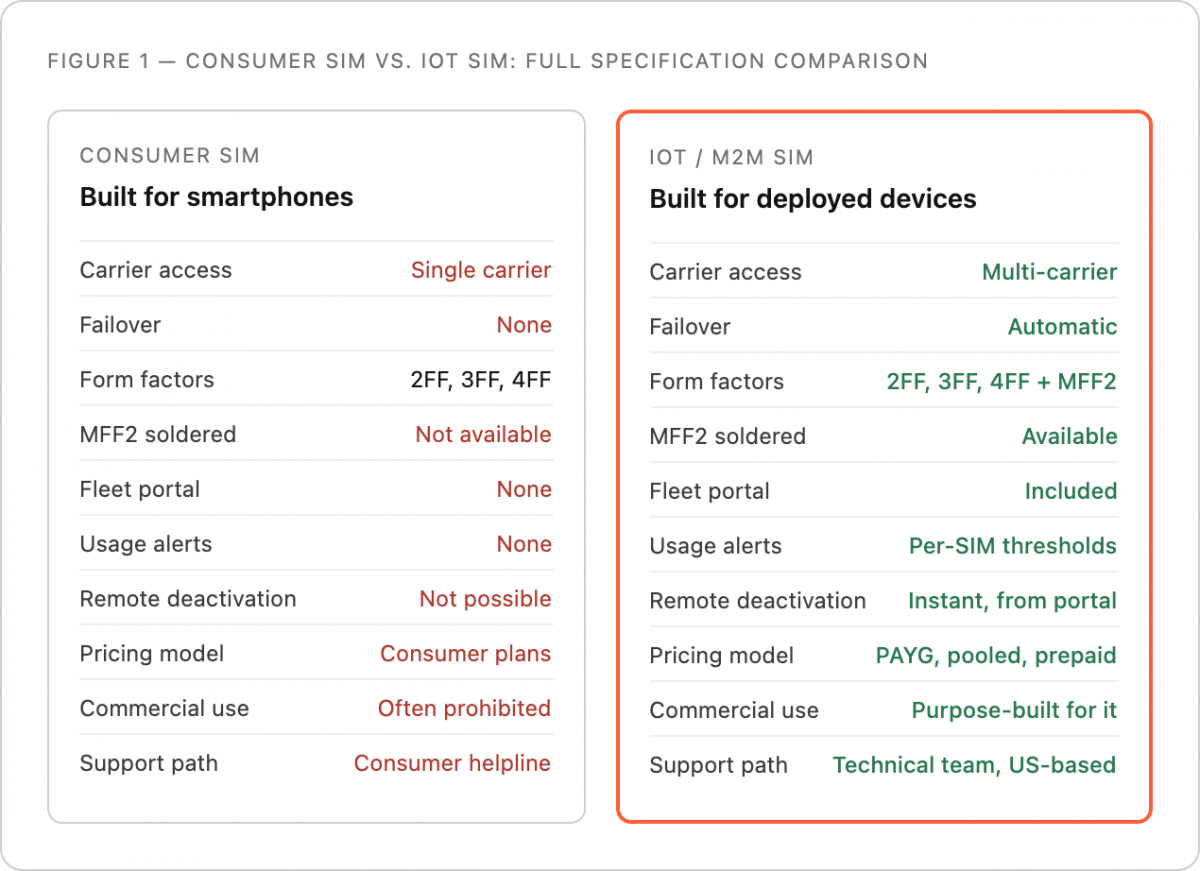
The short answer: Consumer SIMs are provisioned for one carrier, rated for phone environments, priced for human usage patterns, and have no management layer. IoT SIMs are provisioned for multiple carriers, rated for industrial conditions, priced for device usage patterns, and ship with a fleet management platform. Every one of those differences has a specific operational consequence at deployment scale.
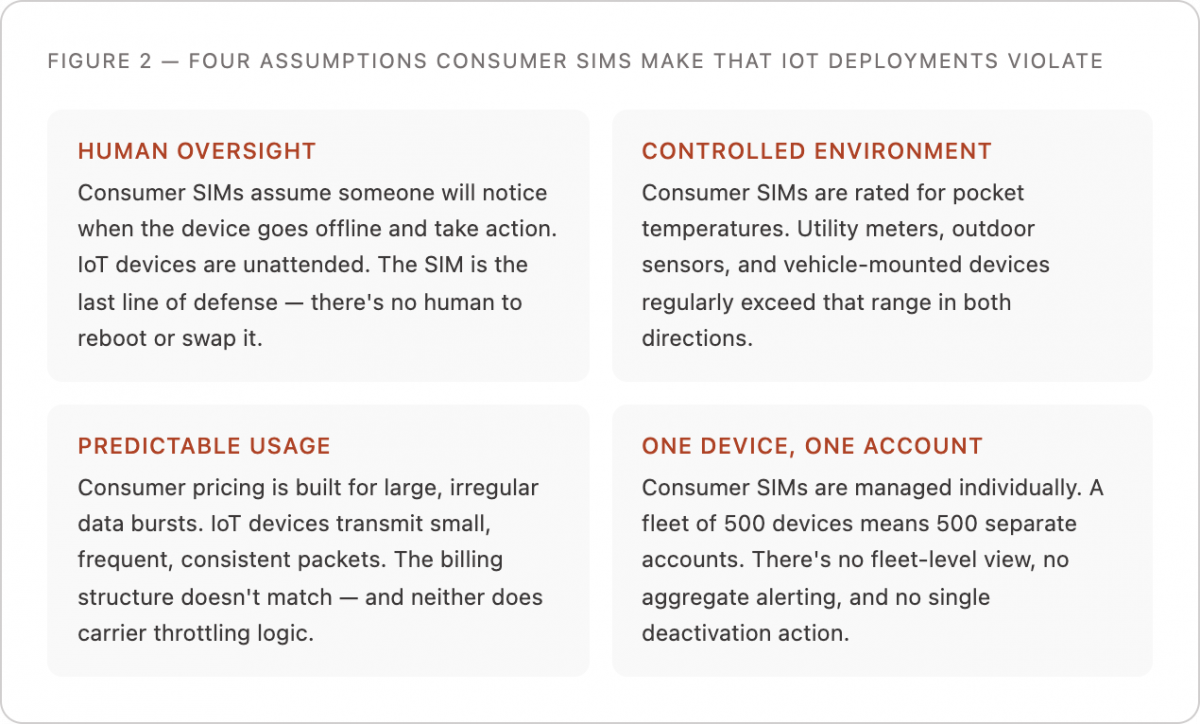
Both cards store subscriber credentials. Both authenticate with cellular networks. Beyond that, the design assumptions diverge in six distinct ways — and understanding each one tells you exactly what you’re trading away when you put a consumer SIM in a deployed device.
Network access: single-carrier vs. multi-carrier
A consumer SIM is provisioned for one carrier. Its authentication credentials are tied to that carrier’s network, and when that carrier has an outage, a coverage gap, or a congestion event, the SIM has no fallback. The device goes offline and stays offline.
An IoT SIM holds credentials for multiple carriers simultaneously. In the US, a Simplex SIM can register on AT&T, T-Mobile, and Verizon. When one carrier’s signal degrades or disappears, the device reattaches to the next available network automatically — typically within seconds, without a reboot or any application-layer intervention. This is carrier failover, and it’s the primary reliability mechanism that consumer SIMs don’t have. The mechanics of how multi-carrier network access is provisioned and how failover actually works are worth understanding before evaluating any provider’s coverage claims.
Form factor and durability: plug-in vs. MFF2
Consumer SIMs are available in three removable form factors: 2FF (mini), 3FF (micro), and 4FF (nano). All three are plastic cards designed for slots in consumer electronics. They can be removed, lost, stolen, or damaged by an end user. In harsh environments — vibration, humidity, thermal cycling — the physical contact between a removable SIM and its slot is a failure point.
IoT SIM providers offer the same three removable form factors plus MFF2 (Machine Form Factor 2): a component-grade chip soldered directly to the device’s circuit board during manufacturing. MFF2 has no removable parts, no slot contact, and is rated for industrial environmental conditions. For deployments where the device enclosure will be sealed, the hardware will be in a harsh environment, or the SIM should not be physically accessible to anyone, MFF2 is the correct choice. It’s the one form factor consumer SIMs don’t come in.
Pricing: consumer plans vs. IoT billing models
Consumer data plans price for human usage: monthly allotments measured in gigabytes, overage charged at consumer rates, throttling built in after the threshold. An IoT device that transmits 30MB per month is paying for a plan designed for someone who streams video on their commute.
IoT pricing models are structured around device behavior. Pay-as-you-go charges per MB consumed, with a low base monthly cost — right for devices with variable or low usage. Pooled plans share data across the fleet, so high-usage devices draw from the same pool as low-usage ones — right for fleets with predictable aggregate consumption. Prepaid covers a fixed data budget over a defined device lifetime — right for sensors and meters with stable, forecastable usage. Understanding how much data your devices actually need is the prerequisite for choosing the right model. The wrong pricing structure costs more than a high per-MB rate — it creates billing surprises that compound at scale.
Management: no portal vs. full fleet visibility
Consumer SIMs ship with no management layer. You activate the SIM with the carrier, you put it in a device, and from that point on your visibility is limited to what the device itself reports — if it can report at all. There is no dashboard showing which SIMs are online, no usage alerts, no fraud detection, no way to deactivate a SIM remotely if a device is compromised or lost.
IoT SIMs from a managed connectivity provider come with a fleet portal included. Every SIM in the account is visible in real time: connection status, data consumed, last active timestamp. Operators can set per-SIM or fleet-level data thresholds, receive alerts when usage crosses them, flag anomalous behavior like a SIM suddenly transmitting from an unexpected country, and suspend or deactivate any SIM instantly without touching the hardware. Full API access means those actions can be automated and integrated into existing operations tooling. The absence of this layer isn’t just inconvenient — it’s a gap that becomes an invisible cost as the fleet grows. Operators who’ve learned this the hard way often describe it as paying for connectivity twice: once for the SIM, once for the manual overhead of managing without visibility.
Carrier policy: commercial use is often outside the terms
Consumer carrier agreements typically prohibit or restrict commercial use — sustained machine-to-machine traffic, continuous fixed-location data transmission, or commercial IoT applications. Most operators running consumer SIMs on deployed devices are technically outside the terms of service, even if the carrier hasn’t flagged it yet. Enforcement is inconsistent but real: carriers periodically audit accounts for non-phone usage patterns and can terminate service without notice. An IoT SIM from a commercial provider has no such ambiguity. The use case is what it was designed for.
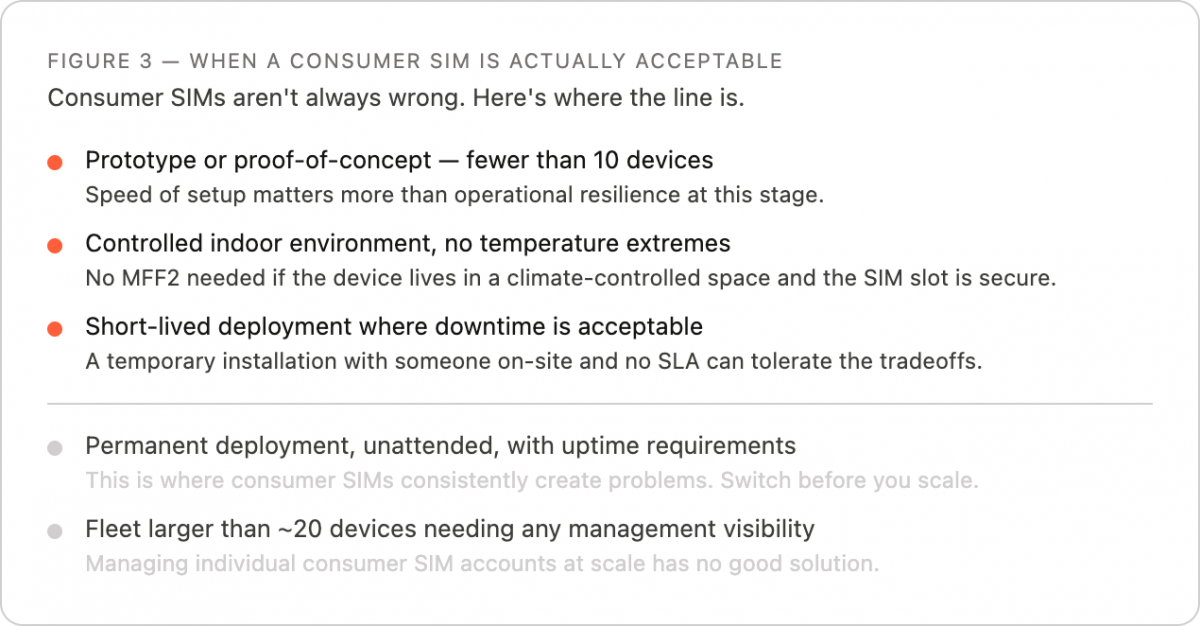
The practical upshot: for a prototype or a small, short-lived pilot, consumer SIMs are a reasonable shortcut. For any deployment that will run unattended at scale, in variable conditions, with uptime requirements — the right SIM is an IoT SIM. The full breakdown of what M2M SIM cards are and how they’re built is a useful companion to this comparison. And if you’re ready to look at what an IoT SIM with full fleet management actually costs, the Simplex IoT data SIM is a reasonable place to start.
This article was curated by Jan Lattunen, CCO Simplex Wireless
About the Author: Jan Lattunen manages Sales and Marketing for Simplex Wireless. Jan has 20 years’ experience in working with SIM card technology and was involved in launching the eSIM in North America with major carriers and OEMs. His expertise in telecommunications is around SIM cards. On a personal note, Jan is a family man and avid cyclist with advocacy for safety in the roads. You can connect with Jan on linkedin.com/in/JanLattunen.