






Consumer SIM vs. IoT SIM: What’s Actually Different?
May 21, 2026
Why Your IoT SIM Bill Is Higher Than It Should Be
May 29, 2026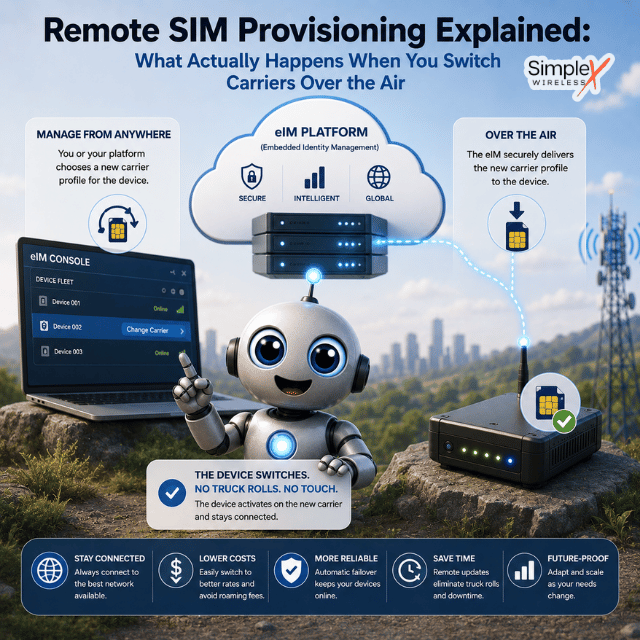
Remote SIM Provisioning Explained: What Actually Happens When You Switch Carriers Over the Air
The mechanics of a profile swap — from the moment the eIM receives an instruction to the moment the device connects on a new carrier.
The most common skepticism about remote SIM provisioning is a single question: can this really work without sending a technician? The short answer is yes. The more useful answer is understanding exactly what happens — step by step — so you can deploy with confidence rather than on faith.
The trigger: how a profile swap starts
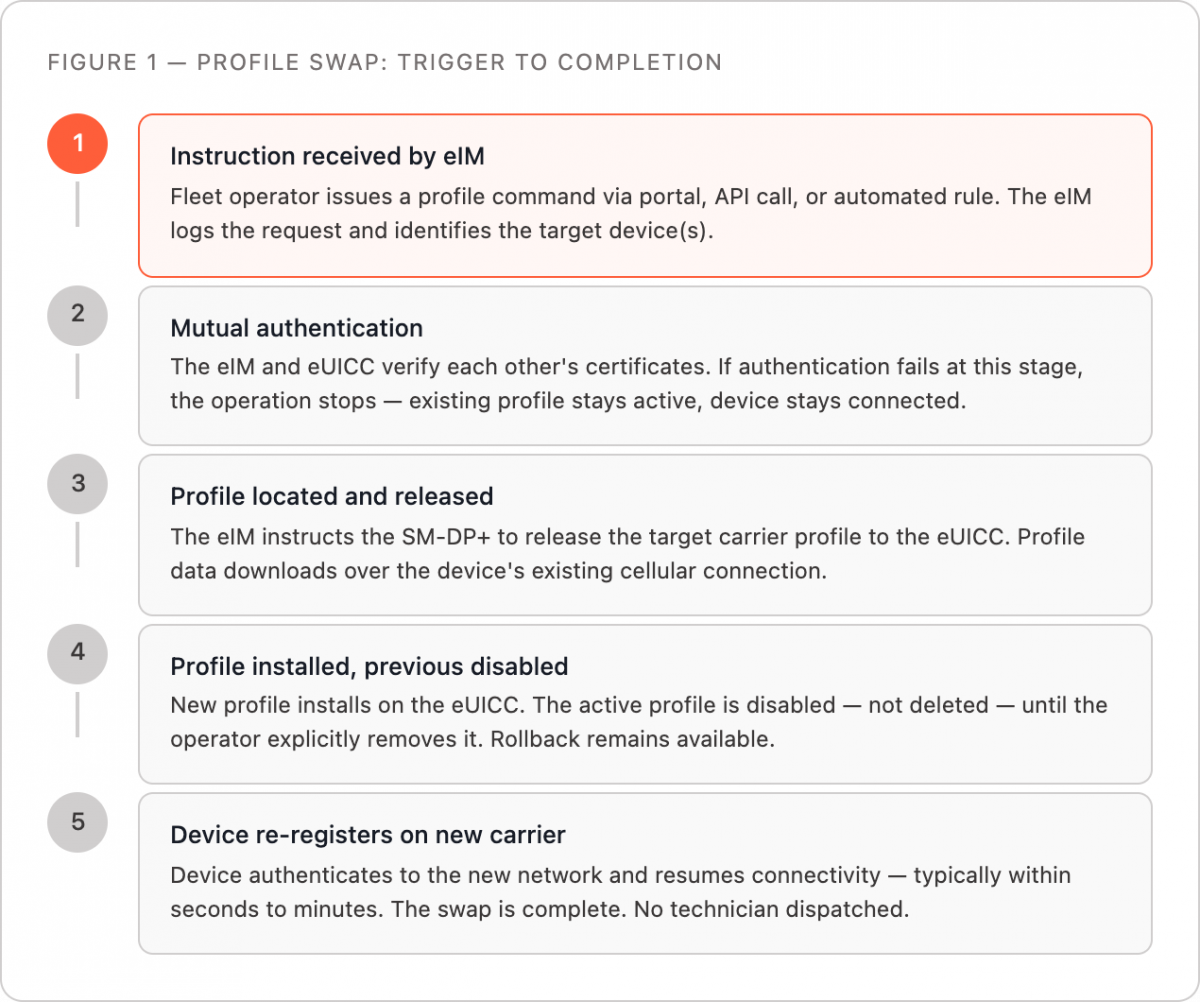
A remote SIM provisioning operation begins with an instruction to the eIM (eSIM IoT Manager). That instruction can come from three places: a fleet operator using the portal, a business system sending an API call, or an automated rule the operator defined in advance — for example, “switch all devices in Region X to Carrier B when Carrier A signal drops below threshold.”
Once the eIM receives the instruction, it does three things before any data moves to the device:
First, it authenticates the request. The eIM verifies that the instruction is authorized — that the requestor has permission to issue a profile command for these specific eUICCs (the embedded SIM chips inside the devices).
Second, it identifies the target profile. The eIM locates the correct operator profile on the SM-DP+ (Subscription Manager – Data Preparation Plus) server — the profile store where carrier credentials live.
Third, it queues the operation. If the device is online, execution begins immediately. If the device is temporarily offline, the operation queues and executes automatically when connectivity returns. No manual retry required.
This queuing behavior is defined in the SGP.32 specification, not a vendor feature — it’s the standard’s answer to the fundamental challenge of managing devices that aren’t always reachable.
The execution: what happens over the air
Once the eIM initiates the profile delivery, the sequence runs between four parties: the eIM, the SM-DP+, the IPA (IoT Profile Assistant), and the eUICC. Here’s what each does.
The IPA — which lives either on the SIM card itself (IPAe) or on the device’s application layer (IPAd) — establishes a secure session with the eIM. This session uses mutual authentication: both the eIM and the eUICC verify each other’s certificates before any profile data moves. A swap that fails authentication at this stage doesn’t proceed.
Once the session is established, the eIM instructs the SM-DP+ to release the target profile to the eUICC. The profile downloads over the cellular connection the device already has — no separate channel, no special hardware.
After the download completes, the new profile is installed on the eUICC and the previously active profile is disabled. The device then re-registers on the new network. From the carrier’s side, the device appears as a new subscriber authenticating for the first time. From the device’s side, connectivity resumes on the new network — typically within seconds to minutes, depending on network conditions.
One detail that matters: the previous profile is disabled, not deleted, until the operator explicitly removes it. That means if something goes wrong after the switch, the fleet operator can re-enable the original profile from the eIM without starting the provisioning process from scratch.
What happens when something goes wrong
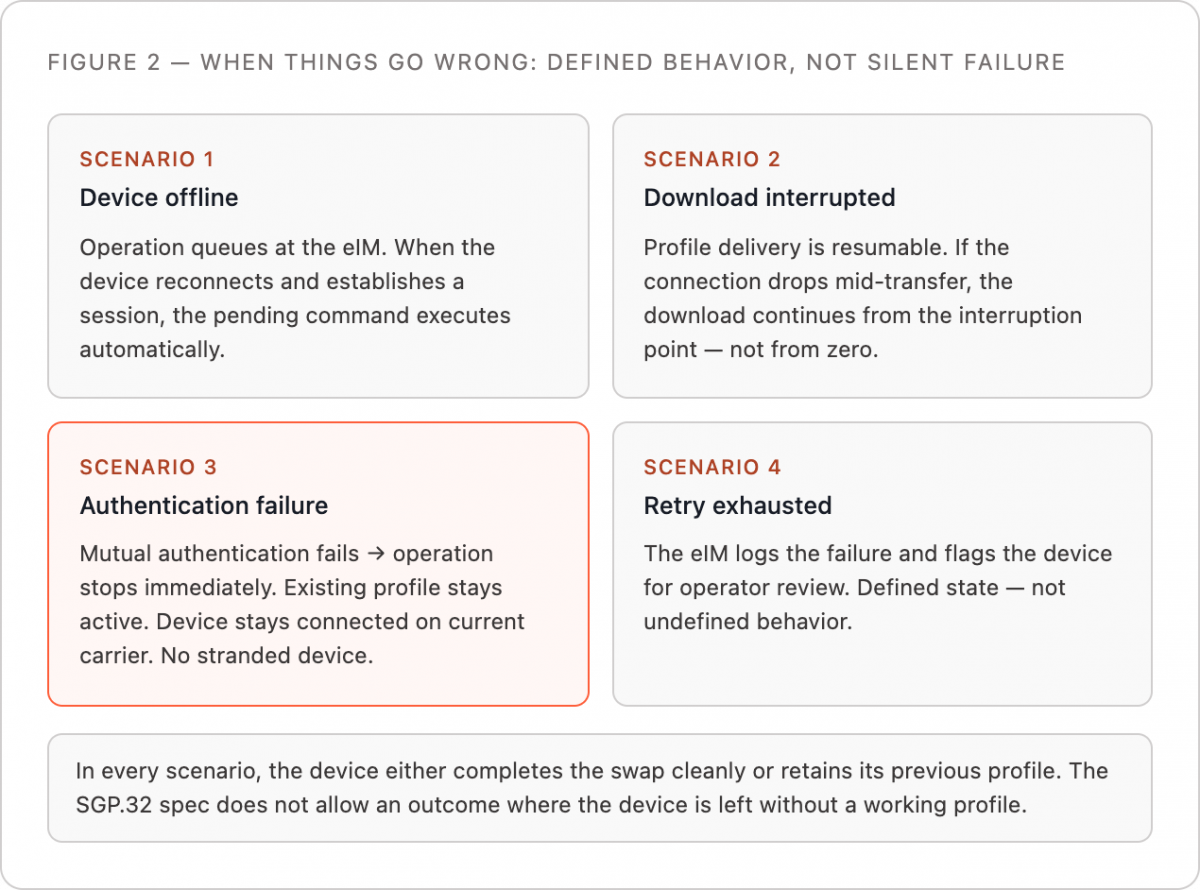
The SGP.32 specification was written with the realities of IoT deployments in mind. Every meaningful failure scenario has a defined behavior — not a silent failure.
Device offline during the operation. The eIM queues the profile state command. When the device comes back online and establishes a session, the pending operation executes. The SGP.32 design for unattended devices treats intermittent connectivity as a normal condition, not an exception.
Download interrupted mid-transfer. Profile delivery uses a resumable process — if the connection drops partway through, the transfer resumes from the interruption point rather than restarting from zero. On a constrained IoT network with limited throughput, this matters.
Authentication failure. If the mutual authentication between the eIM and eUICC fails — due to a certificate mismatch, a misconfigured eUICC, or an attempt from an unauthorized eIM — the operation stops. The existing profile remains active. The device stays connected on its current carrier.
Retry exhausted. If a profile operation fails repeatedly, the eIM logs the failure state and flags the device for operator review. No automatic recovery that could leave the device in an undefined state.
In all four scenarios, the device never ends up stranded — either the swap completes cleanly, or the original profile remains in place. That’s the fundamental guarantee that makes remote provisioning viable for unattended fleets rather than a managed risk.
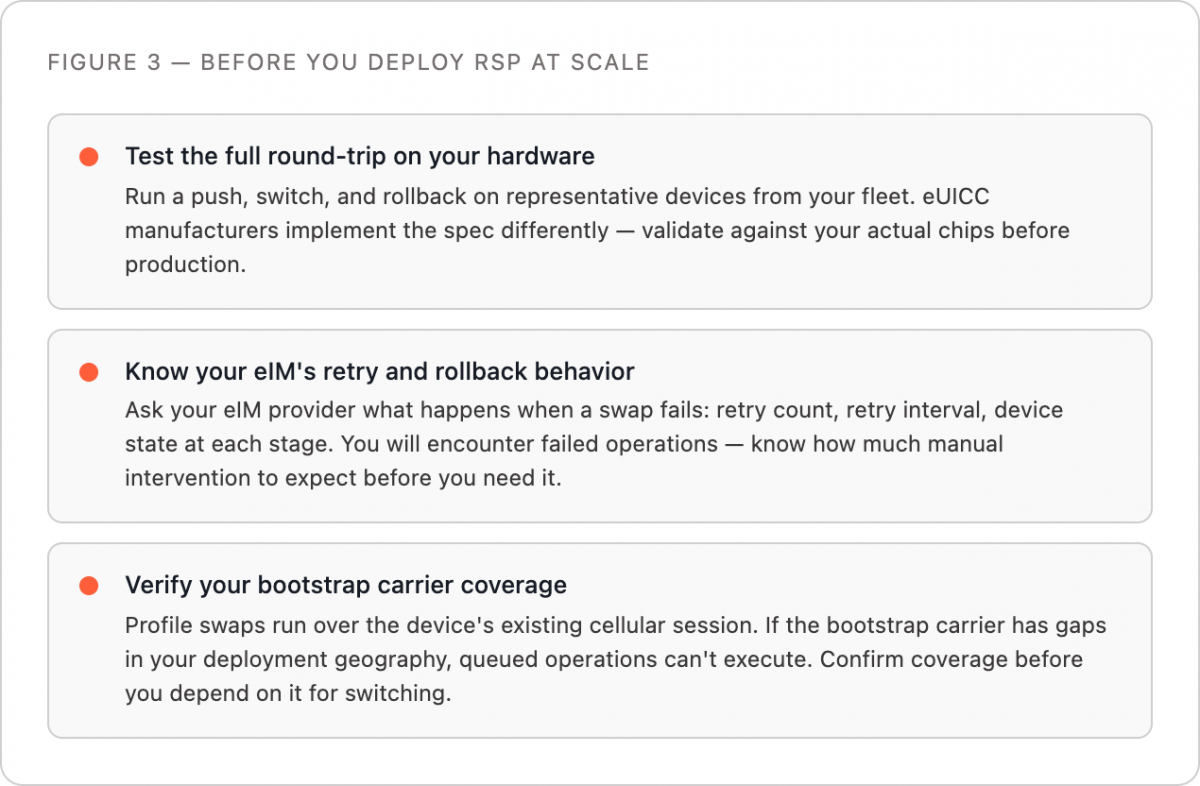
What to do before you deploy
Three things to verify before you’re dependent on remote provisioning in production.
Test the full round-trip with your specific hardware. Run a profile push, a switch, and a rollback on representative devices from your fleet before deployment. Implementation differences between eUICC manufacturers mean that a profile swap that works on one chip may behave differently on another. Validate against the actual chips in your devices, not against the spec in the abstract.
Understand your eIM’s retry and rollback behavior. Ask your eIM provider what happens when a swap fails — how many retries, over what interval, and what state the device is in at each stage. This is not a theoretical question. You will encounter devices that miss operations, and the answer determines how much manual intervention your team will need.
Confirm your connectivity fallback. Remote provisioning runs over the device’s existing cellular session. If that session drops during a swap, the queuing behavior covers you — but your devices need a viable bootstrap profile to maintain the connection in the first place. Verify that your bootstrap carrier has the coverage you need in your deployment geography before you depend on it for profile switching.
A profile swap that used to take days — field technician dispatched, SIM replaced, device back online — now takes minutes. Remote SIM provisioning via SGP.32 is what makes that possible. Understanding the mechanics, including what happens when steps fail, is what makes it reliable at scale.
If you want to see how Simplex Wireless handles profile management from the eIM server side, the product overview covers the architecture in detail.
This article was curated by Jan Lattunen, CCO Simplex Wireless
About the Author: Jan Lattunen manages Sales and Marketing for Simplex Wireless. Jan has 20 years’ experience in working with SIM card technology and was involved in launching the eSIM in North America with major carriers and OEMs. His expertise in telecommunications is around SIM cards. On a personal note, Jan is a family man and avid cyclist with advocacy for safety in the roads. You can connect with Jan on https://linkedin.com/in/JanLattunen