






5 Industries Being Transformed by 5G NTN IoT
August 26, 2026
Why Did SGP.32 Introduce CoAP in Addition of HTTPS for IoT eSIM Provisioning?
August 31, 2026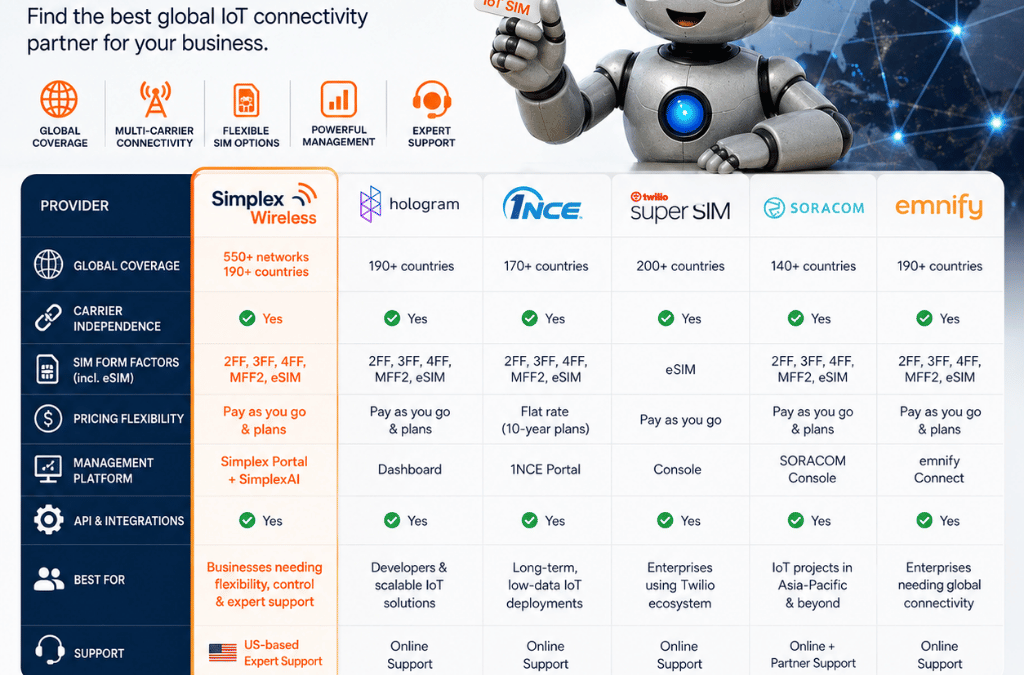
IoT SIM Providers Compared: Simplex vs. Hologram, 1NCE, Twilio Super SIM, Soracom, and EMnify
Every IoT SIM provider’s homepage claims global coverage, transparent pricing, and reliable failover. Those pages don’t help you when your first two hundred devices ship. What actually differs between providers is how the pricing model behaves at your usage pattern, whether the eSIM roadmap is real or a slide, and who answers when a device goes dark.
This comparison looks at five providers buyers evaluate most often alongside Simplex: Hologram, 1NCE, Twilio Super SIM, Soracom, and EMnify. Every claim below comes from each company’s own published pricing pages, product documentation, or press releases as of mid-2026. Connectivity pricing changes often and quote-only models mean the final number for your specific volume won’t show up on any page, ours included, so confirm current terms directly before you commit.
The five providers, briefly
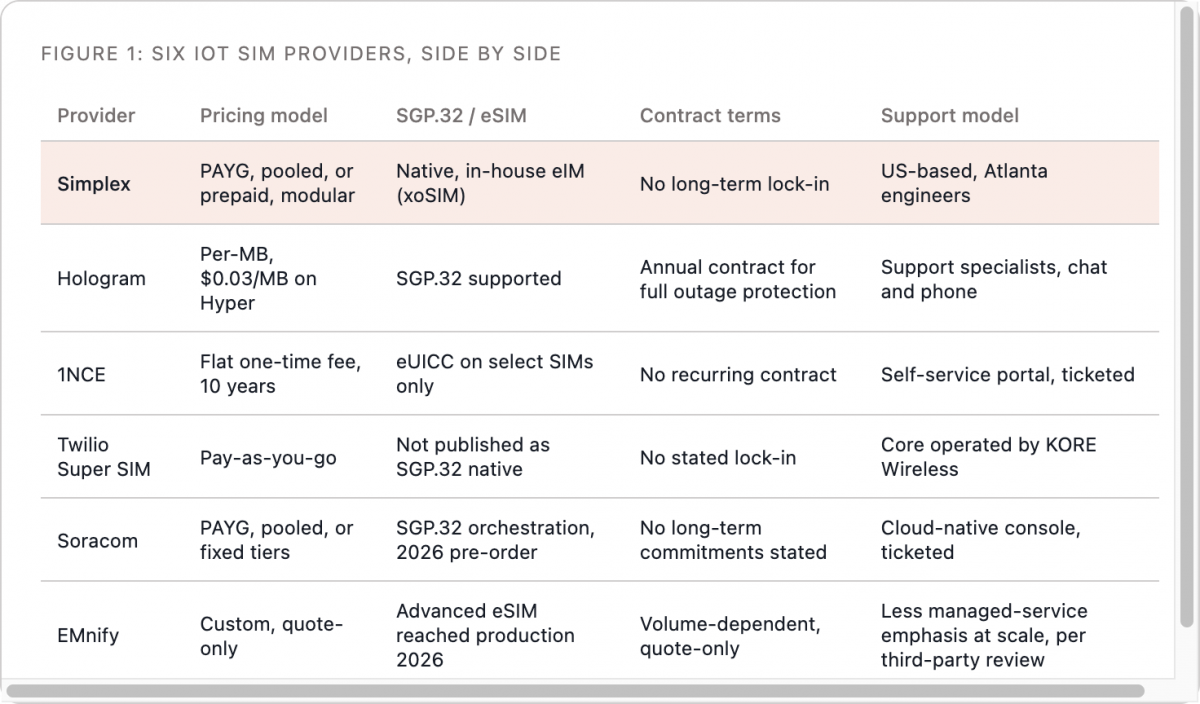
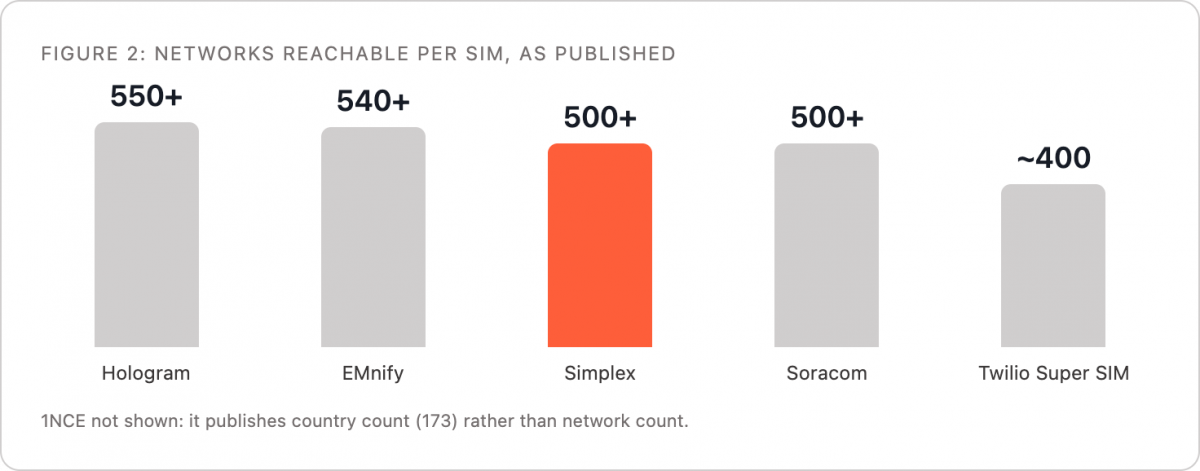
Hologram runs its own multi-carrier network reaching 550+ carriers in 190+ countries, with a Hyper eUICC SIM at $0.03/MB and an Outage Protection option that gives each SIM two independent mobile cores for automatic fallback.
1NCE sells a flat, prepaid model: roughly $12 to $14 covers a SIM plus ten years of service, including 500 MB of data and 250 SMS, across 173 countries. There’s no recurring bill unless you exceed the allowance and buy a top-up.
Twilio Super SIM connects to close to 400 cellular networks on a pay-as-you-go basis. Its mobile core is now operated by KORE Wireless rather than run entirely in-house by Twilio, which is worth knowing if a vendor’s own infrastructure ownership matters to your evaluation.
Soracom is a cloud-native, AWS-integrated platform spanning 500+ carriers across roughly 174 to 200 countries depending on the plan, with pay-as-you-go, pooled, and fixed-price tiers and no long-term lock-in stated in its terms.
EMnify connects through 540+ networks in roughly 190 countries, with a multi-IMSI eUICC design and a bootstrap-connectivity model well suited to manufacturers provisioning at the factory. Its pricing pages don’t publish rates; every quote is custom.
What the comparison actually shows
None of these five providers is a bad choice for the right use case, and it’s worth being straightforward about that. 1NCE’s flat-fee model is genuinely hard to beat for a low-data device with a long field life, like a smart meter that reports a few kilobytes a day for a decade: paying once and never thinking about the bill again removes an entire category of operational overhead. Hologram’s dual-core outage protection is a real, verifiable architecture, not marketing language, and its per-MB rate is published and easy to model against. EMnify’s AWS-native integrations (Transit Gateway attachment, multicloud data streaming) are a legitimate advantage for a team whose backend already lives entirely in one cloud.
Where the differences start to matter for a multi-year fleet decision:
Network reach varies less than the marketing suggests. Hologram, EMnify, Soracom, and Simplex are all in the same 500-to-550-network range. Twilio Super SIM’s roughly 400 networks is smaller, and it’s worth noting the connectivity now runs through KORE Wireless’s core rather than a platform Twilio operates end to end.
eSIM and SGP.32 readiness is uneven. Simplex, Hologram, and Soracom have shipped or are shipping production SGP.32 capability. EMnify’s Advanced eSIM reached production in 2026 after a longer runway. 1NCE’s eUICC support (branded “Freedom to Switch”) is limited to specific SIM types rather than the full product line, so a buyer standardizing on one SKU needs to check which one supports it before ordering.
Pricing transparency differs sharply. Hologram, 1NCE, and Simplex publish enough pricing structure to model a real cost estimate before talking to sales. EMnify does not publish rates at all: every number is quote-only, which makes a fair apples-to-apples comparison impossible without going through a sales process for each vendor being evaluated.
Where Simplex fits
On raw network count, Simplex sits in the same tier as Hologram, EMnify, and Soracom rather than ahead of them. That’s a fair comparison to make, and buyers should make it directly. Where Simplex’s approach differs is in three areas that don’t show up in a networks-and-countries table.
The eIM (eSIM IoT manager) server behind Simplex’s SGP.32 support was built in-house rather than licensed from a third party, and it’s been tested for interoperability with multiple eUICC manufacturers, including Kigen, STMicroelectronics, and Valid. The xoSIM product supports IPAe, so retrofitting existing hardware for eSIM doesn’t require a device redesign.
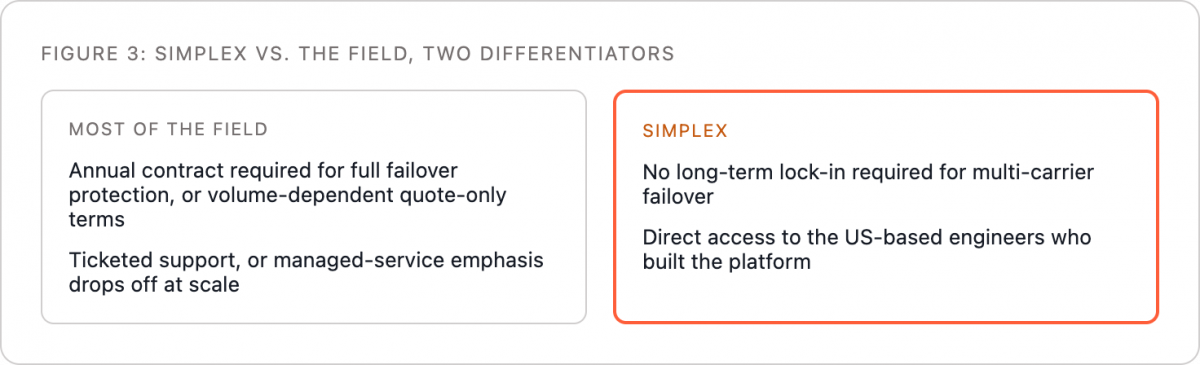
On contract terms, Simplex doesn’t require the kind of carrier lock-in that shows up in some multi-year deals, and its bring-your-own-operator option lets a team consolidate existing carrier contracts under one dashboard without switching connectivity first, something none of the five providers above publish as a core product.
On support, Simplex’s team is US-based out of Atlanta, with the engineers who built the multi-carrier failover system answering escalations directly rather than routing through a generalist ticket queue.
Where Simplex has a genuine limit worth naming against this specific set of competitors: Hologram, EMnify, and Soracom are larger operations with broader third-party integration ecosystems (native cloud provider integrations, wider public case-study libraries) than Simplex currently publishes. A team whose architecture is already deeply built around one hyperscaler’s tooling should weigh that directly rather than take coverage numbers as the deciding factor.
Questions to ask any of these providers
Ask each of the six the same questions, including Simplex:
- Is your published pricing final, or does it change materially at my actual volume?
- Is your eSIM management server your own, or licensed and operated by a third party?
- What’s the average time from detection to resolution on your last ten support tickets?
- If a device sits in a country with permanent-roaming restrictions, what happens automatically?
- What’s the minimum commitment before I can leave, and what does leaving involve?
- Can I see raw per-device usage data, or only account-level totals?
- What happens to my SIMs and my data if your company is acquired or shuts down?
The decision framework
Coverage numbers cluster closer together across these six providers than the marketing suggests. The real differences sit in pricing transparency, how far along the eSIM roadmap actually is, what a contract locks you into, and who picks up the phone when something breaks. Weigh those four against your specific fleet size, data profile, and deployment timeline rather than the country count on a homepage. If you want a cost model built against your actual usage, compare plans or talk to Simplex’s engineering team directly.
This article was curated by Jan Lattunen, CCO Simplex Wireless
About the Author: Jan Lattunen manages Sales and Marketing for Simplex Wireless. Jan has 20 years’ experience in working with SIM card technology and was involved in launching the eSIM in North America with major carriers and OEMs. His expertise in telecommunications is around SIM cards. On a personal note, Jan is a family man and avid cyclist with advocacy for safety in the roads. You can connect with Jan on https://linkedin.com/in/JanLattunen