







eSIM for EV Chargers: Retrofitting with SGP.32
October 19, 2026
Can You Change Your IoT Connectivity Provider Without Replacing Your SIMs?
A SIM card is supposed to be the part of an IoT deployment nobody has to think about again. In practice, it’s often the part that quietly locks a fleet in place. A device might connect to five networks and still not be portable, because portability isn’t about how many towers a SIM can reach today. It’s about what happens the day you need to move to a different provider, without sending anyone into the field to do it.
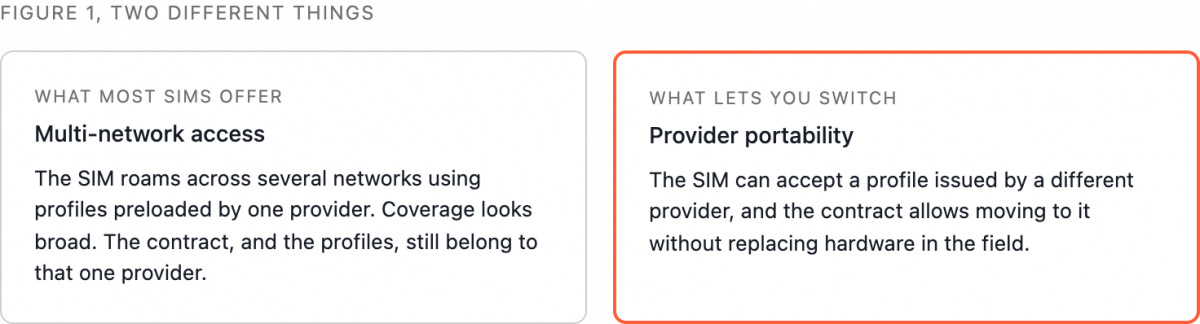
That distinction gets expensive when it’s discovered too late, usually at contract renewal, when a price increase arrives with no real leverage to push back because switching would mean replacing thousands of physical SIMs across a fleet that’s already deployed. Figure 1 above shows the two concepts buyers tend to conflate. The question “can we actually change providers if we need to” should get answered during procurement, not during a renewal negotiation. Here’s what determines the answer, and what to check before you sign anything.
What to evaluate
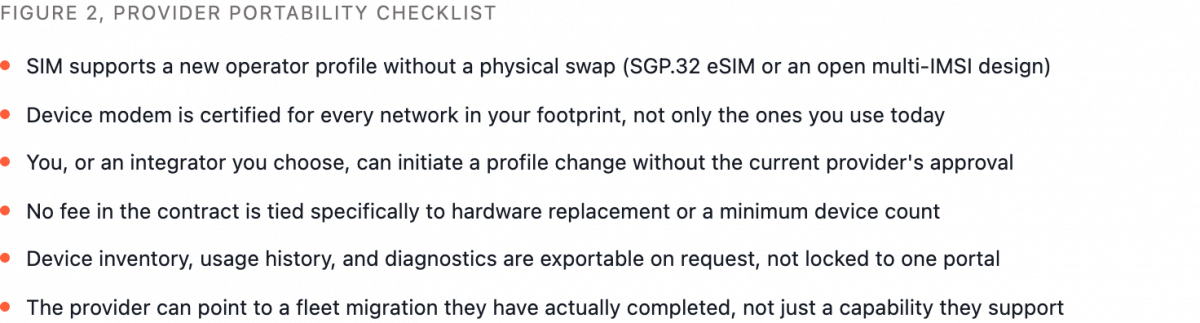
SIM and profile architecture. Can the SIM accept a new operator profile without a physical swap? SGP.32, the GSMA’s current eSIM specification for IoT, defines exactly this: a eUICC (the embedded chip capable of holding more than one operator profile) that can receive a new profile over the air. A SIM without that capability, or without a genuinely open multi-IMSI design, is tied to whatever was loaded at manufacture.
Device certification, not just SIM capability. A portable SIM paired with a device whose modem was never certified for the target networks doesn’t help. Portability has to be checked at the device level too, not assumed from the SIM alone.
Who controls provisioning. This is usually the real answer to whether you’re locked in. Can you, or a provider you choose, initiate a profile change, or does it require the current provider’s cooperation and approval every time? An eIM (the server that manages profile switching under SGP.32) you can access independently is a different situation than one only the incumbent controls.
Commercial terms tied to switching. Exit fees rarely say “you can’t leave.” They say “migration fee,” “minimum device commitment,” or “hardware replacement required,” which functions the same way.
Access to your own operational data during a move. Can you export device inventory, usage history, and diagnostics, or does that stay in the outgoing provider’s portal until they choose to release it?
A tested, not theoretical, migration path. Has the provider actually moved a fleet before, or is portability a line in a sales deck?
Common pitfalls
Three mistakes come up often enough to name directly.
Confusing “multi-network” with “portable.” A SIM roaming across five networks under one provider’s agreements is still single-provider. If that provider raises rates or its support quality drops, five networks of coverage doesn’t give you an exit.
Not reading the exit clause until you need it. Contracts rarely block departure outright. They attach a cost to it and call it something else.
Assuming eSIM alone solves the problem. SGP.32 gives a SIM the technical capacity to hold a new profile. It doesn’t obligate any provider to actually issue you one. Ask who controls that issuance, not just which protocol the SIM runs.
How Simplex addresses each criterion
Simplex built its SIM architecture around this exact test.
On SIM and profile architecture, Simplex’s cards run on xoSIM, an SGP.32-compliant eUICC with IPAe support, meaning the eSIM management logic sits on the SIM itself rather than arriving as a separate retrofit project. A device shipped years before SGP.32 existed can still receive a new operator profile once its SIM is swapped for one running xoSIM.
On device certification, Simplex’s network access spans 190-plus countries and 500-plus underlying networks, which covers most deployment footprints without needing a second SIM sourced elsewhere.
On who controls provisioning, Simplex’s eIM server was built in-house, not resold from a third party, so profile management runs on infrastructure Simplex actually operates and can open up to a customer or their integrator, rather than depending on someone else’s platform.
On commercial terms, Simplex’s model is modular, priced around what a deployment actually needs rather than sold as a fixed bundle, and structured so leaving isn’t gated behind a hardware replacement clause. The hidden cost of carrier lock-in usually shows up exactly there, in the fine print rather than the headline rate.
On data access, Simplex’s portal keeps device inventory, usage history, and diagnostics visible and exportable, so a migration, Simplex’s or otherwise, isn’t blocked by data you can’t reach.
On a tested migration path, Simplex has run interoperability testing across multiple eUICC manufacturers, three of which are public: Kigen, STMicroelectronics, and VALID. That matters because a profile provisioned in factory or moved later has to actually work across different SIM hardware, not just on paper.
One limit worth naming plainly: xoSIM’s IPAe design solves portability for a SIM you can physically swap. It doesn’t reach a device with a eUICC soldered to the board and no accessible SIM slot at all. That case needs SGP.32 support built in at the firmware level, an OEM decision made long before any connectivity provider gets involved. And no SIM technology cancels a termination fee already written into an existing contract with a different provider. Check the paperwork alongside the hardware, not instead of it.
Questions to ask any provider
Put these to every vendor you’re evaluating, Simplex included:
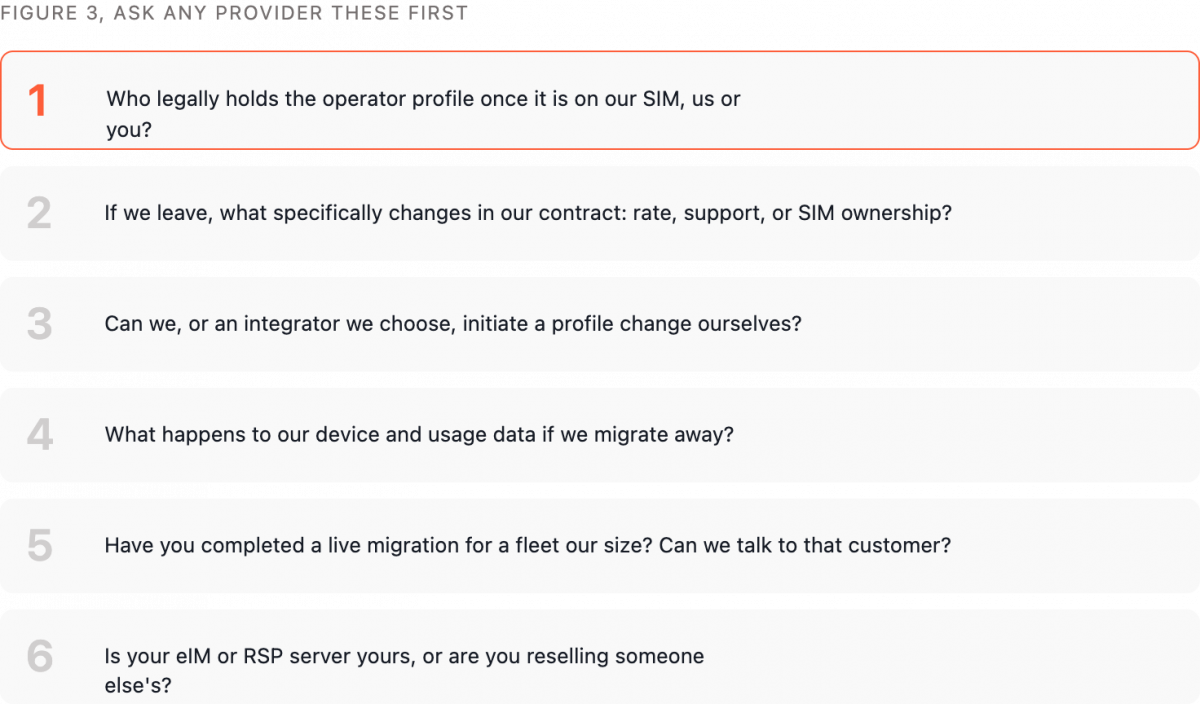
A vendor who can’t answer question one clearly has already told you something about how question two will go.
The bottom line
Portability isn’t a feature you check for after signing a contract. It’s a property of the SIM, the device, and the paperwork together, and all three have to line up before a fleet is actually free to move. Most buyers only find out which one was missing when they try to leave.
If you have a fleet deployed already and aren’t sure where your current setup lands on this framework, send Simplex your SIM type, device model, and contract terms. We’ll review what’s actually portable today and where a future switch would get stuck, no obligation to change anything.
This article was curated by Jan Lattunen, CCO Simplex Wireless
About the Author: Jan Lattunen manages Sales and Marketing for Simplex Wireless. Jan has 20 years’ experience in working with SIM card technology and was involved in launching the eSIM in North America with major carriers and OEMs. His expertise in telecommunications is around SIM cards. On a personal note, Jan is a family man and avid cyclist with advocacy for safety in the roads. You can connect with Jan on https://linkedin.com/in/JanLattunen