







Case Study: How Livelox Powers Orienteering Experiences with Reliable IoT Connectivity
March 23, 2026
The Alarm System Cellular Backup Economics Most Dealers Are Getting Wrong
April 2, 2026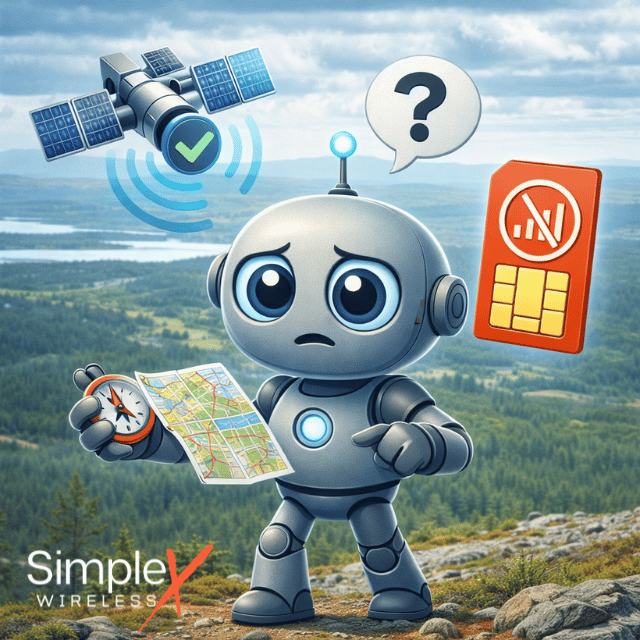
Your GPS Is Working. Your SIM Isn’t.
The coverage gap that kills live tracking never shows up on a coverage map.
A tracker that loses signal mid-race doesn’t display an error. It just stops moving. A fleet vehicle that disappears for three minutes on a dispatch platform doesn’t announce a connectivity failure — from the operator’s side, there’s just a gap, and no immediate way to know whether the hardware failed, the driver stopped, or the SIM dropped the link.
In most cases, it’s the SIM.
Two Systems, One Failure Mode Nobody Debugs First
A GPS tracker is two systems sharing one enclosure. The first calculates position — antenna, chip, satellite lock. The second transmits that position — modem, SIM, carrier network. They can fail independently, and they often do.
GPS product teams know this intellectually, but connectivity gets treated as secondary in practice. Most investment goes into the tracking layer: antenna placement, fix accuracy, power optimization, enclosure ratings. Cellular is handled at procurement. Pick a carrier, order SIMs, ship devices. The assumption is that if the SIM connects in the lab, it connects in the field.
It doesn’t. Not uniformly.
The applications where GPS tracking is most commercially valuable — live sports, fleet dispatch, lone worker safety, high-value asset monitoring — are exactly the applications where buffered delivery fails the use case. A geofence alert delayed two minutes is useless. A coach watching a live race sees a dot stop moving and has no way to know whether the athlete stopped or the tracker lost signal. A fleet dispatcher trying to reroute vehicles is working blind the moment a van goes dark.
Most deployments don’t discover this until they’re running in the field. By then, the SIM is already installed in hardware that may be sealed, remote, or impossible to reach.
Why Single-Carrier SIMs Fail GPS Deployments Specifically
Carrier coverage maps show aggregate signal strength across large grid squares. What they don’t show is the specific tower, the specific terrain, and the specific moment when your tracker needs to transmit.
GPS deployments run in places where coverage is worst. Fleet vehicles run remote distribution routes. Sports events happen in valleys, forests, and mountain terrain — which is also the terrain of dead zones. Construction equipment sits in basements and steel structures that attenuate signal. Agricultural sensors go into areas no carrier has a business case to densify.
A single-carrier SIM performs according to that carrier’s coverage in those specific locations. Even the strongest national operators have meaningful gaps in exactly the environments where GPS tracking is commercially critical.
The failures are also inconsistent, which makes them harder to debug than a clean outage. A tracker might connect reliably during event setup the day before a race, then lose signal during the race itself when hundreds of competitors and spectators are pulling on the same tower. A vehicle might track perfectly on 80% of a route and drop out on one stretch through a particular valley. These patterns surface gradually — after deployment, in production, under pressure.
Single-carrier lock-in creates a migration problem too. A significant portion of the installed GPS tracker base was built on 3G hardware — the right call at the time, but now running on networks being shut down. European operators have already decommissioned 3G in several markets. The ones still running are on someone else’s timeline. A deployment locked to a single carrier’s 3G network requires renegotiation, possible hardware replacement, and re-certification when that network goes offline.
Moving Carrier Selection to the Device
The fix is to stop treating carrier selection as a deployment-time decision and handle it at the device level instead.
Multi-network IoT SIMs don’t lock a tracker to one operator. They connect to whichever network has the strongest signal at that location and switch automatically as conditions change. In the US, that means access to AT&T, T-Mobile, and Verizon — not a choice between them. For a GPS tracker moving through terrain, dead zones on one carrier’s network don’t become dead zones in position data. The SIM transitions, the transmission completes, the live track stays continuous. The handoff is invisible to the platform.
For a sports timing company running 200 trackers across a mountain course, that’s the difference between a product that works and one that has to be explained to organizers after the race. For a fleet operator managing 1,000 vehicles across regional routes, it’s the difference between reliable dispatch data and a support queue full of “tracker went offline” tickets.
The network migration problem looks different with multi-network SIMs too. A deployment on a platform that already supports 4G LTE handles a 3G sunset by updating the active network profile — not by replacing SIMs, reopening contracts, or touching devices in the field.
The economics have also changed. There are no revenue minimums or contracted capacity floors for IoT-specific multi-network plans. Pricing scales with active devices. A GPS product at any deployment scale can access multi-network coverage without the commercial terms that used to reserve it for large enterprise operators.
Three Things to Do Before Your Next Deployment
Audit your existing coverage data. Don’t accept carrier coverage maps at face value. Request real-world signal data for the specific geographies your trackers operate in. If your provider can’t supply that, that’s meaningful information.
Test SIM performance in your actual deployment environment. Office signal is not field signal. Test in the terrain, the enclosures, and the conditions your devices will actually run in — before you’ve shipped 500 units.
Evaluate your 3G exposure. If you have devices still running on 3G hardware, map which carrier networks they’re locked to and what the decommission timeline looks like in your markets. The time to plan that migration is before the shutdown notice arrives, not after.
The GPS is accurate. The satellite fix is clean. The only question is whether the position data gets from the device to your platform when it needs to. That’s a connectivity decision — and it’s worth treating like a product decision, not a procurement afterthought. Explore the Simplex coverage map to see what multi-network looks like across your deployment geography.