






How to Evaluate an IoT SIM Provider: A Due Diligence Guide for Multi-Year Deployments
May 7, 2026
Why Your IoT Device Keeps Losing Connection — and What a Multi-Carrier SIM Does About It
May 14, 2026
From Physical SIMs to SGP.32: What Changes for Your IoT Fleet
The way cellular IoT fleets are managed is changing. Here’s what that means if you’re still doing it the old way.
The technician drives two hours to a remote utility cabinet, opens the enclosure, and swaps a SIM card the size of a thumbnail. Then drives back. Multiply that by a thousand devices, or ten thousand, and you start to understand the real cost of managing a cellular IoT fleet on physical SIM cards. SGP.32 — the GSMA’s specification for IoT eSIM management — was designed to eliminate exactly that problem.
What an eUICC Is and Why It Changes Everything
A physical SIM card does one thing: it identifies your device to a specific carrier’s network. To change carriers, you change the card. That’s been the arrangement since the 1990s.
An eUICC (embedded Universal Integrated Circuit Card) is a different kind of SIM chip — soldered directly into the device rather than slotted in a tray. The key difference isn’t the form factor; it’s what the chip can hold. An eUICC stores multiple operator profiles — the digital equivalents of SIM cards — and can switch between them without any physical intervention.
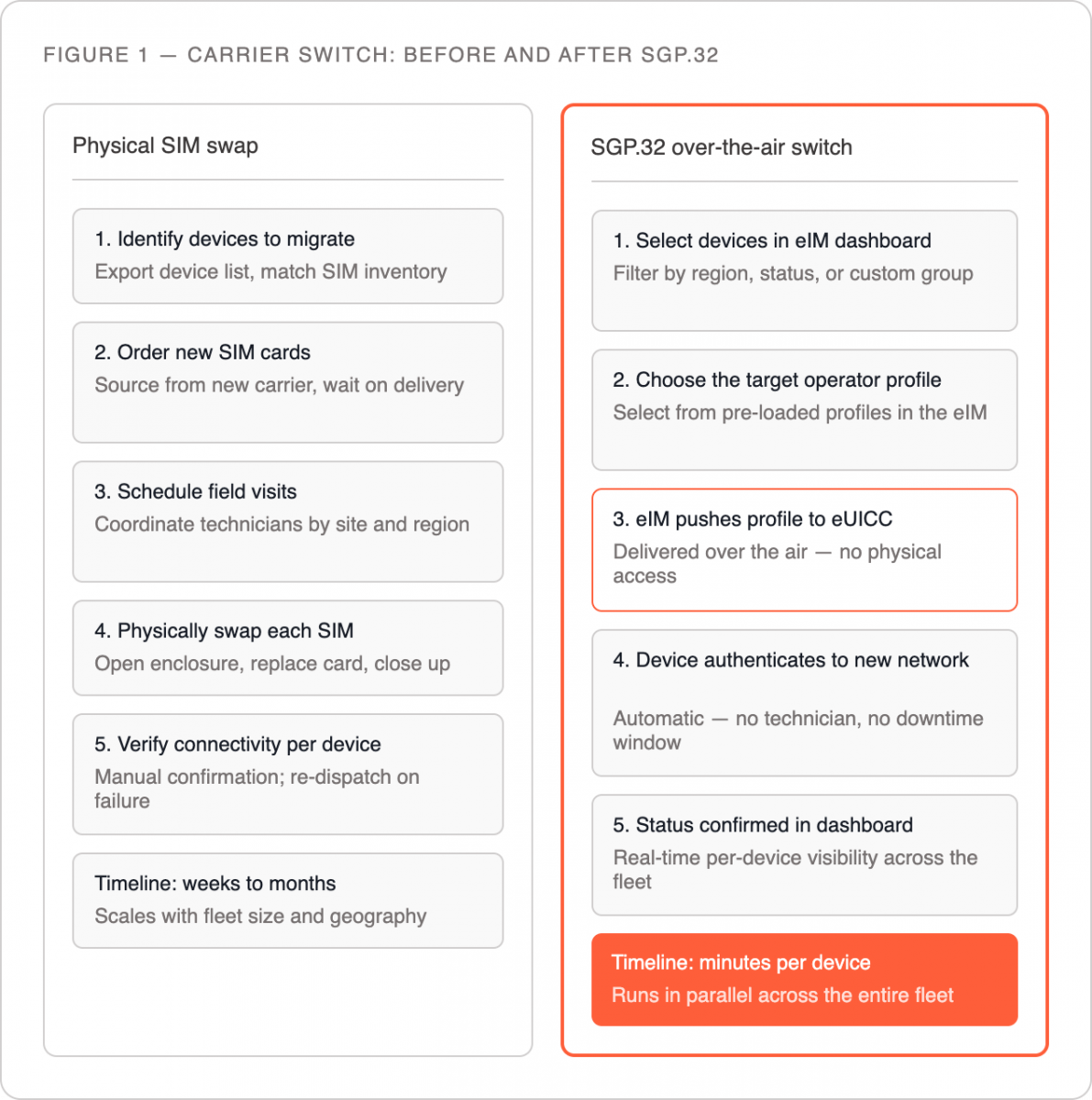
Remote SIM provisioning (RSP) is the capability that makes this useful at scale. Instead of dispatching a technician, your management system pushes a new operator profile to the eUICC over the air. The device authenticates to the new network, typically within minutes. No site visit, no downtime window, no logistics coordination.
SGP.32 is the GSMA specification that standardizes how this works for IoT fleets specifically. Its predecessors — SGP.02 for M2M, SGP.22 for consumer devices — weren’t built for the unattended, large-scale deployments that characterize IoT. SGP.32 introduces a new server-side component called the eIM (eSIM IoT Manager) to orchestrate profile management across fleets of devices that have no user interface and may be operating in remote locations with intermittent connectivity.
Why IoT Is Different From Consumer eSIM
Consumer eSIM — the version you use when activating a smartphone on a new carrier — works differently from what your fleet needs.
The SGP.22 standard for consumer eSIM assumes a user is present: someone scans a QR code, taps a confirmation, and the profile activates. That model fails completely for IoT. A water meter in a field doesn’t have a screen. A GPS tracker sealed inside a shipping container can’t scan a QR code. An industrial sensor in a hazardous enclosure won’t be physically accessed for months.
SGP.32 is designed for unattended operation from the start. Profiles can be pushed, switched, and deleted by the eIM server without any interaction from the device side beyond connectivity. The specification also addresses the scale problem: it’s built to handle large volumes of profile operations in parallel, not sequentially as consumer specs were designed.
There’s a practically important distinction here: SGP.32 supports two interfaces for connecting the eIM to devices. IPAe (IoT Profile Assistant embedded) lives on the SIM card itself. IPAd (IoT Profile Assistant device-side) lives on the device’s application layer, which requires firmware or OS integration. For fleets with existing deployed hardware, IPAe is the more practical path: the SGP.32 management capability lives on the SIM, not the device. You can bring an older device into SGP.32 compliance by upgrading the SIM card, without touching the hardware.
What’s Costing You Right Now
Most fleet operators know truck rolls are expensive. Fewer have calculated what they actually total across a fleet’s operational life.
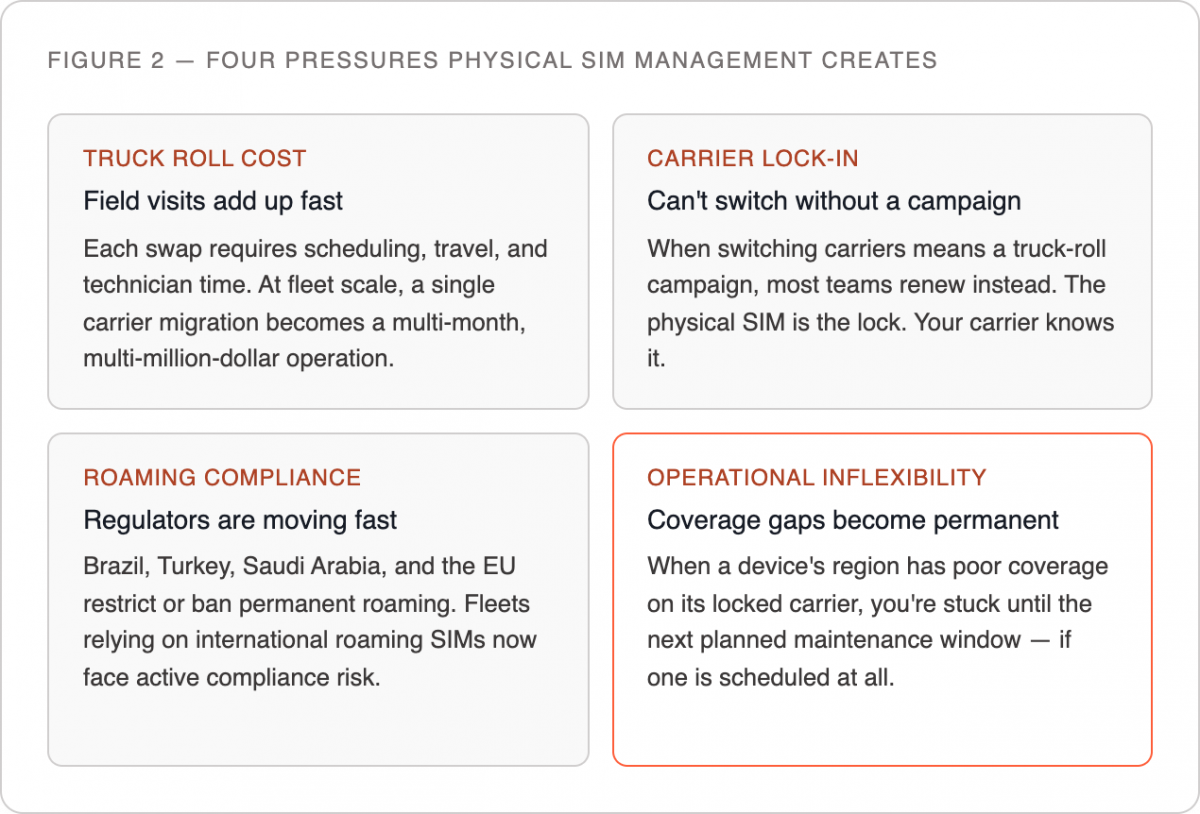
A field service call to swap a single SIM — accounting for technician time, travel, scheduling overhead, and device downtime — can run into the hundreds of dollars per visit. For a large-scale IoT deployment of several thousand devices, a carrier migration requiring physical SIM replacement can cost millions before a single new SIM card is purchased. That number rarely appears in procurement analysis; it gets absorbed across operations budgets and written off as routine maintenance. But it’s there.
Carrier lock-in is the downstream consequence. If switching providers requires a truck-roll campaign, most companies don’t switch. They renew, on whatever terms the carrier offers. The negotiating power that comes from operating in a competitive market disappears the moment your connectivity is physically fixed into hardware.
There’s a third pressure that’s becoming more urgent: permanent roaming restrictions. Regulators in Brazil, Turkey, Saudi Arabia, and across the EU are increasingly restricting or banning devices that connect permanently to foreign networks. Fleets that rely on international roaming SIMs as a cost-control mechanism are now facing compliance risk. Switching to local operator profiles on demand is an operational requirement in these markets — not an optional improvement.
What the Workflow Looks Like After the Switch
Managing a cellular IoT fleet under SGP.32 isn’t a different version of what you do today — it’s a different kind of activity.
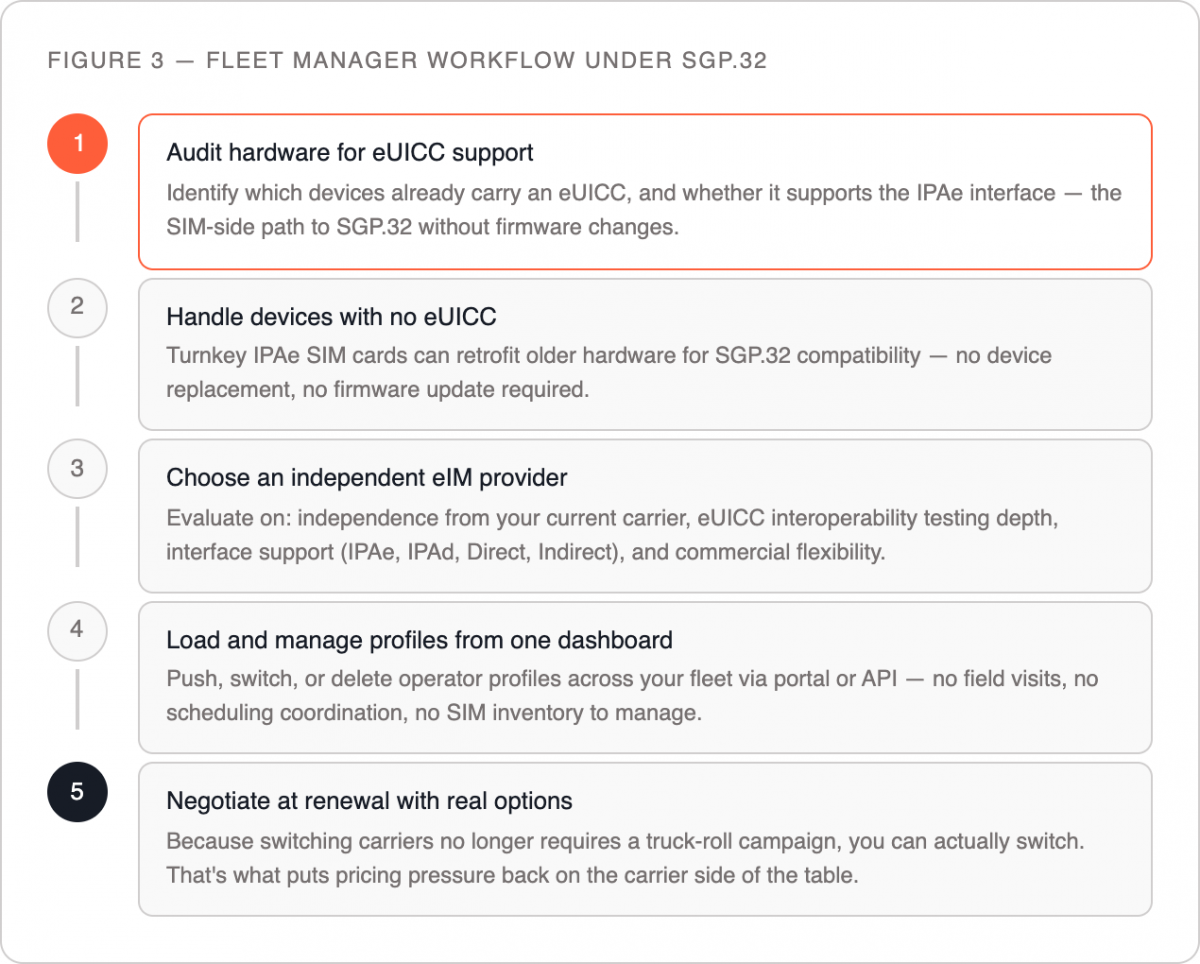
Instead of coordinating SIM replacement campaigns, you manage profiles from a dashboard or API. When coverage degrades in a region, you switch affected devices to a carrier with better signal there. When a contract comes up for renewal, you negotiate with real options — or switch. When a device is deployed in a market with local SIM requirements, you provision the right profile before it goes live.
The practical steps for moving an existing fleet toward SGP.32:
Audit your hardware for eUICC compatibility. Devices that already include an eUICC chip can often begin the transition without hardware replacement — particularly if the eUICC supports IPAe, which puts the management interface on the SIM rather than requiring a firmware update.
Identify devices with no eUICC. For these, turnkey IPAe SIM cards — like the ones Simplex offers through the Works With Simplex program — can bring older hardware into SGP.32 compliance without a full device retrofit.
Evaluate eIM providers on criteria that hold up. Independence from your current carrier, breadth of interoperability testing across eUICC manufacturers, and flexibility in commercial model are the dimensions that matter most at this stage.
The shift from physical SIM management to SGP.32 doesn’t require replacing your fleet overnight. In most cases, it starts with understanding what your devices already support — and what a single SIM upgrade can unlock. For a closer look at how the profile provisioning process works at the device level, the article on eSIM provisioning mechanics for IoT covers the step-by-step in detail.
This article was curated by Jan Lattunen, CCO Simplex Wireless
About the Author: Jan Lattunen manages Sales and Marketing for Simplex Wireless. Jan has 20 years’ experience in working with SIM card technology and was involved in launching the eSIM in North America with major carriers and OEMs. His expertise in telecommunications is around SIM cards. On a personal note, Jan is a family man and avid cyclist with advocacy for safety in the roads. You can connect with Jan on https://linkedin.com/in/JanLattunen