







Remote SIM Provisioning Explained: What Actually Happens When You Switch Carriers Over the Air
May 26, 2026
The Hidden Cost of Carrier Lock-In on a Cellular Fleet
June 1, 2026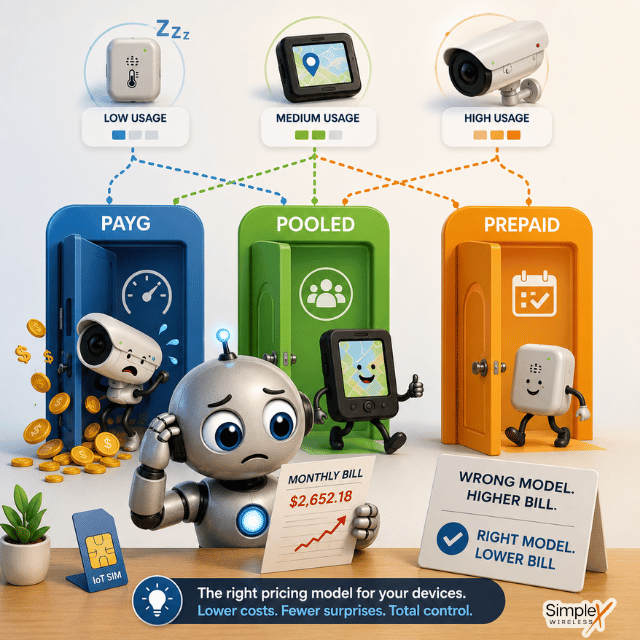
Why Your IoT SIM Bill Is Higher Than It Should Be
Most billing surprises aren’t about the per-MB rate. They’re about choosing the wrong pricing model for how your devices actually behave.
When IoT operators compare data plans, they usually compare per-MB rates. That’s the wrong variable. A plan with a higher per-MB rate that fits your fleet’s usage pattern will cost less — and produce fewer surprises — than a cheaper plan that doesn’t. The pricing model is the variable that determines whether your bill is predictable or not. The per-MB rate just scales it.
Three pricing models exist for IoT connectivity because device fleets behave in genuinely different ways. Each model is right for one kind of deployment and wrong for another — and the failure mode of each is specific enough that you can usually diagnose which one you’re experiencing without switching anything first.
PAYG: the right flexibility premium, in the right situation
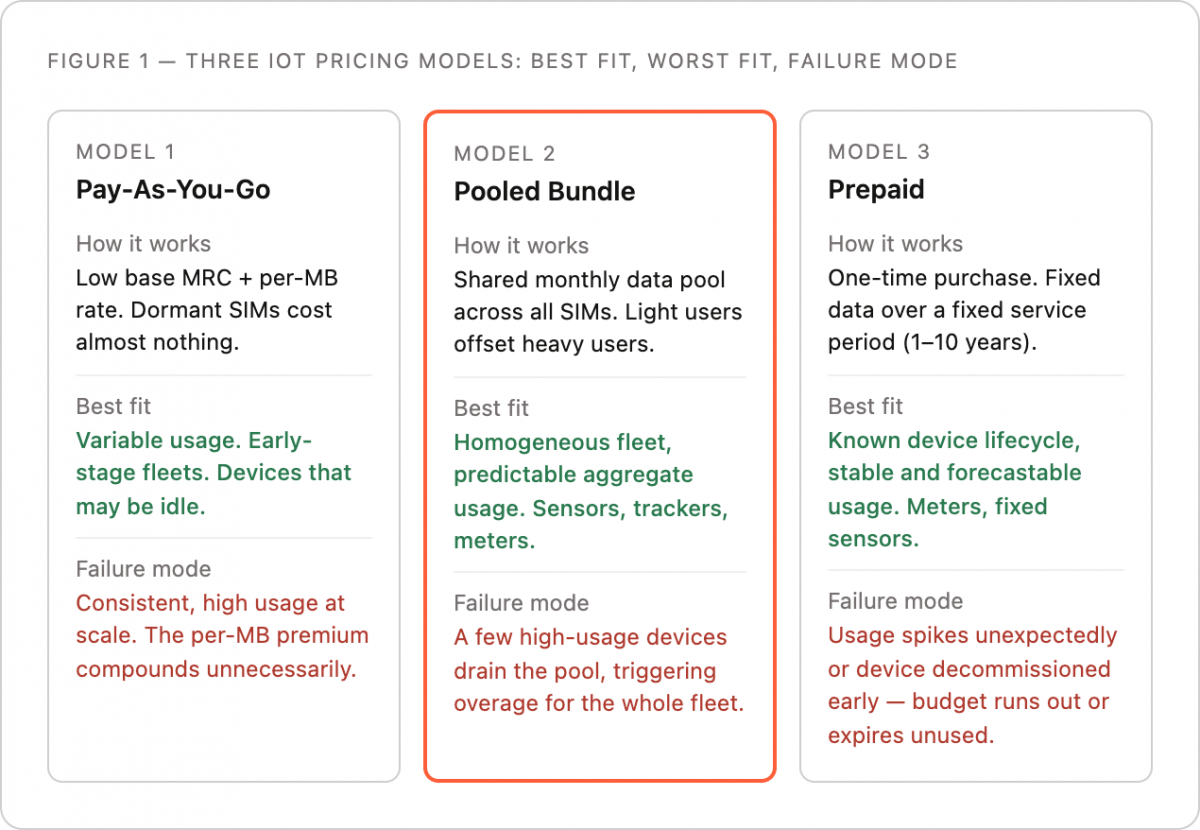
Pay-as-you-go charges a low monthly base per SIM plus a per-MB rate on actual data consumed. A SIM that transmits nothing costs almost nothing. A SIM that transmits a lot costs proportionally more. The flexibility premium is real — the per-MB rate is higher than on a pooled plan — but it’s worth paying when usage is genuinely unpredictable or when the fleet includes a large number of inactive SIMs at any given time.
The failure mode appears when a fleet grows and usage stabilizes. An operator who starts on PAYG with 50 devices and highly variable usage may find that at 500 devices with consistent moderate consumption, the aggregate PAYG cost exceeds what a pooled plan would cost for the same data volume. The flexibility premium they’re paying no longer buys anything useful. Knowing how much data your devices actually use is the prerequisite for identifying this transition point.
Pooled bundles: the shared pool that creates outlier risk
A pooled data plan assigns a shared monthly data allowance across all SIMs in the account. A sensor that uses 5MB draws from the same pool as a gateway that uses 500MB. In a homogeneous fleet — where most devices have similar usage profiles — pooling is efficient: the aggregate usage is predictable, the pool is sized appropriately, and overages are rare.
The failure mode is device heterogeneity. When a fleet mixes low-usage sensors with a smaller number of high-consumption devices — security cameras, video gateways, asset trackers in high-frequency mode — the high-usage outliers drain the pool disproportionately. The sensors don’t consume their share, but that headroom doesn’t offset the gateways exceeding theirs. The result: the fleet triggers overage on the pooled plan while the aggregate usage across all devices might actually fit a larger pool, or might warrant segmenting device types onto different plans entirely.
Prepaid: the lifetime plan that assumes a known lifetime
Prepaid IoT data purchases a fixed allocation — typically 250MB to 1GB — over a fixed service period of one to ten years. There’s no monthly billing, no recurring invoices, and no ambiguity about what was spent. For devices with a defined mission lifecycle and stable, forecastable usage, prepaid is the cleanest pricing structure available.
The failure mode is assumption drift. Prepaid makes sense when both the usage volume and the deployment timeline are known. When either changes — a firmware update adds telemetry that doubles transmission frequency, a deployment extends beyond the original plan period, or devices are decommissioned early — the prepaid budget breaks in one direction or the other. Either the allocation runs out before the service period ends, or it expires with data remaining. Both outcomes represent money spent on data that didn’t map to actual device behavior.
The decision variable operators overlook: structure, not rate
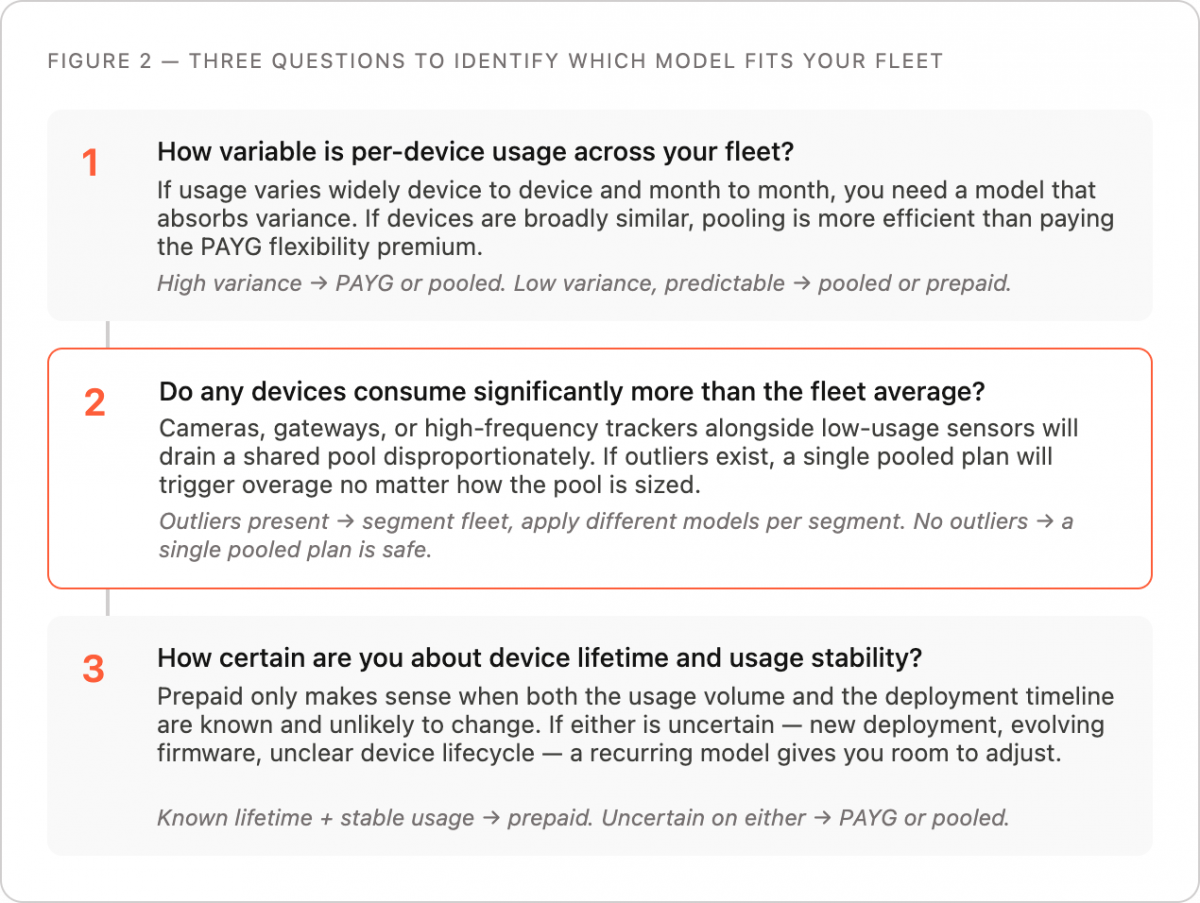
The per-MB rate matters, but it’s not the first thing to optimize. Before comparing rates across providers, it’s worth diagnosing whether the current plan structure is creating costs that have nothing to do with rate. An operator on PAYG with consistent high usage could reduce their bill significantly by switching to a pooled plan — with the same provider, at the same rate sheet. An operator with a heterogeneous fleet on a single pooled plan could eliminate overage by splitting device types across separate plan segments. Neither of those changes requires switching providers. The hidden cost of IoT connectivity is often structural, not rate-based.
That said, rate transparency matters too. A plan with the right structure but hidden fees — platform charges, activation costs, inactivity penalties, minimum volume commitments — can produce just as many billing surprises. The case for transparent IoT pricing is straightforward: if you can’t read the invoice and predict next month’s bill before it arrives, the pricing model is designed to obscure costs, not reflect them.
If any of those warning signs are familiar, the starting point is your usage data — not a new provider. Pull per-device consumption from your portal, identify outliers, and map actual behavior against the model structure you’re on. If you don’t have a portal that shows per-device usage, that’s the more fundamental problem. The Simplex IoT data SIM includes full fleet visibility as standard — usage per SIM, threshold alerts, and a transparent pricing structure across all three models. The diagnostic starts with the data, not the rate sheet.
This article was curated by Jan Lattunen, CCO Simplex Wireless
About the Author: Jan Lattunen manages Sales and Marketing for Simplex Wireless. Jan has 20 years’ experience in working with SIM card technology and was involved in launching the eSIM in North America with major carriers and OEMs. His expertise in telecommunications is around SIM cards. On a personal note, Jan is a family man and avid cyclist with advocacy for safety in the roads. You can connect with Jan on linkedin.com/in/JanLattunen.