







Why Your IoT SIM Bill Is Higher Than It Should Be
May 29, 2026
The Real Cost of IoT Connectivity Failures: Downtime, Truck Rolls, and What’s Actually at Risk
June 4, 2026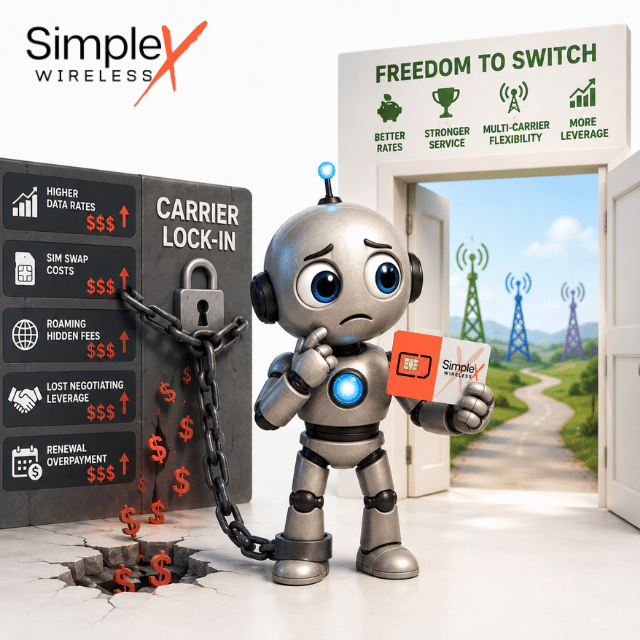
The Hidden Cost of Carrier Lock-In on a Cellular Fleet
When you can’t switch carriers, you’re not just overpaying on data rates. You’re surrendering negotiating leverage on every contract renewal — and the bill compounds at fleet scale.
Most IoT fleet operators know their carrier relationship isn’t working for them. The rates aren’t great, the service isn’t ideal, but switching feels harder than staying. That calculation — stay because leaving is expensive — is exactly the leverage your carrier is counting on. The cost of lock-in isn’t a single line item. It’s the sum of what you overpay in data rates, what a SIM swap campaign would cost, what roaming eats into your margins, and what you’ve given away at every renewal. This post puts numbers to each of those.
The data rate gap: what non-negotiated rates cost at scale
Carrier contracts for IoT data plans are negotiated. Most SMEs don’t negotiate — they accept the published rate or the renewal offer that arrives. Larger customers with volume commitments and credible alternatives get better rates. The difference isn’t dramatic per device. But it compounds.
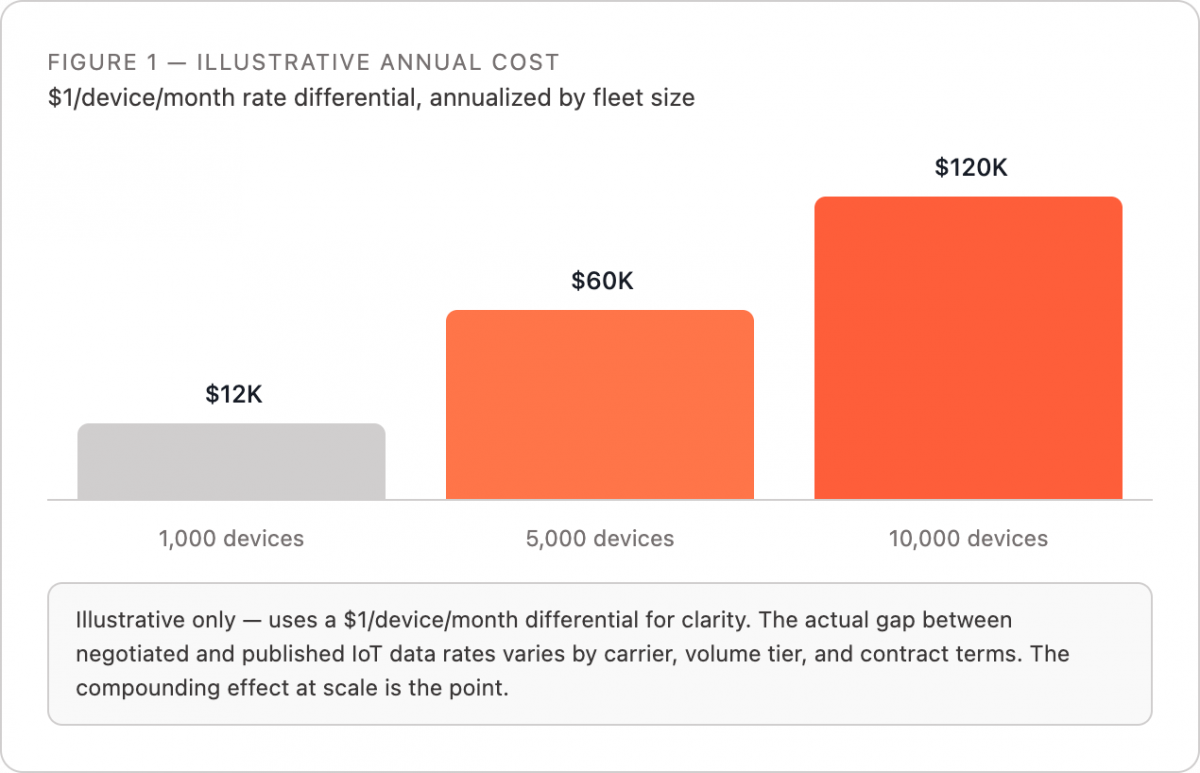
Consider a fleet of 10,000 devices where the current rate is $1 per device per month higher than a competitive alternative. That’s $10,000 per month, or $120,000 per year — for rates alone, before any service or coverage differences.
The numbers change with fleet size and the actual rate gap, but the structure doesn’t. Small per-unit differences become material annual amounts at scale. The illustration below uses a $1/device/month differential across three fleet sizes to show how quickly the gap widens.
The deeper problem isn’t the current overpayment — it’s the renewal dynamic. When your devices run on physical SIMs tied to one carrier, you walk into a renewal negotiation without a credible alternative. Switching carriers on a physical SIM fleet requires a truck roll to every device — or thousands of them. The cost of that alternative is so high that it’s not really an alternative. Your carrier knows it.
The truck roll bill: what a SIM swap campaign actually costs
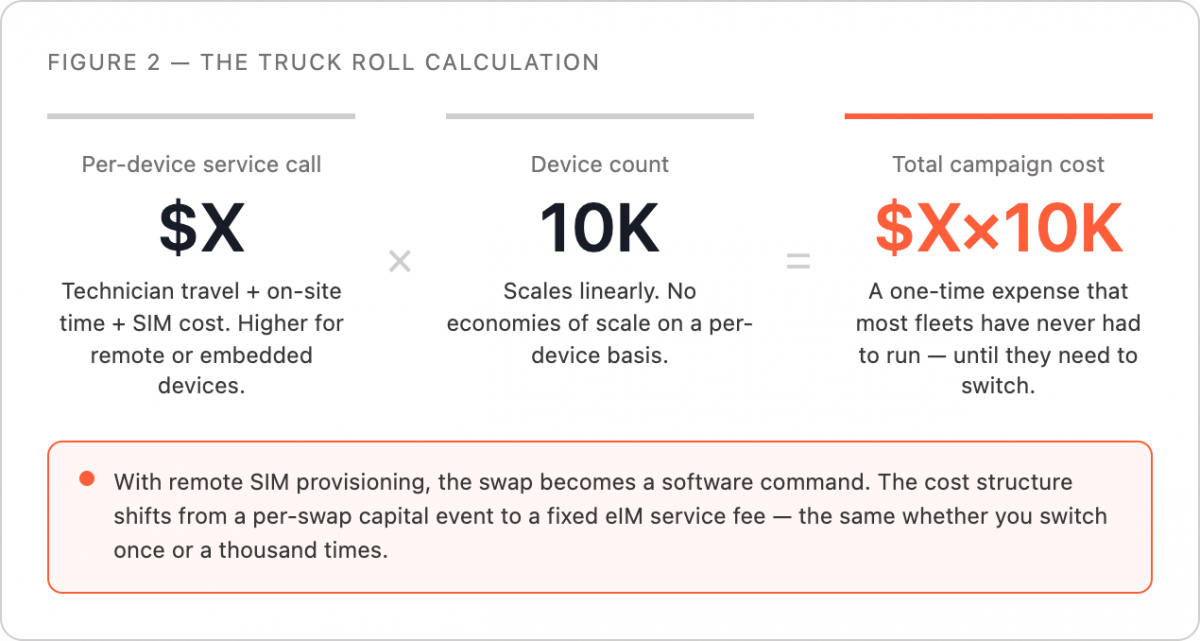
When a physical SIM fleet needs to change carriers, someone has to touch every device. In practice, that means a service call — a technician dispatched, a SIM card replaced, a device back online. The cost per visit varies by industry, geography, and device location, but it’s never trivial.
For devices in accessible locations — a retail location, a logistics hub — the per-device cost is lower. For devices mounted on infrastructure, installed in remote locations, or embedded in equipment that requires disassembly, it’s higher. The total scales directly with device count.
What makes this cost invisible in most fleet budgets is that operators rarely model it explicitly. If you’ve never switched carriers at scale, you’ve never seen the line item. The truck roll cost is theoretical until it isn’t — until coverage degrades, a better rate becomes available, or a regulatory change forces a profile update that a physical SIM simply can’t receive.
Remote SIM provisioning under SGP.32 converts that potential line item from a capital event to a software command. The cost doesn’t disappear — it shifts from per-swap to the eIM service fee, which is a fixed or volume-based operational cost rather than a per-device mobilization.
The roaming trap: when devices travel
A SIM card registered on a foreign network indefinitely is in permanent roaming. For fleets that cross borders — logistics vehicles, shipping containers, agricultural equipment operating across regions — this is a common condition.
The cost has two dimensions. The first is commercial: roaming data rates are typically higher than local connectivity rates. A device roaming on a foreign network pays the roaming tariff on every byte, which is rarely as competitive as a local plan. At scale, across many devices, that differential is significant.
The second dimension is regulatory. As eSIM standards have evolved, regulators in markets including Brazil, Turkey, Saudi Arabia, and the EU have introduced restrictions on permanent roaming SIMs. In some cases the restriction is a flag or warning; in others, service is suspended. For a fleet that depends on those devices staying online, that’s not a compliance footnote — it’s an operational risk.
Remote SIM provisioning solves both problems. A device traveling into a new region can be switched to a local carrier profile over the air. Roaming rates drop. Regulatory exposure drops. No one touches the hardware.
What changes when you own an independent eIM
The leverage mechanism is straightforward: if you can switch carriers without a SIM swap, your carrier knows it. That changes every renewal conversation.
You walk into the negotiation with competitive profiles loaded on your eIM and ready to activate. You’re not asking for a discount — you’re presenting a credible alternative. The carrier’s pricing offer now has to compete against what you can load tonight. That’s what the SGP.32 specification makes structurally possible for the first time at the enterprise fleet level.
One important clarification: this only works if the eIM is independent from your connectivity provider. If you buy your eIM from your MNO, the leverage disappears. Your profile management platform and your data plan are now controlled by the same party. You’ve replaced SIM-level lock-in with management-level lock-in — and the renewal dynamic is identical.
An independent eIM — one that will load any MNO’s profiles and has no stake in your carrier choice — is the structural requirement for the leverage to be real. That independence is not a feature. It’s the product.
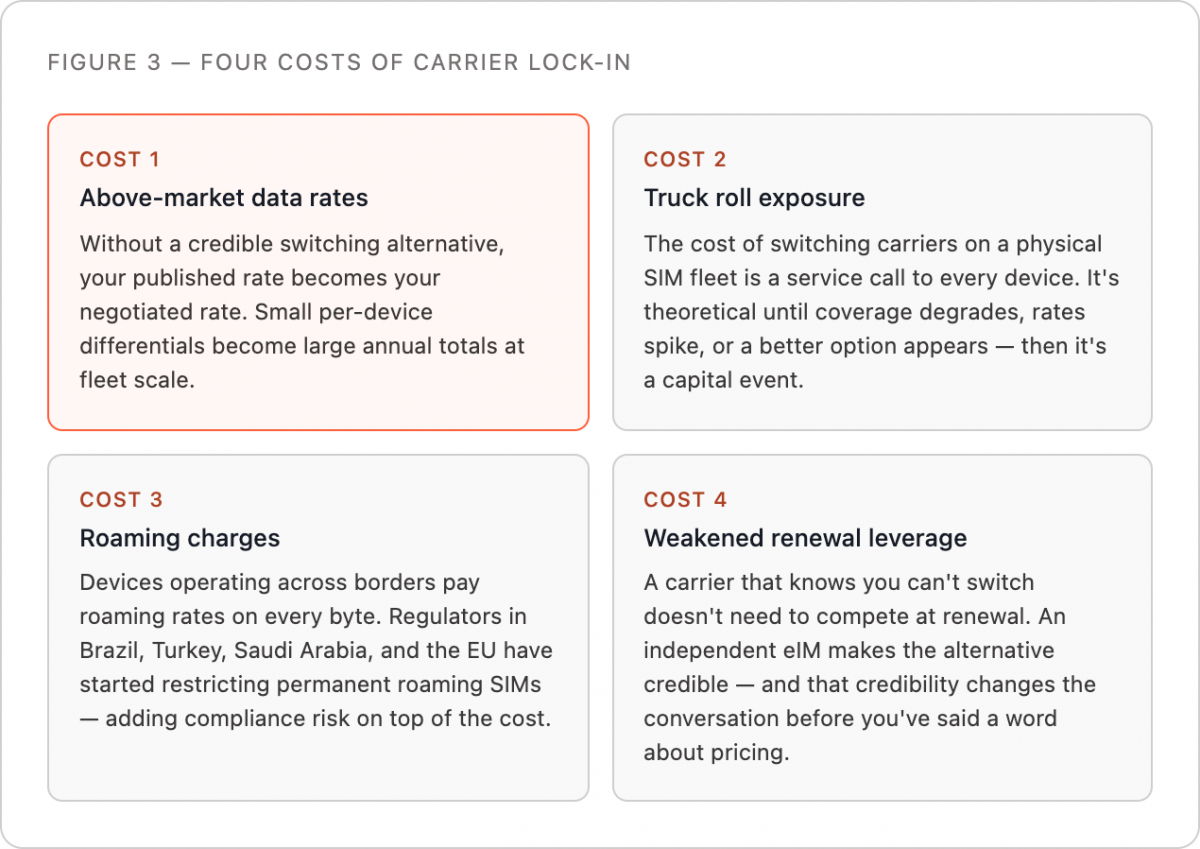

The cost of carrier lock-in isn’t speculative. It’s the sum of rates you couldn’t negotiate, SIM swaps you couldn’t afford to run, roaming charges you couldn’t avoid, and renewal leverage you didn’t have. An independent eIM changes all four of those conditions — but only if it’s genuinely independent.
See how Simplex Wireless built its eIM platform to work with any MNO’s profiles, without connectivity lock-in built into the model.
This article was curated by Jan Lattunen, CCO Simplex Wireless
About the Author: Jan Lattunen manages Sales and Marketing for Simplex Wireless. Jan has 20 years’ experience in working with SIM card technology and was involved in launching the eSIM in North America with major carriers and OEMs. His expertise in telecommunications is around SIM cards. On a personal note, Jan is a family man and avid cyclist with advocacy for safety in the roads. You can connect with Jan on https://linkedin.com/in/JanLattunen