







What Is In-Factory Profile Provisioning, and Why Should IoT Manufacturers Care?
August 3, 2026
What Can You Actually Ask Your IoT Network? A Field Guide to Natural Language Queries
August 10, 2026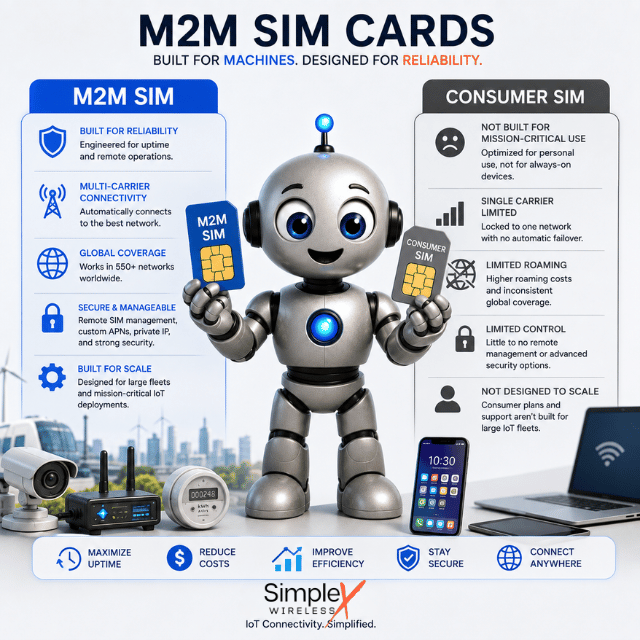
M2M SIM Cards: What They Are and How They Differ From Consumer SIMs
A vending machine that reports its stock levels every hour doesn’t need a phone plan. It needs an M2M SIM card — and most teams don’t realize they’ve been using the wrong one until the bill or the outage forces the question.
M2M stands for machine-to-machine: a SIM card built to let one device talk to a server without a person in the loop. If you’ve deployed connected hardware and provisioned it with a prepaid SIM from a phone carrier, you’ve probably already run into the mismatch — SIMs that get flagged for “unusual” usage, no way to see which device is burning data, or a support line that assumes you’re calling about a dropped call.
What an M2M SIM actually is
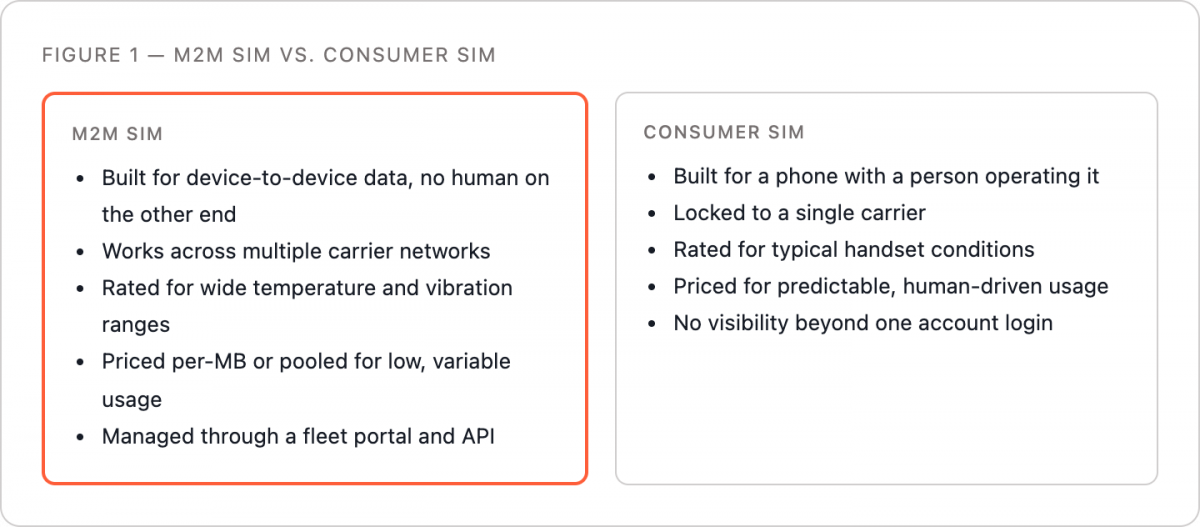
An M2M SIM is a cellular SIM designed around one assumption: the thing on the other end is a machine, not a person. That single difference reshapes almost everything about how the SIM is built and sold. Physically, M2M SIMs are commonly available in the MFF2 solderable form factor as well as standard plastic cuts, so they can be mounted directly onto a circuit board instead of sitting in a removable tray. Functionally, they’re provisioned to work across multiple carrier networks rather than being locked to one, which matters when a device ships to a location its manufacturer never tested.
The billing model reflects the same logic. A phone plan assumes a person checking usage and topping up manually. An M2M SIM is priced and managed for a fleet: per-megabyte or pooled data plans, a portal that shows every SIM’s status at once, and an API so usage and location data can feed into whatever system already tracks the fleet. The card itself doesn’t look different from a consumer SIM. Everything behind it does.
Why the distinction matters for IoT specifically
“M2M” and “IoT” get used almost interchangeably now, but the term M2M predates the IoT label by a couple of decades — it comes from an earlier generation of telemetry, vending, and fleet-tracking deployments that didn’t need internet-scale connectivity, just a reliable data link back to a server. IoT SIM is now the more common term for the same underlying product, but the M2M framing is still useful because it names the actual requirement: no human operator, ever.
That requirement shows up in ways a phone SIM was never designed for. A parking sensor or an agricultural monitor may sit outdoors through a full range of seasonal temperature swings; many M2M-grade SIMs are rated for a materially wider temperature and vibration range than the phone-grade cards most consumer plans ship with. A device might transmit ten kilobytes a day for five years with no one ever looking at it — a usage pattern that reads as suspicious to a consumer network built around daily human activity, and that some carriers will flag or throttle precisely because it doesn’t look like a person’s phone.
Where teams get this wrong
The most common mistake is starting a pilot on a consumer SIM because it’s fast and cheap, then discovering the problems only once the deployment has scaled past the point where switching is easy. A handful of failure modes show up again and again.
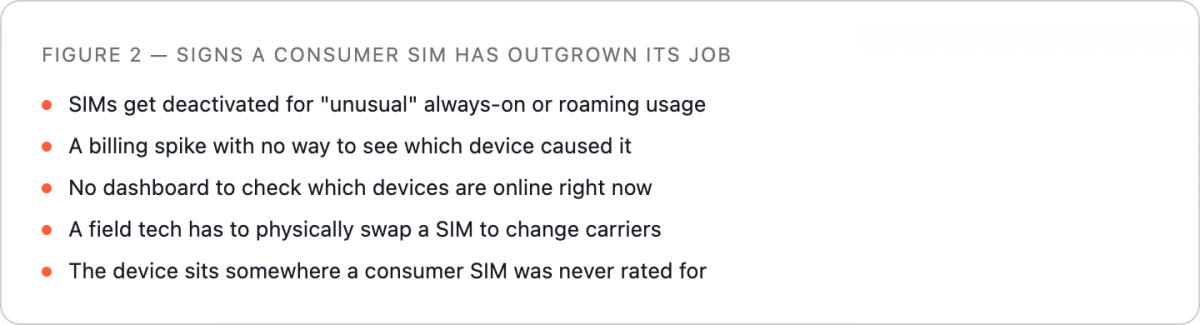
The first is carrier deactivation. Some carriers’ terms of service allow them to suspend SIMs that show non-human usage patterns — constant low-level data transfer, permanent roaming, no voice or SMS activity at all. A fleet of sensors can get silently cut off with no warning that would ever reach a person checking a phone bill.
The second is a total lack of fleet visibility. A consumer account shows one SIM’s usage. A deployment of five hundred devices has no equivalent view, so the first sign of trouble is usually a support ticket from a customer whose device stopped reporting — not a dashboard alert.
The third is hardware mismatch. A plastic consumer SIM in a socket rated for vibration and temperature extremes will eventually fail at the connector, not the chip, and it’s a maddening failure to diagnose because everything about the SIM’s identifying information — its ICCID — looks perfectly normal right up until it doesn’t.
What to do about it
If any of the above sounds familiar, the fix isn’t dramatic, but it does take a deliberate evaluation rather than a like-for-like swap.
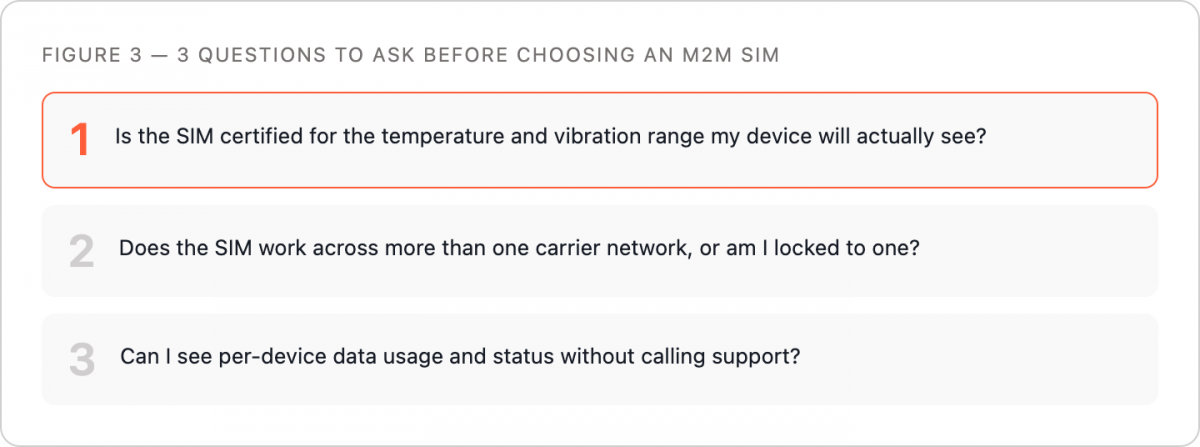
Start by matching the SIM’s rated operating environment to where the device actually lives — not where it was tested. If it’s outdoors, in a vehicle, or in an enclosure with no climate control, that changes which SIM is appropriate.
Next, check whether the SIM supports more than one carrier network. A multi-carrier M2M SIM protects against a single carrier’s local outage or coverage gap taking down the whole fleet — a difference explained in more detail alongside how APN configuration determines which network a device actually reaches.
Finally, confirm the pricing model matches the usage pattern before committing to a plan. A fleet of low-usage sensors on a plan built for high-volume consumer data is a common way teams end up paying more than the deployment should cost — and it’s worth asking any provider, including the one you’re already using, to walk through why they’re recommending a given plan rather than just quoting a per-MB rate.
A consumer SIM will work in a lab. It’s the deployment — the temperature swings, the years of unattended uptime, the fleet you can’t see into — that exposes the gap. Understanding what an M2M SIM is built for is the first step to closing it; choosing the right SIM for M2M deployments is the next.
This article was curated by Jan Lattunen, CCO Simplex Wireless
About the Author: Jan Lattunen manages Sales and Marketing for Simplex Wireless. Jan has 20 years’ experience in working with SIM card technology and was involved in launching the eSIM in North America with major carriers and OEMs. His expertise in telecommunications is around SIM cards. On a personal note, Jan is a family man and avid cyclist with advocacy for safety in the roads. You can connect with Jan on https://linkedin.com/in/JanLattunen