







eSIM Provisioning for IoT: What Actually Happens — and Where Deployments Stall
April 6, 2026
Why Your IoT Modem Takes 15 Minutes to Register — And What’s Actually Happening
Slow registration on a roaming SIM isn’t a mystery — it’s a predictable outcome of how PLMN scanning works, and most of it is fixable in minutes.
You power-cycle a Quectel module with a roaming SIM and wait. Five minutes. Ten. Finally — +CEREG: 0,5. Registered, roaming, on 2G. Your native carrier test SIM connected in under ten seconds on the first try. The difference isn’t coverage and it’s not a faulty SIM. It’s how multi-carrier registration actually works — and a few fixable things that make it worse.
What’s Happening During Registration
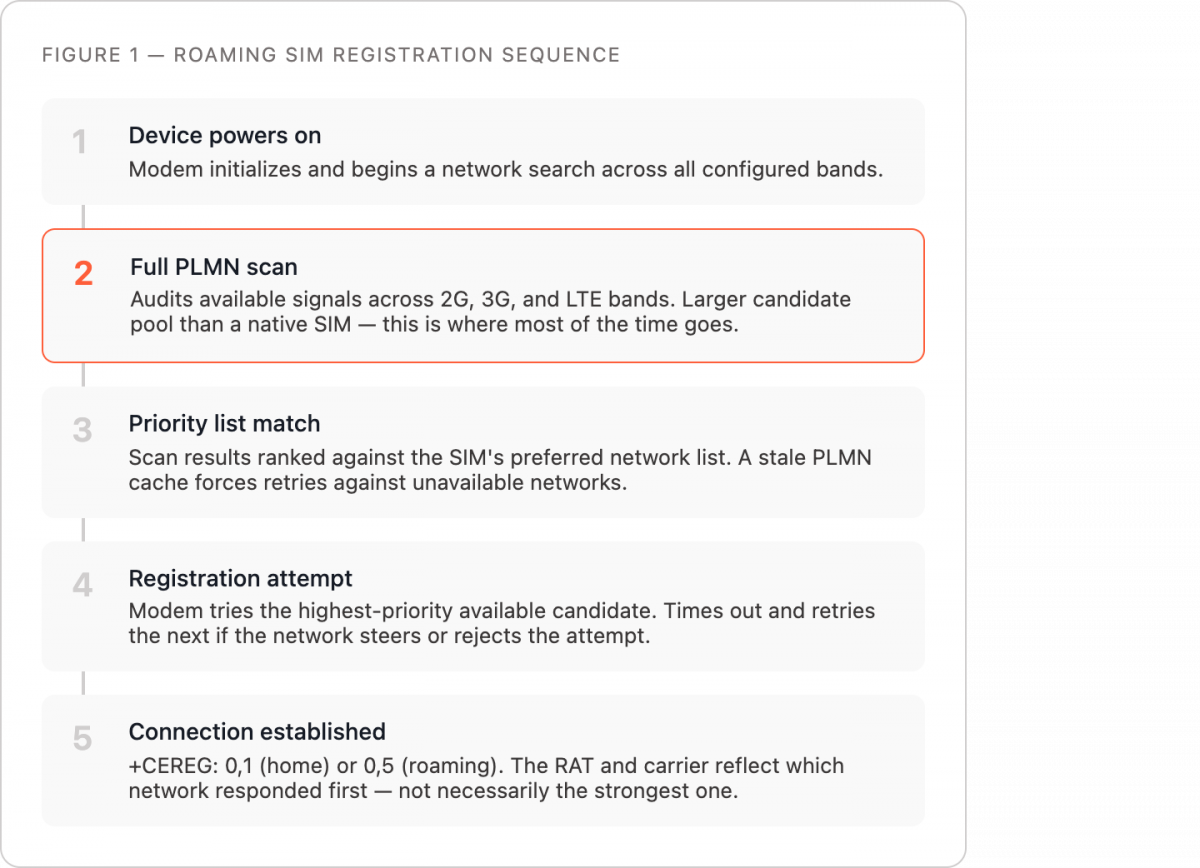
When a device powers on, the modem runs a PLMN (Public Land Mobile Network) scan. It audits available signals across all supported frequency bands and RATs (Radio Access Technologies — 2G, 3G, and LTE), ranks them against the SIM’s preferred network list, and attempts registration in priority order. If a preferred network is listed but unavailable, the modem waits for a timeout before moving to the next candidate.
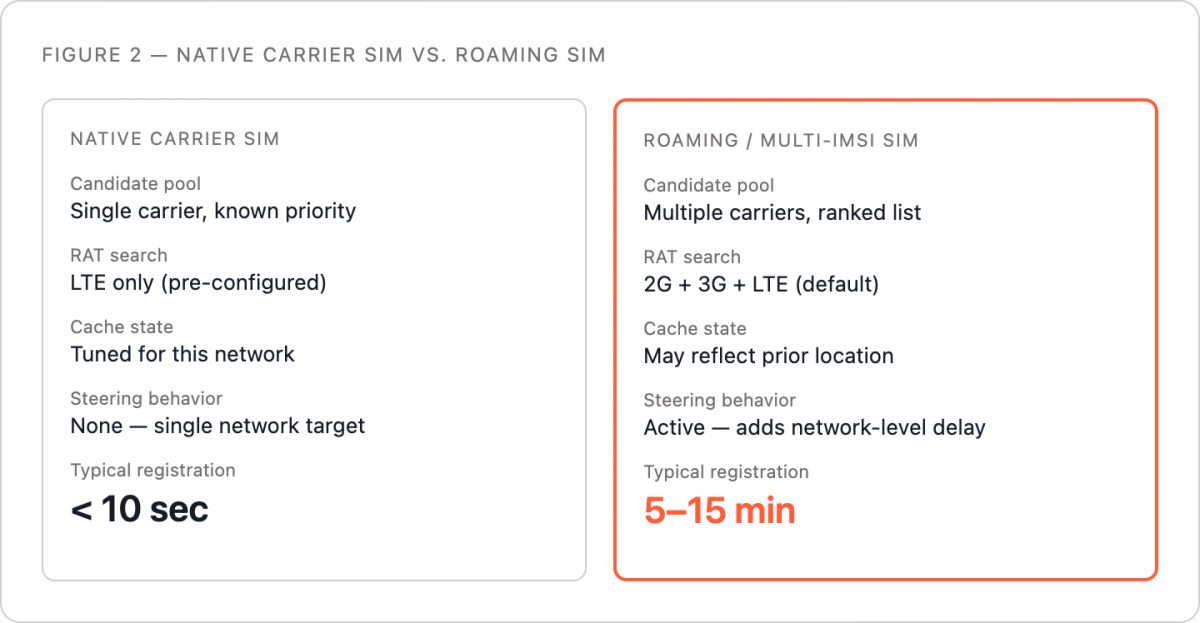
For a native carrier SIM — AT&T, Verizon, T-Mobile — this is fast. The SIM carries a focused instruction set: check these specific networks, in this priority order. The modem firmware is often tuned for that carrier’s signaling behavior. The handshake is familiar, the candidate pool is small, and registration completes quickly.
A roaming SIM works differently. It carries a preference list covering multiple carriers across multiple RATs. The modem scans a wider candidate space, ranks results, and works down the list — attempting registration at each step. Add a stale PLMN cache from a previous session or location, and the modem may spend several minutes retrying unavailable networks before doing a fresh scan.
Why This Matters for IoT Specifically
Consumer devices experience slow registration occasionally and move on. IoT developers hit it on every power cycle, every firmware flash, every cold-start validation. A 15-minute registration cycle turns a single debugging session into an afternoon. When you’re iterating on APN configuration or testing cold-boot behavior across firmware versions, that time compounds fast.
More importantly, slow registration obscures real problems. If your device hunts for 20 minutes before connecting, you can’t tell whether the cause is coverage, SIM provisioning, APN configuration, or modem firmware — the failure signal is buried under wait time. That’s not a productivity issue; it’s a diagnostic blind spot.
There’s also a production risk. Devices that register slowly in development often register slowly in the field — particularly at power-on after a battery swap or cold restart. For deployments where time-to-connect matters — alarm systems, asset trackers, medical monitors — a 15-minute window isn’t a development inconvenience. It’s a field failure mode.
What Can Go Wrong — And Usually Does
Four failure modes account for the majority of slow registration cases.
Stale PLMN cache. Modems cache network scan results to speed up future registrations. If the cached list reflects a different location, a different carrier configuration, or a previous RAT lock, the modem spends time retrying unavailable networks before falling back to a fresh scan. This is especially common after a firmware upgrade or SIM swap.
Automatic RAT selection with 2G in the pool. When a device searches across 2G, 3G, and LTE simultaneously, it may register on 2G simply because that network answered first — even if a stronger LTE signal is available. The modem isn’t evaluating signal quality at that stage; it’s accepting the first registration that completes.
Roaming steering latency. Some carrier platforms actively steer roaming traffic toward preferred partner networks. The steering process involves network-level exchanges the modem waits on silently. It doesn’t surface as an error in the AT command log — it shows up as unexplained delay.
Outdated firmware. Early firmware releases for common IoT chipsets had documented issues with PLMN search behavior on non-native SIMs. Registration handling improved substantially in later releases — and it’s a fixable variable most developers don’t check first.
How to Actually Fix It
Three changes resolve the majority of cases, in order of how quickly they take effect.
1. Lock to LTE-only during development. The AT command AT+QCFG="nwscanmode",3,1 locks a Quectel BG95 to LTE-only search. This eliminates the 2G fallback and narrows the modem’s candidate pool substantially. The setting persists across reboots — re-enable multi-RAT support before production deployment if your device requires it.
2. Clear the PLMN cache. Running AT+COPS=? forces a fresh network scan (allow one to two minutes). To stop the modem from retrying networks it previously failed on, check your firmware’s AT command manual for the FPLMN (Forbidden PLMN) clear command and run it after any SIM swap or firmware upgrade.
3. Upgrade firmware. For Quectel BG95-M3 modules, upgrading from early 01.01x releases to the 01.2xx series addresses multiple registration-related issues documented in Quectel’s release notes. Check the Quectel support portal for the current release targeting your hardware variant.
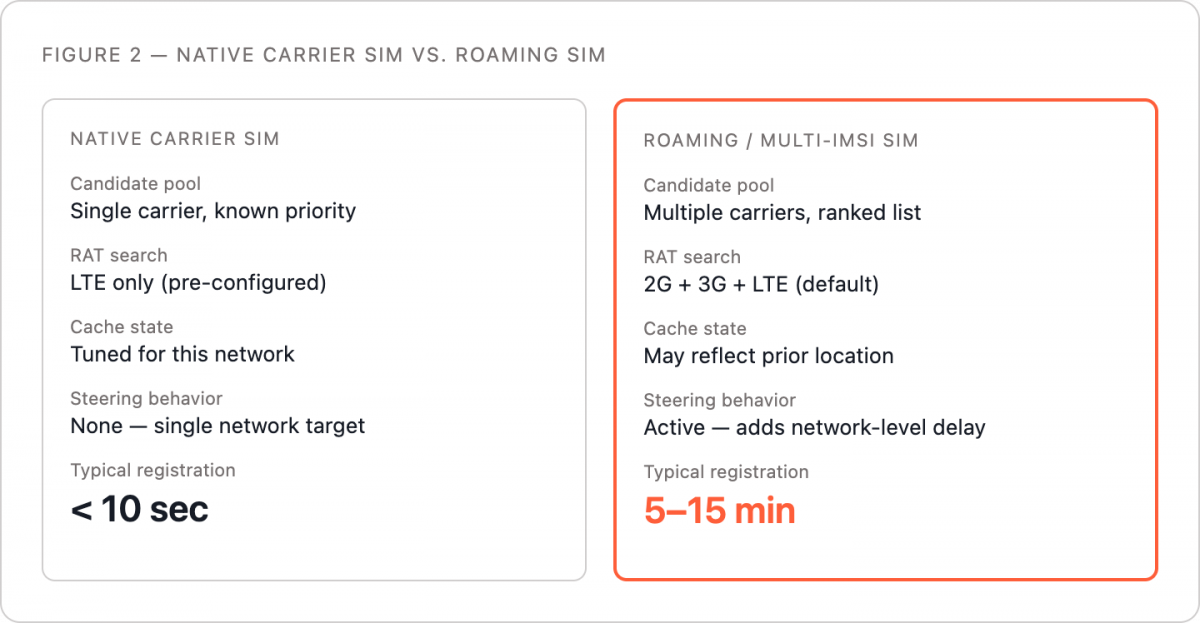
Slow registration is almost always the intersection of modem configuration, firmware version, and how the SIM’s preferred network list interacts with local carrier infrastructure. Locking to LTE, clearing the PLMN cache, and running current firmware resolves most cases.
If you’ve done all three and registration times are still long, check your SIM’s provisioning status and confirm your APN is set correctly — simplex.iot for Simplex SIMs — before assuming the problem is coverage. Explore our coverage and SIM options if you’re still evaluating which SIM tier fits your deployment.
This article was curated by Jan Lattunen, CCO Simplex Wireless
About the Author: Jan Lattunen manages Sales and Marketing for Simplex Wireless. Jan has 20 years’ experience in working with SIM card technology and was involved in launching the eSIM in North America with major carriers and OEMs. His expertise in telecommunications is around SIM cards. On a personal note, Jan is a family man and avid cyclist with advocacy for safety in the roads. You can connect with Jan on https://linkedin.com/in/JanLattunen