







Does Your IoT Device Need a Public IP Address?
April 20, 2026
What Is an IoT Data Pool and How Does It Work?
April 27, 2026
When Your PTT Radio Is Also a Web Browser: Managing Data on Android Field Devices
Android-based PTT devices give field teams powerful communication tools — and an open door to the internet. Here’s how to control what happens on the other side of that door.
The shift from dedicated two-way radios to Android-based push-to-talk devices has real operational advantages: richer displays, GPS integration, app flexibility, and cellular coverage that follows carrier networks rather than proprietary frequencies. But Android is a general-purpose operating system. The same device running your PTT app can also run a browser, stream video, download apps from the Play Store, and consume data your organization is paying for in ways you never intended. For PTT resellers and the enterprise customers they serve, that’s not a hypothetical problem — it’s a billing and policy reality that surfaces as soon as devices leave the office.
The challenge: open internet on a purpose-built device
A PTT device used the way it’s supposed to be used consumes very little data. PTT over cellular traffic is low-bandwidth by design — voice packets are small, and a well-run deployment with 50 active field radios can operate comfortably within a modest pooled data plan. The economics of PTT connectivity work precisely because voice traffic is predictable and lean.
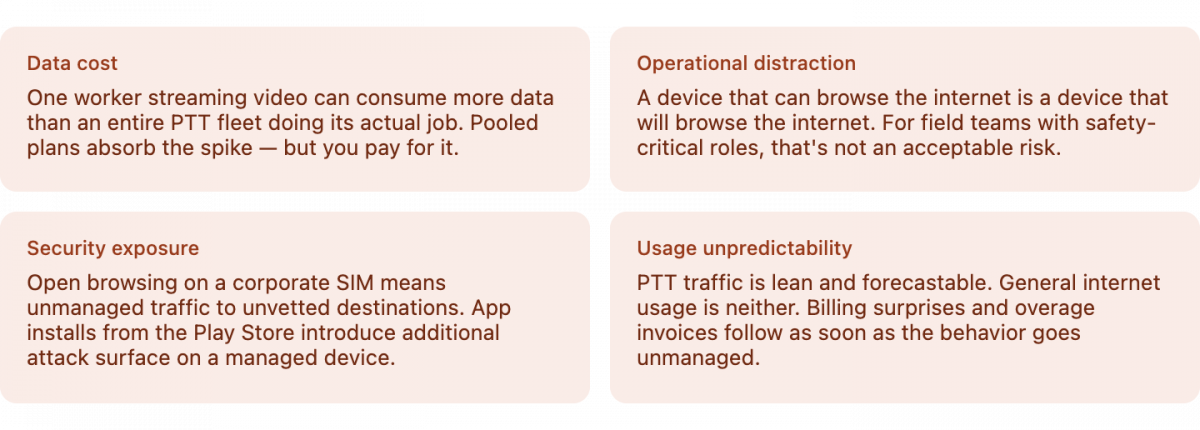
Android breaks that predictability. A worker who discovers the device has a browser and a YouTube app can consume in an afternoon what 20 PTT-only devices would use in a month. Multiply that across a fleet, and the data cost model collapses. Beyond cost, there are operational concerns: distracted workers, unauthorized app installs, and in regulated industries, potential data handling issues if personal browsing happens on a corporate SIM with a fixed IP address.
The devices themselves compound the problem. Modern Android PTT hardware often features large touchscreens designed to make the device more capable — but that same screen makes it easy and intuitive to use as a general smartphone. The hardware isn’t the issue. The issue is that the operating system was never designed to be a one-app device, and without deliberate configuration, it won’t behave like one.
Figure 1 — Four dimensions of the open internet problem
Why the SIM card alone can’t solve it
The instinct is to ask the connectivity provider to handle the problem at the network level — restrict the SIM so it can only reach the PTT server and nothing else. That’s technically possible through a private APN with traffic filtering, sometimes called a walled garden. The SIM connects to a closed network that only routes traffic to a defined list of IP addresses. Everything else is blocked before it ever leaves the carrier.
The limitation is that this architecture is genuinely complex and expensive to operate at the scale and price point that PTT deployments typically demand. It requires dedicated private network infrastructure, IP whitelisting management, and carrier-level configuration that doesn’t fit neatly into a self-serve connectivity model. For most PTT operators and their customers, it’s not the right tool for the problem — not because it doesn’t work, but because it’s overbuilt for what they actually need.
A standard IoT SIM on an open APN gives devices full internet access. That’s the right default for most IoT use cases, where the device is purpose-built and the software controls what it communicates with. For Android PTT devices, it puts the access control problem squarely at the device and operations layer, where it can actually be addressed more cost-effectively.
What the right approach looks like
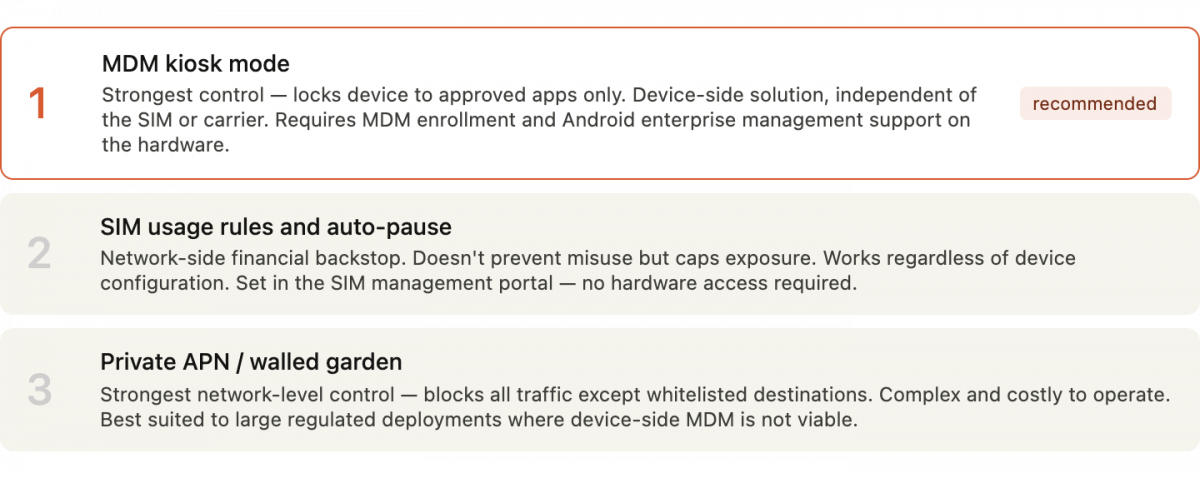
Effective data control for Android PTT fleets uses two layers that address the problem at different levels, with a third providing a financial backstop.
MDM — Mobile Device Management software — is the strongest tool available and should be the first line of defence for any organization deploying Android PTT at scale. An MDM solution configured in kiosk mode locks the device to a defined app set: the PTT application runs, the browser doesn’t load, the Play Store is inaccessible. Android’s enterprise management APIs support this natively, and several MDM platforms are specifically designed for PTT and field device deployments. The device still connects to the cellular network and still consumes data — but only for the traffic generated by the approved app. This is a device-side solution, independent of the SIM or the connectivity provider.
SIM-level usage controls provide the second layer. Through the Simplex portal, operators can configure per-SIM data alerts and automatic pause rules. When a SIM reaches a defined usage threshold — say, 80% of its monthly allocation — an alert fires. When it hits the cap, the SIM pauses automatically until manually reset or the billing cycle turns over. This doesn’t prevent misuse from happening, but it caps the financial exposure from any single device and surfaces the problem immediately rather than at month-end invoice review.
Used together, MDM handles the behavioral problem and SIM automation handles the financial backstop. Neither is complete without the other: MDM can be misconfigured, bypassed on certain device models, or not yet deployed on an inherited fleet. SIM-level caps ensure that even when the device layer fails, the cost exposure has a hard ceiling.
Figure 2 — Ranked list: three control approaches by strength
How Simplex fits into the PTT connectivity stack
Simplex serves many PTT operators deploying cellular SIM cards into Android field devices across North America and internationally. The pricing model fits the PTT use case well: pay-as-you-go plans mean operators only pay for actual consumption, which keeps costs low for well-managed fleets and avoids the minimum charge structures that penalize smaller deployments. For fleets that have consolidated onto a pooled bundle, heavy users offset light ones without per-device overage risk.
The SIM management portal includes per-SIM usage monitoring with configurable alert thresholds and automatic pause rules — the second control layer described above. Setting a 100MB auto-pause on every device in a fleet takes minutes in the portal and takes the billing exposure question off the table entirely. When a device hits its limit, it stops — the operator gets visibility, and the customer doesn’t get a surprise invoice.
On the connectivity side, multi-carrier access across AT&T, T-Mobile, and Verizon in the US and Rogers, Bell, and TELUS in Canada means field devices connect to whichever network is strongest at a given location. For PTT in particular, consistent connectivity matters more than peak speed — a device that fails over seamlessly between carriers keeps the radio working; one locked to a single network has dead zones where the PTT app simply goes silent.
Simplex doesn’t control what runs on the Android device. That’s the MDM layer, and it belongs to the reseller and their customer. What Simplex controls is the network connection and the data economics — and both are configurable to match the operational model you’re running.
Figure 3 — Side-by-side comparison: MDM vs. SIM usage rules
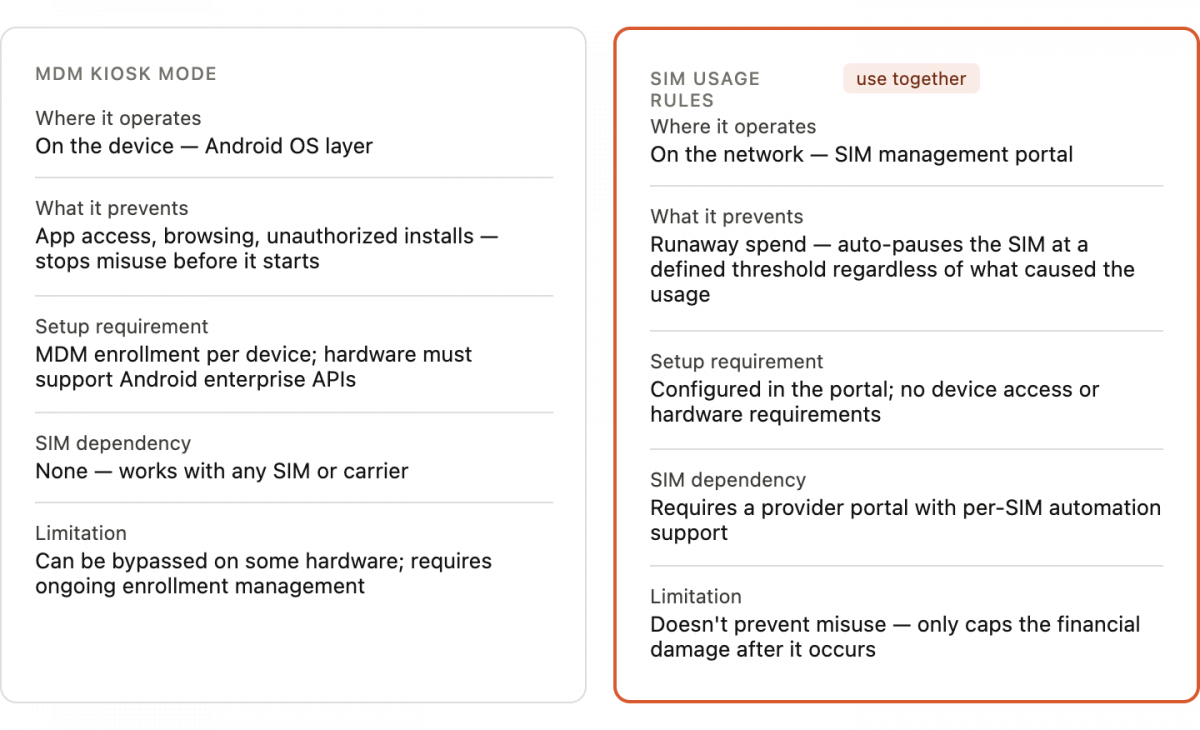
Neither layer is a complete solution on its own. MDM without SIM controls leaves you exposed when a device is misconfigured or unenrolled. SIM controls without MDM cap the damage but don’t stop the behavior. Used together, they address the problem at the level where it actually lives — and give PTT operators the control they need to offer their customers a managed, predictable service rather than an open-ended data bill.
If you’re deploying Android PTT devices and want to understand how Simplex’s SIM management tools fit into your fleet’s data control strategy, reach out to the team at sales@simplexwireless.com.
This article was curated by Jan Lattunen, CCO Simplex Wireless
About the Author: Jan Lattunen manages Sales and Marketing for Simplex Wireless. Jan has 20 years’ experience in working with SIM card technology and was involved in launching the eSIM in North America with major carriers and OEMs. His expertise in telecommunications is around SIM cards. On a personal note, Jan is a family man and avid cyclist with advocacy for safety in the roads. You can connect with Jan on https://linkedin.com/in/JanLattunen