






IPAe vs IPAd: Why the SIM-Side Approach Matters for Retrofits
June 16, 2026
How to Evaluate an eIM Provider: The Enterprise Checklist for SGP.32 Fleet Management
July 6, 2026
How to Evaluate an IoT SIM Provider: A Due Diligence Guide for Multi-Year Deployments
Most IoT SIM buying decisions are made on two criteria. There are six that actually matter.
A SIM card commitment for a large IoT deployment isn’t a monthly subscription you cancel if it doesn’t work out. Devices get shipped, APN configurations get hardcoded, and support teams get trained on one portal. Switching providers 18 months in — because the coverage turned out to be single-carrier in disguise, or the bill was impossible to audit, or support stopped responding after the sale — is an operational project nobody wants.
The providers who win on price comparisons and coverage maps aren’t necessarily the ones you’ll still want to be working with in year three. Price and coverage are two of six criteria that separate a reliable long-term partner from a vendor who looked good in a demo.
This guide gives you the framework to evaluate providers properly. The criteria are designed to be genuinely useful regardless of which vendor you’re looking at — including Simplex. A provider who meets all six is worth a conversation. A provider who struggles on any of them is worth a harder question.
What to evaluate
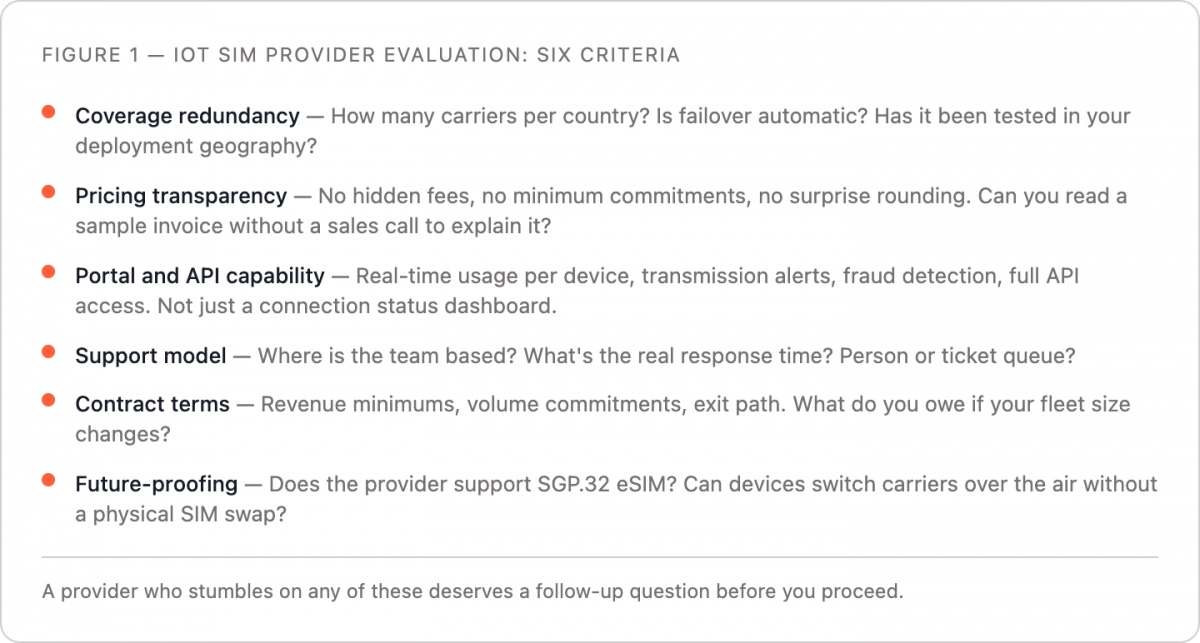
Coverage redundancy — not just country count. A coverage map that shows 191 countries tells you nothing about how many carriers are active per country, whether failover is automatic or manual, or whether the SIM has actually been tested in your deployment geography. The architecture that determines whether your devices will stay connected is which carriers are in the provider’s network and how the SIM behaves when one goes down — not the number on the brochure.
Pricing transparency — can you read the bill? Hidden fees, minimum revenue commitments, and surprise rounding are how IoT connectivity bills become unpredictable at scale. Before committing, ask to see a sample invoice for a fleet similar to yours. If it takes a sales call to explain what each line means, that’s the answer.
Portal and API capability. A dashboard that shows connection status is the baseline. A useful portal shows real-time data usage per device, triggers alerts when a device stops transmitting, surfaces anomalous usage that signals fraud or misconfiguration, and exposes an API so you can integrate fleet visibility into your own tooling. The difference between these two things is the difference between visibility and guesswork.
Support model — person or ticket queue? Where is support staffed, and what’s the realistic response time when something goes wrong at 2am? A support team in a different time zone that operates on tickets is a different product than a team you can call. Find out before you’re in an incident.
Contract terms — what’s the exit path? Revenue minimums, volume commitments, and lock-in periods are where providers recover the margin they gave away on the per-MB rate. Read the contract before signing and ask specifically: what do I owe if I reduce fleet size by 30% in year two?
Future-proofing — is there an eSIM path? Devices deployed today may run for five to ten years. A provider with no SGP.32 eSIM capability means any future carrier switch on those devices will require a physical SIM swap. That’s a truck roll problem you’re building into your fleet before you’ve shipped a single unit.
Three mistakes buyers make
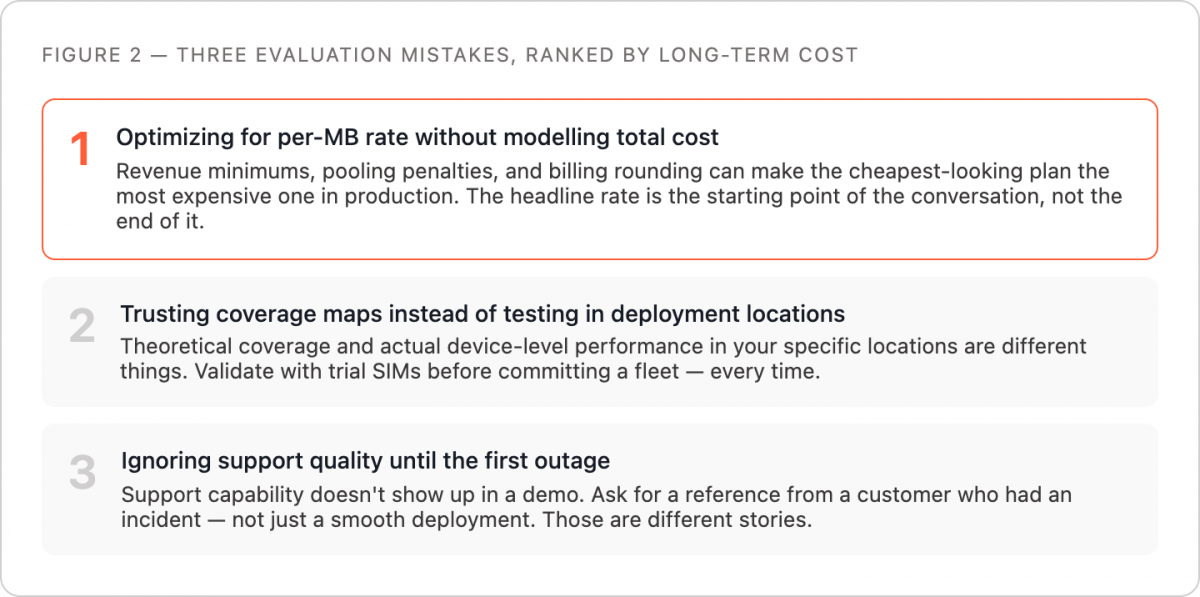
Optimizing for the lowest per-MB rate. The per-MB rate is the most visible number in any comparison, and the least reliable predictor of total cost. A provider with a lower rate but a revenue minimum, a pooled plan that penalizes low-usage devices, or a billing model that rounds up to the nearest MB will cost more at scale than a provider with a slightly higher rate and no hidden structure. Model total cost against your actual usage distribution — not the per-MB headline.
Skipping coverage validation in actual deployment locations. A carrier’s coverage map shows theoretical signal boundaries — not device-level performance inside a steel enclosure in a basement, or under a bridge, or in a concrete utility vault. Validating with trial SIMs at your actual deployment locations before committing a full fleet is not optional for any deployment where downtime has a measurable cost. The cost of a trial is trivial compared to the cost of a failed deployment.
Ignoring support quality until the first outage. Support capability doesn’t reveal itself in a demo. It reveals itself at 11pm on a Tuesday when 15% of your fleet goes offline and you need an answer fast. Ask for a reference from a customer who had an incident — not a customer who had a smooth deployment. Those are different stories, and you need to hear both.
How Simplex addresses each criterion
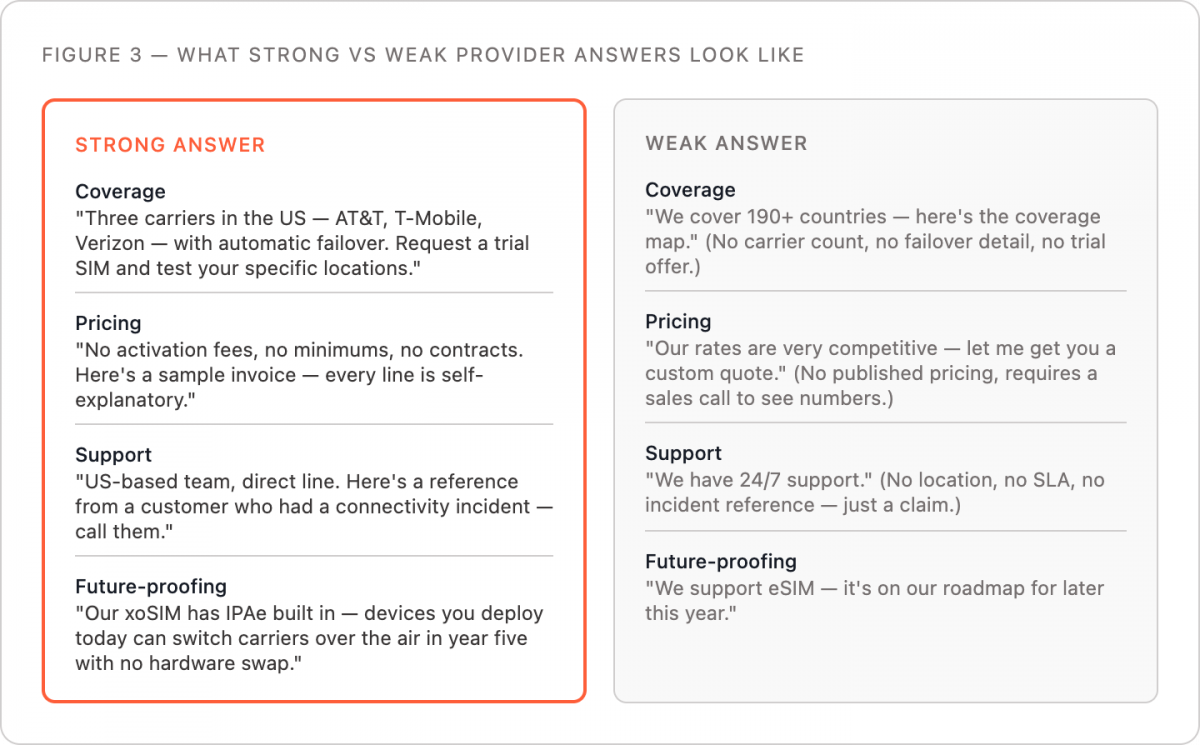
Coverage redundancy. Simplex SIM cards access 550+ networks across 191 countries, with automatic multi-carrier failover — not steered roaming that routes through a single preferred carrier. In the US, that means AT&T, T-Mobile, and Verizon on a single SIM. Failover is a function of the SIM’s network access configuration, not a manual intervention. Trial SIMs are available to validate coverage before committing.
Pricing transparency. No activation fees, no platform fees, no revenue minimums, no contracts. Three plan models — PAYG, pooled, and prepaid — with published pricing. Postpaid plans (PAYG and pooled) have a 10-SIM minimum order; prepaid starts at a single SIM for testing. One honest note: Simplex’s online pricing is structured around self-serve enrollment, and very large deployments with complex custom requirements are better handled through a direct conversation with the sales team than through the standard pricing page.
Portal and API capability. The Simplex portal provides real-time usage monitoring per device, configurable alerts, anomaly detection, sub-accounts for fleet segmentation, and a full API for integration into external tooling. The portal is visible from day one — you don’t need to hit a device count threshold to access fleet visibility features.
Support model. Support is staffed in Alpharetta, Georgia. US business hours, direct access — not a global ticket queue with an offshore tier-one filter. The Livelox team referenced this specifically: when integration questions came up, Simplex’s support team responded with answers, not ticket numbers.
Contract terms. No contracts, no revenue minimums, no lock-in. Start with a single prepaid SIM for testing. Scale to a fleet without committing to a volume floor. Exit when you need to without an exit fee.
Future-proofing. Simplex’s xoSIM is an eUICC SIM card with on-SIM IPAe built in — meaning any device running a xoSIM can be upgraded to full SGP.32 eSIM management without a hardware swap. For fleets with a five-to-ten year device lifespan, that’s the difference between a carrier switch being a software operation and a truck roll.
Questions to put to any provider — including Simplex
These aren’t the criteria above restated as questions. These are the stress-test questions for after a vendor has given you a confident answer on every dimension.
- If your primary carrier in our main deployment region has a four-hour outage tonight, walk me through exactly what happens to our devices — second by second.
- Show me last month’s invoice for a fleet similar to ours in size and usage. Walk me through every line.
- What happens to our SIM cards and device configurations if we decide to leave your platform in 18 months?
- Give me a reference from a customer who had a connectivity incident — not just a smooth deployment. I want to hear what the support experience was actually like under pressure.
- If we scale from 500 to 5,000 devices in two years, what changes in our pricing structure, our support tier, and our contract terms?
- Your coverage map shows our deployment region as covered. Which specific carriers are active there, and have you tested device-level performance in that geography — not just theoretical signal boundaries?
A provider who answers all six directly has earned the next step.
Choosing an IoT SIM provider is a multi-year decision that compounds — in either direction. The right framework surfaces the gaps before they become production problems, and the right provider clears every bar without hedging. If you’re ready to put Simplex through the same checklist, explore our IoT SIM cards and request a trial SIM to test coverage in your actual deployment locations.
This article was curated by Jan Lattunen, CCO Simplex Wireless
About the Author: Jan Lattunen manages Sales and Marketing for Simplex Wireless. Jan has 20 years’ experience in working with SIM card technology and was involved in launching the eSIM in North America with major carriers and OEMs. His expertise in telecommunications is around SIM cards. On a personal note, Jan is a family man and avid cyclist with advocacy for safety in the roads. You can connect with Jan on https://linkedin.com/in/JanLattunen