







How to Evaluate an IoT SIM Provider: A Due Diligence Guide for Multi-Year Deployments
June 18, 2026
Your IoT Network Data Exists. Getting an Answer From It Shouldn’t Take This Long.
July 9, 2026
How to Evaluate an eIM Provider: The Enterprise Checklist for SGP.32 Fleet Management
Ten questions that separate production-ready eIM platforms from pilot projects — and the answers that should disqualify a vendor before you sign anything.
The SGP.32 eIM market is early. That means buyers don’t have years of vendor track records to compare, analyst reports to benchmark against, or colleagues who’ve already been through a full procurement cycle. What most enterprises do instead is evaluate eIM providers the same way they evaluate any software vendor: demo, pricing, a few references. That framework misses the dimensions that actually matter for production IoT deployments.
An eIM (eSIM IoT Manager) is the server that manages profile operations — push, switch, delete — for every eUICC (embedded Universal Integrated Circuit Card) in your fleet. If it goes down, your remote provisioning goes down with it. If it’s not validated against your device’s chip, it may work in the lab and fail in the field. And if it’s bundled with your connectivity contract, you haven’t escaped carrier lock-in — you’ve moved it up one layer.
This checklist gives you the framework to evaluate eIM providers properly before you commit.
What to evaluate
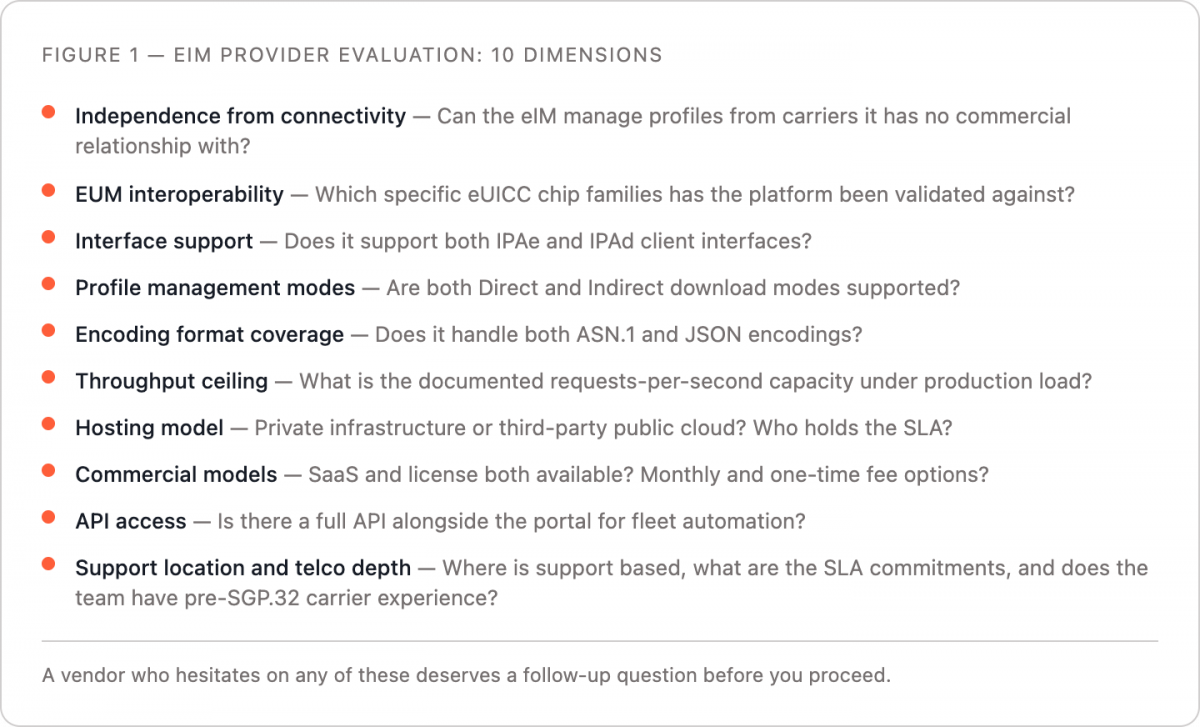
The ten dimensions below determine whether an eIM platform is genuinely production-ready — or only looks that way in a demo.
Independence from connectivity. The most important structural question. An eIM sold or managed by your MNO gives that MNO leverage over your profile operations. If you can only switch to profiles the same provider controls, the freedom SGP.32 promises is theoretical. A genuinely independent eIM works with any carrier’s profiles — including ones you’ve sourced elsewhere.
EUM interoperability. EUMs (eUICC Manufacturers) — the companies that make the chips inside your SIM cards — implement the SGP.32 specification with variation. An eIM tested against one EUM’s chips is a pilot. An eIM tested and validated against multiple EUMs is a production platform. Ask for the specific chip families, not a generic “yes, we’re compatible.”
Interface and protocol coverage. SGP.32 supports two client interfaces (IPAe and IPAd), two profile management modes (Direct and Indirect), and two encoding formats (ASN.1 and JSON). Full coverage means the platform works with whatever hardware your fleet contains — now and as it evolves. Partial coverage means you’ll hit a ceiling at scale.
Scale and hosting model. What is the documented throughput ceiling — requests per second under load? And is the platform hosted on the vendor’s own infrastructure or on a public cloud? Private hosting matters for data security posture and SLA accountability. A platform processing hundreds of requests per second is a pilot platform; a production fleet needs carrier-grade throughput.
Commercial flexibility. Does the vendor offer both SaaS and licensed deployment models? Monthly and one-time fee options? Full API access alongside a portal? Lock-in can happen at the commercial layer too — if the only option is a long-term SaaS contract with one pricing tier, you’re constrained before you’ve provisioned a single device.
Support location and telco depth. Where is the support team? What are their SLA commitments in writing? And what is the vendor’s actual telecoms background — were they building carrier-grade platforms before SGP.32 existed, or did the spec create the company?
Three mistakes buyers make when evaluating eIM providers
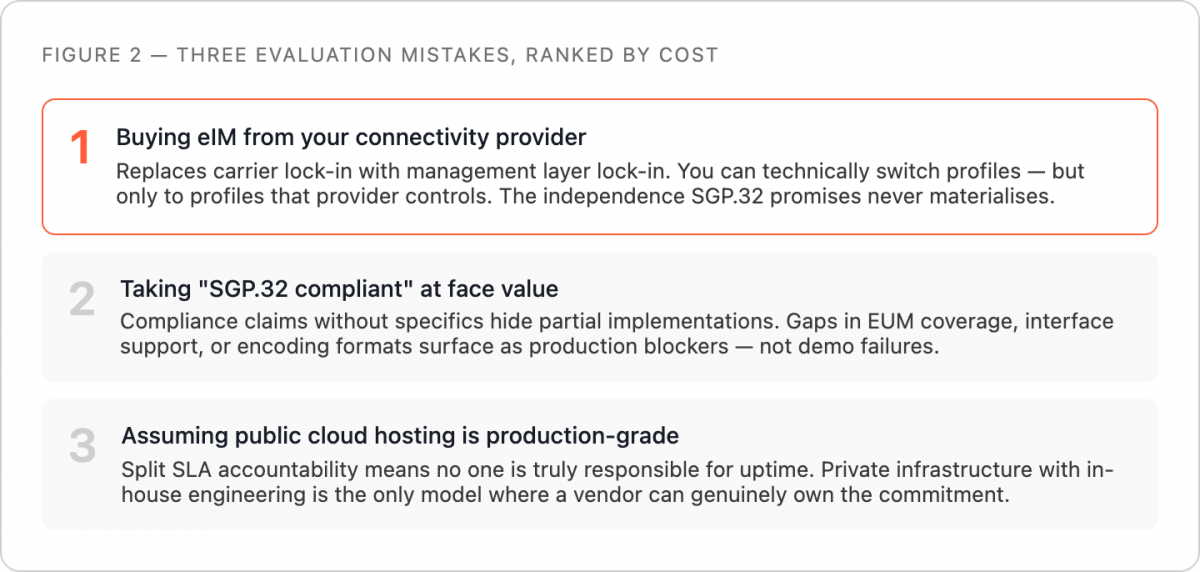
Treating the eIM as a connectivity add-on. An enterprise asks their existing MNO whether they support SGP.32, the MNO says yes, and the deal gets done. What they’ve purchased is profile management that only works within that MNO’s ecosystem. The leverage SGP.32 was designed to create — the ability to switch carriers without a truck roll — disappears the moment your eIM and your connectivity come from the same vendor. You’ve traded physical SIM lock-in for management layer lock-in.
Accepting “SGP.32 compliant” without asking what that means. The specification covers a lot of ground. A vendor can claim compliance while supporting only IPAd (not IPAe), only Direct mode (not Indirect), only one EUM’s chips, and only ASN.1. Each gap is a constraint you’ll discover in production. Ask for the specific subset of the spec they’ve implemented and tested — and ask for evidence, not assurances.
Underweighting hosting and SLA accountability. When an eIM is hosted on a public cloud by a vendor who built on top of it, accountability for uptime is split. The vendor points at the cloud provider; the cloud provider has no SLA with you. If your profile operations depend on this platform, you need to know exactly who is responsible when it goes down — and whether that person has a direct line you can call.
How Simplex addresses each criterion
Independence from connectivity. The Simplex eIM operates independently from Simplex’s own connectivity offering. Customers can bring their own carrier contracts and use the eIM for profile management only — or use Simplex connectivity, or a mix of both. The platform has no commercial relationship with the profiles it manages. That independence is the product, not a feature of a connectivity bundle.
EUM interoperability. Simplex has validated its eIM against four EUM chip families, with Kigen (ARM), ST Microelectronics, and VALID publicly nameable. That breadth matters in production: whatever chip is inside your deployed devices, the platform has been tested against it. Most eIM vendors haven’t done this work because it requires genuine investment in interoperability testing — and most eIM vendors are either EUMs themselves or startups without the resources to run it.
Interface and protocol coverage. Simplex supports IPAe and IPAd, Direct and Indirect profile management, and both ASN.1 and JSON encodings. Full spec coverage means the platform adapts to your fleet — not the other way around.
Scale and hosting. The platform is hosted on bare metal infrastructure owned and operated by Simplex in Atlanta, Georgia — not on AWS, Azure, or GCP. Throughput is carrier-grade: the team that built this platform spent decades building and supporting mission-critical systems for Tier 1 operators. The SLA sits with Simplex directly, not a cloud provider SLA that Simplex passes through to you.
Commercial models. Simplex offers both SaaS (monthly fee, managed service) and licensed deployment (for enterprises that need to run the eIM inside their own infrastructure or white-label it). Both models include API access alongside the portal. One honest limitation: the licensing model is designed for larger enterprise deployments and may not be the right fit for smaller fleets in early evaluation — the SaaS tier is the right starting point for most.
Support and telco depth. The support team is in Alpharetta, Georgia. The founding team has over 30 years of carrier-grade telecom experience, including direct work with Tier 1 operators before SGP.32 existed. That background is the difference between a platform built by people who understand what production cellular infrastructure actually requires, and one built by people who learned the spec last year.
Questions to ask any eIM provider — including us
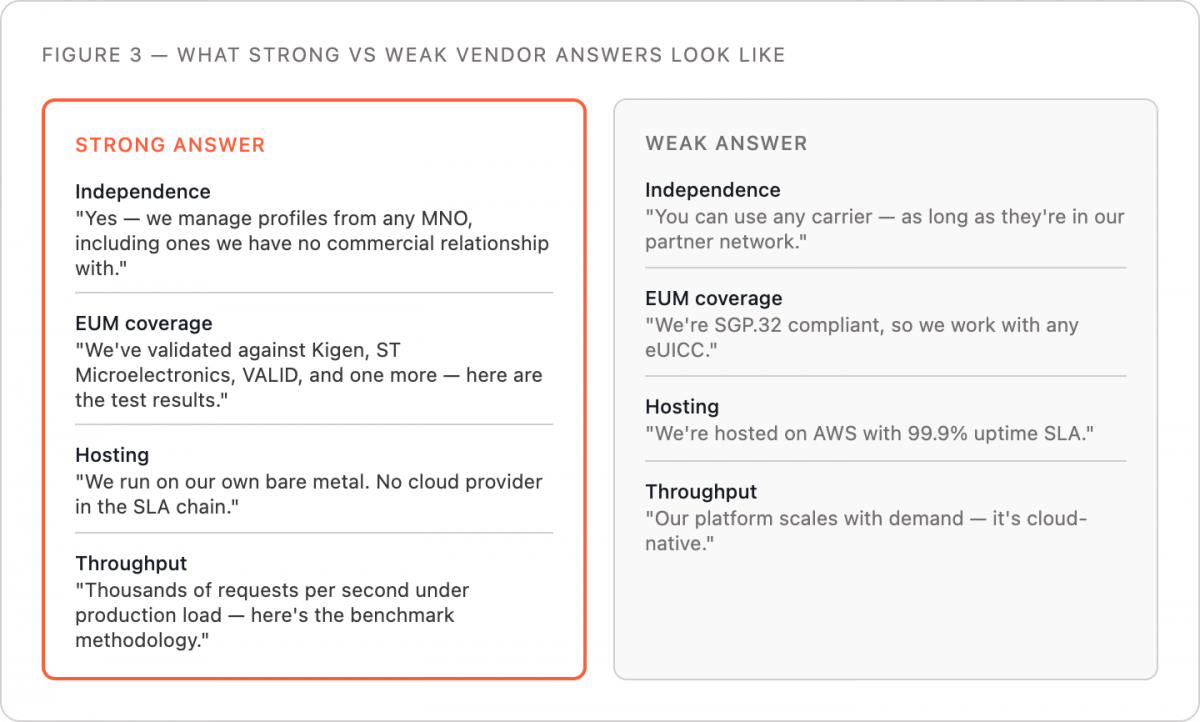
These aren’t the same questions as the criteria above restated. These are the follow-up questions — the ones to ask after a vendor has given you a confident answer on every dimension.
- If your eIM platform goes offline for four hours, walk me through exactly what happens to in-flight profile operations — and how they recover.
- Can you show me a profile switch running live against a device with a chip from an EUM you haven’t mentioned yet?
- What percentage of your current customer base uses BYOO (Bring Your Own Operator) vs. Simplex connectivity — and why does that split look the way it does?
- Has your platform ever failed an interoperability test with a specific eUICC implementation? What was the issue and how was it resolved?
- If we license the platform and run it internally, what does the handoff of knowledge look like — and what breaks first when your team isn’t available?
- What is the one thing about your eIM that your most technically demanding customer has pushed back on?
A provider who answers all six without deflecting has earned the next conversation.
Evaluating an eIM provider is ultimately a question of whether the platform can do what SGP.32 promises — at production scale, with your hardware, without creating a new form of the lock-in you were trying to escape. The checklist above won’t make the decision for you, but it will surface the gaps before they become production problems. Explore the xoSIM to see how Simplex approaches every one of these criteria in practice.
This article was curated by Jan Lattunen, CCO Simplex Wireless
About the Author: Jan Lattunen manages Sales and Marketing for Simplex Wireless. Jan has 20 years’ experience in working with SIM card technology and was involved in launching the eSIM in North America with major carriers and OEMs. His expertise in telecommunications is around SIM cards. On a personal note, Jan is a family man and avid cyclist with advocacy for safety in the roads. You can connect with Jan on https://linkedin.com/in/JanLattunen