







Your IoT Network Data Exists. Getting an Answer From It Shouldn’t Take This Long.
July 9, 2026
Why Interoperability Testing With Multiple eUICCs Matters
July 16, 2026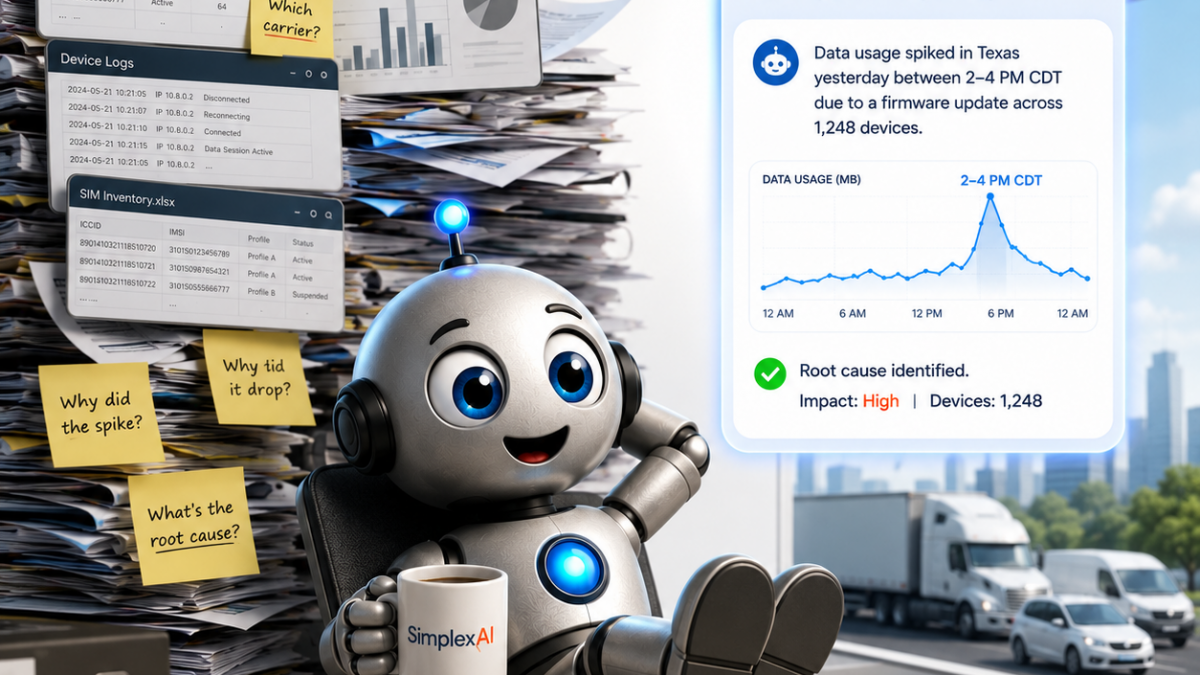
Why Fleet Operations Teams Spend More Time Finding IoT Data Than Acting On It
You know your fleet is generating data. The problem is what it takes to get at it.
A vehicle goes dark in Ohio. A device in a refrigerated trailer shows an unusual session termination. Three trackers in the southeast haven’t reported in six hours. These aren’t hypotheticals — they’re the kind of events fleet operations teams deal with every shift. And in every case, the first obstacle isn’t fixing the problem. It’s finding out what’s actually happening.
The Connectivity Challenge Fleet Operations Actually Faces
Fleet connectivity is not a static problem. Vehicles cross carrier coverage boundaries constantly. A tracker that was on T-Mobile US in Atlanta may hand off to a different operator by the time it reaches rural Tennessee. Devices that were healthy yesterday may show session anomalies today tied to a carrier behavior change you didn’t trigger and weren’t notified about.
At the same time, the questions fleet ops teams ask are operational and immediate. Which devices are active right now? Which ones dropped a session in the last four hours and why? Is the data consumption on this vehicle normal for its route? Which carrier is it on, and is that carrier supporting LTE (Long-Term Evolution) in that region?
These aren’t complex analytical questions. They’re basic situational awareness. But answering them requires navigating a management portal that was designed for configuration and control, not rapid-fire operational queries. GPS asset trackers across fleet, logistics, and construction verticals all share this constraint: the connectivity layer generates rich session data, but surfacing it quickly enough to be operationally useful requires either deep platform knowledge or a faster interface.
Most fleet teams have neither.

Why This Problem Is More Acute in Fleet Than Other IoT Verticals
A smart meter sitting in a fixed location generates predictable session behavior. If something goes wrong, the failure mode is usually binary — it’s connected or it isn’t — and the timeline for response is measured in hours or days.
Fleet devices don’t behave that way. They’re mobile, they cross coverage zones, and the session patterns are inherently variable because the devices themselves are in motion. A termination cause of “Admin-Reset” on a stationary sensor is worth investigating. The same cause on a vehicle tracker that just crossed a state line may be completely normal.
This means fleet ops teams need context alongside data. Not just “this session ended” but “this session ended, here’s the carrier, here’s the cell tower, here’s how it compares to the last 30 days of behavior for this device.” Deploying cellular connectivity across a fleet is the first challenge. Understanding what that fleet is doing in production, at scale, across multiple carriers, is the ongoing one.
The standard management portal gives you the data. It doesn’t give you the context fast enough to act on it during a shift.

What the Right Visibility Layer Looks Like for Fleet Teams
Fleet operations teams don’t need more data. They need faster access to the data they already have. The right visibility layer for a connected fleet has three characteristics.
First, it answers questions in plain language. “How many devices are active in Florida right now” and “which tracker used the most data this week” should not require a filter, a report, or a portal walkthrough. These are operational questions that get asked multiple times a day. The interface should match how the team actually works.
Second, it surfaces anomalies before they become incidents. Unusual traffic spikes, drop-rate changes, and session termination pattern shifts should be flagged automatically — not discovered during a manual review. Selecting the right cellular IoT SIM provider for fleet tracking is part of avoiding these problems at the infrastructure level. But an intelligent visibility layer catches what configuration alone can’t prevent.
Third, it gives every team member access, not just the person who knows the platform. Network ops, customer support, dispatchers, and management all need to answer connectivity questions. If only one person can pull that data effectively, every connectivity question becomes a dependency on that person.

How SimplexAI Works for Fleet Operations
SimplexAI is built into the Simplex platform and answers operational questions in plain English — no SQL, no BI tools, no specialist knowledge of the portal required.
For fleet teams specifically, it means a dispatcher can ask “which devices are active in Texas right now” and get an immediate answer. A support rep can ask “what did the last session for this tracker look like” and see the carrier, the cell tower, the termination cause, and the data consumed — without opening a separate view. A manager can ask “which SIM used the most data last week” and have the answer before the conversation ends.
Historical session data goes back 30 days and is fully queryable. Carrier coverage intelligence across 100+ operators worldwide is built in, so questions like “does AT&T support LTE-M on this route” get answered directly. For fleets already using eSIM (eUICC) across multiple carrier profiles, SimplexAI surfaces which profile is active on any device at any time.
The data your fleet generates every day doesn’t change. The time it takes your team to act on it does.
See how Simplex serves connected fleet operations — and try SimplexAI in your account today.
This article was curated by Jan Lattunen, CCO Simplex Wireless
About the Author: Jan Lattunen manages Sales and Marketing for Simplex Wireless. Jan has 20 years’ experience in working with SIM card technology and was involved in launching the eSIM in North America with major carriers and OEMs. His expertise in telecommunications is around SIM cards. On a personal note, Jan is a family man and avid cyclist with advocacy for safety in the roads. You can connect with Jan on https://linkedin.com/in/JanLattunen