







What Is 5G NTN IoT? A Simple Guide
August 12, 2026
The eIM Is the First Enterprise System eSIM Has Ever Had
August 17, 2026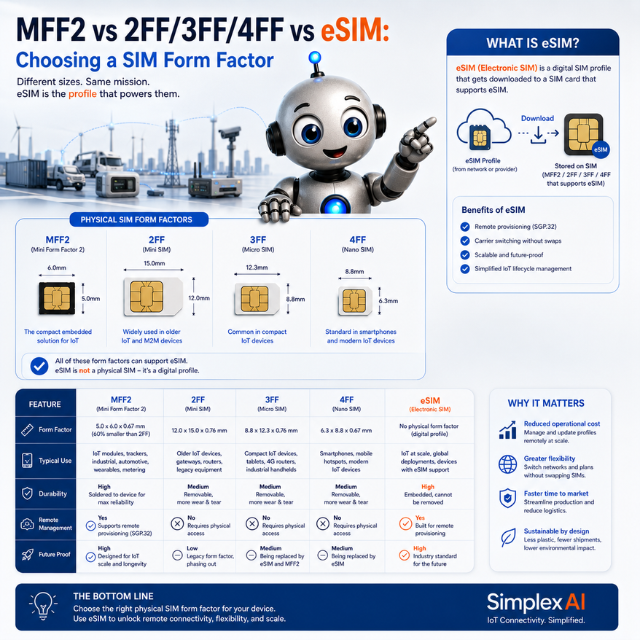
MFF2 vs 2FF/3FF/4FF vs eSIM: Choosing a SIM Form Factor
A device’s SIM decision gets made once, usually early, and it’s expensive to unmake later — here’s what actually determines the right choice.
Most teams pick a SIM form factor the same way they pick a connector size: whatever fits the board. That works until the device needs to switch carriers two years into a five-year deployment, and the team discovers the physical package they chose has nothing to do with whether that switch is even possible.
What these terms actually are
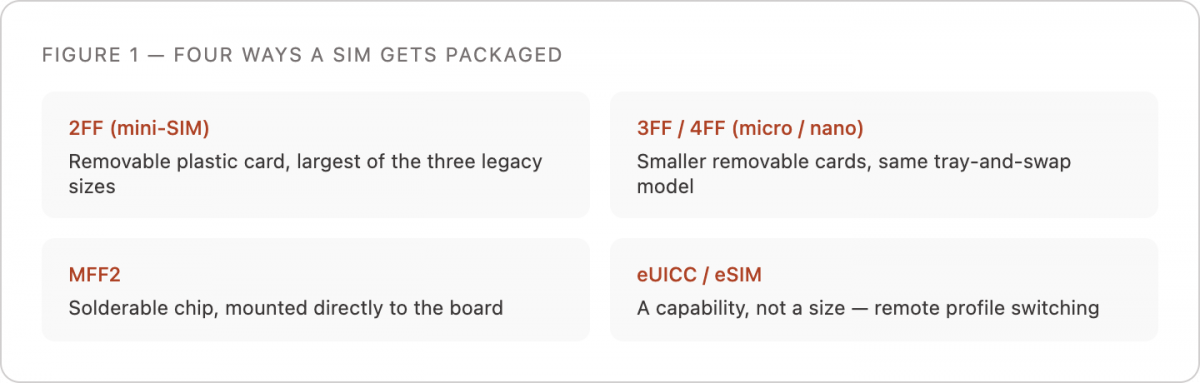
2FF, 3FF, and 4FF are GSMA-defined size standards for a removable plastic SIM — what most people know as mini-SIM, micro-SIM, and nano-SIM. They sit in a tray or slot and can be physically pulled out and swapped. MFF2 is a different physical standard: a small solderable chip package, mounted directly onto the circuit board rather than inserted into a socket. It’s built for devices that won’t be opened for routine service.
Here’s the point most comparisons get wrong: eSIM isn’t a size. It’s a capability. An eSIM is a SIM built around an eUICC (embedded universal integrated circuit card) — a chip that can hold more than one carrier profile and switch between them remotely, without anyone touching the hardware. That capability is governed by GSMA specifications: SGP.02 for the original machine-to-machine remote provisioning model, SGP.22 for consumer devices, and SGP.32 for the newer specification built specifically for IoT fleets.
The two ideas are independent. An MFF2 chip can ship as a fixed, single-profile SIM, or it can ship as an eUICC capable of remote profile swaps. The same is true of a 4FF nano-SIM. “Which form factor” and “does it support eSIM” are two separate questions — and answering only the first one is exactly how teams end up locked into a carrier they didn’t mean to commit to permanently.
How this differs from the old approach
The older model treated the SIM as a one-time decision: pick a physical size that fits the device, order it pre-loaded with one carrier’s profile, and if the carrier relationship ever needs to change, send someone to physically remove and replace the card. That’s workable for a 2FF or 4FF SIM sitting in an accessible tray. It’s close to impossible for an MFF2 chip soldered into a sealed enclosure — the “swap” becomes a hardware respin.
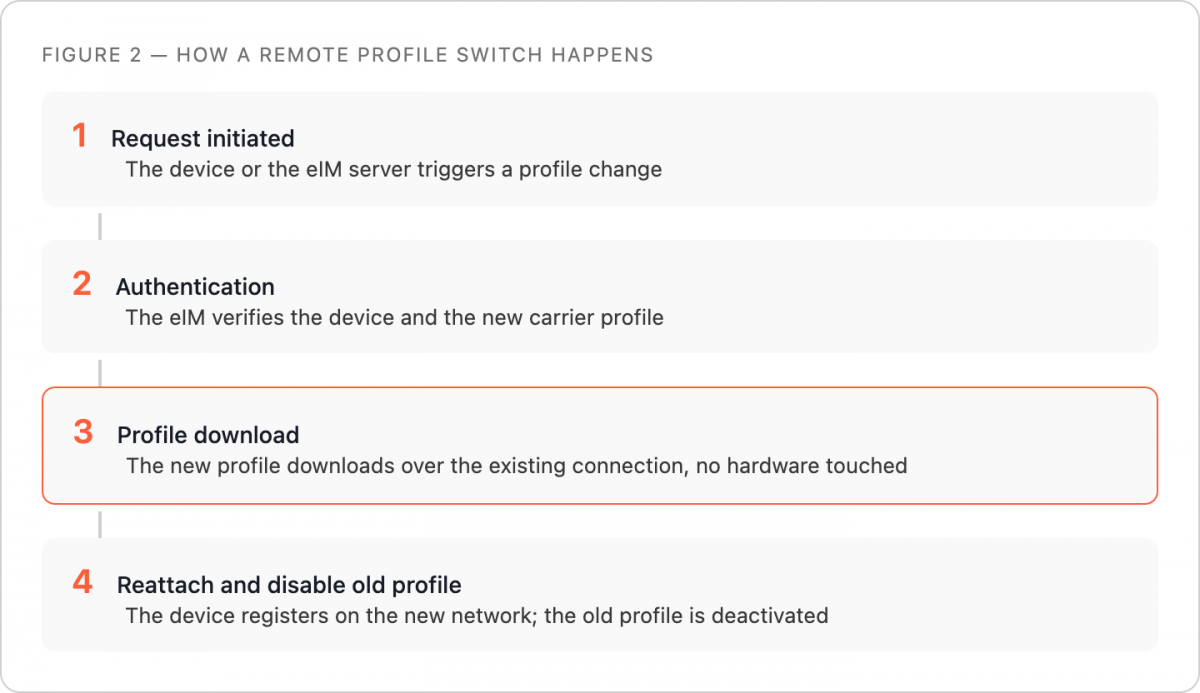
An eUICC changes what happens after the SIM ships, not how it’s packaged. Instead of a fixed profile burned in at manufacturing, the chip holds a slot that can be reprovisioned over the air. The mechanics, explained in more depth elsewhere, work the same way regardless of whether the underlying chip is MFF2 or a removable cut:
What this means in practice
The practical decision splits into two independent choices, not one.
First, pick the physical package based on the device, not the carrier plan. If the enclosure is field-serviceable and someone can reasonably open it during the device’s life, a removable 2FF, 3FF, or 4FF SIM keeps that option cheap and simple. If the device is sealed, exposed to vibration, or expected to run for years without physical access — the pattern covered in more detail when comparing consumer, industrial, and automotive SIM grades — MFF2 is the more durable answer regardless of which carrier ends up on it.
Second, and separately, decide whether the carrier relationship might ever need to change: a multi-year regulatory shift, a coverage gap in one region, a renegotiation at renewal. If there’s any real chance of that, specify eUICC capability on the chip — ideally with IPAe, the on-SIM implementation defined in SGP.32 that lets existing hardware become eSIM-ready without a retrofit. That decision costs nothing to make correctly up front and a full hardware respin to fix later.
Where it goes wrong
The most common failure is treating “MFF2” and “eSIM” as synonyms — ordering a solderable chip and assuming it can be reprovisioned remotely, only to discover during a carrier renegotiation that it shipped as a fixed, single-profile part. The fix at that point is a new board revision, not a software update.
A second failure shows up in the opposite direction: choosing a 4FF nano-SIM for a device that will actually sit in a vibration-heavy environment, because nano-SIM was the default in the reference design. The connector, not the chip, is usually what fails first, and it tends to fail in the field rather than in testing.
A third, documented in more depth elsewhere, is assuming eSIM provisioning happens the way it does on a consumer phone — a two-minute activation. IoT provisioning across a fleet of unattended devices has more steps and more places it can stall, and planning for that difference in advance avoids a rollout that looks broken when it’s actually just slower than expected.
The decision, in short
Form factor and eSIM capability answer two different questions: how the SIM is physically packaged, and whether the carrier relationship on it can ever change without touching the hardware. Get both answers right at the design stage, and the SIM stops being a recurring decision at all. Simplex’s engineering team can walk through both questions against a specific device and deployment plan, and a trial SIM is the fastest way to confirm the combination works before it’s locked into a board revision.
This article was curated by Jan Lattunen, CCO Simplex Wireless
About the Author: Jan Lattunen manages Sales and Marketing for Simplex Wireless. Jan has 20 years’ experience in working with SIM card technology and was involved in launching the eSIM in North America with major carriers and OEMs. His expertise in telecommunications is around SIM cards. On a personal note, Jan is a family man and avid cyclist with advocacy for safety in the roads. You can connect with Jan on https://linkedin.com/in/JanLattunen