







Why Did SGP.32 Introduce CoAP in Addition of HTTPS for IoT eSIM Provisioning?
August 31, 2026
Commercial Drones and Cellular Connectivity: Why a Single Carrier Is Never Enough
September 3, 2026
The Business Case for 5G NTN IoT
Satellite connectivity for IoT has a cost. So does not having it. Here is how to work out which is larger for your deployment.
Most conversations about 5G NTN (Non-Terrestrial Network) IoT focus on the technology — what it is, how satellites replace towers, which industries it suits. The conversation that actually drives procurement decisions is different: what does it cost, what does it save, and how do you know whether the numbers work for your specific operation?
This guide is for the person building that business case. It won’t tell you NTN is right for every deployment — it isn’t. What it will give you is the framework to make an honest assessment, the cost factors that most analyses miss, and the questions you should put to any provider before signing.
What NTN IoT actually costs
The headline cost is the modem module. NTN-capable modules — built on chipsets like Qualcomm’s 212S or MediaTek’s MT6825 — currently run $20–$40 per device at modest volumes, compared to $5–$15 for a standard terrestrial NB-IoT (Narrowband IoT) or LTE-M module. That’s a real premium, and it’s the number that dominates most initial objections.
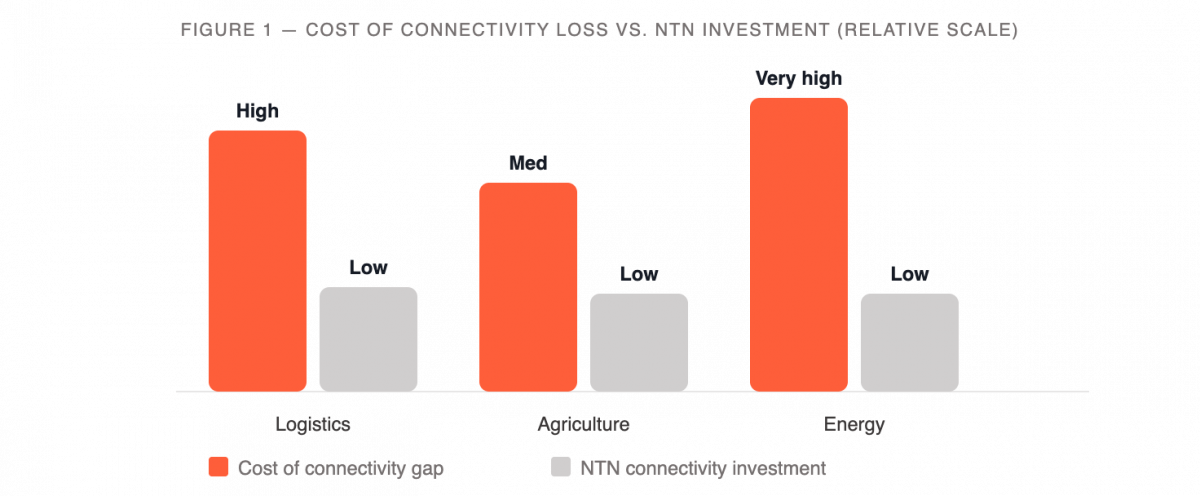
But the module is only one part of the cost picture. Figure 1 shows the relationship between operational cost of connectivity gaps and the NTN investment required across three industries. The pattern is consistent: the industries with the highest cost of being offline are also the ones where the NTN premium looks smallest relative to what it protects against.
Beyond the module, four additional cost factors belong in every NTN business case.
Connectivity plan cost. A hybrid architecture — terrestrial-first with NTN fallback — means you pay terrestrial rates when the device is in coverage, and satellite rates only when it isn’t. For a fleet truck that spends 80% of its time in urban or suburban corridors, the satellite component of the bill may be modest. For a sensor permanently installed in a remote basin, the satellite rate applies to every transmission. Know your coverage split before modeling connectivity cost.
Power budget redesign. NTN-capable chipsets require an onboard GNSS (Global Navigation Satellite System) receiver for Doppler pre-compensation. That’s an additional continuous power draw that doesn’t exist in terrestrial designs. Devices running years on a small battery over terrestrial NB-IoT will need their power model reworked. This is engineering time, not a line item, but it’s real cost.
Protocol tuning. Firmware configured for terrestrial latency will behave incorrectly on NTN. MQTT keep-alive intervals, TCP timeout parameters, and retransmission logic all need review and adjustment. For teams without in-house firmware experience, this may require external support.
Hardware generation timing. NTN requires modem support at the hardware level. Existing deployed devices cannot be software-upgraded. If you have a fleet in the field, NTN is a next-generation hardware decision, not a retrofit. Factor in the depreciation timeline of your current hardware when modeling payback period.
What connectivity gaps actually cost
This is the side of the equation that most business cases undervalue, because the costs are distributed across departments and don’t appear on a single line item.
For logistics and cold chain operators, a four-hour connectivity gap on a temperature-sensitive shipment is a potential cargo claim. The average refrigerated cargo claim in US trucking runs into thousands of dollars per incident, before legal costs. A single avoided claim on a high-value pharmaceutical shipment can exceed the NTN premium on an entire device fleet.
For energy infrastructure operators, a connectivity gap on a pipeline pressure monitor is a window during which a developing fault goes undetected. The cost of a missed anomaly — regulatory penalty, environmental remediation, emergency response — is orders of magnitude larger than the cost of continuous monitoring.
For agricultural operations, the cost is subtler but compounds across seasons. Irrigation decisions made on stale sensor data waste water and reduce yield. Livestock that wander beyond coverage boundaries and aren’t located promptly create replacement costs. These are not dramatic line items, but across a large operation they add up to meaningful numbers.
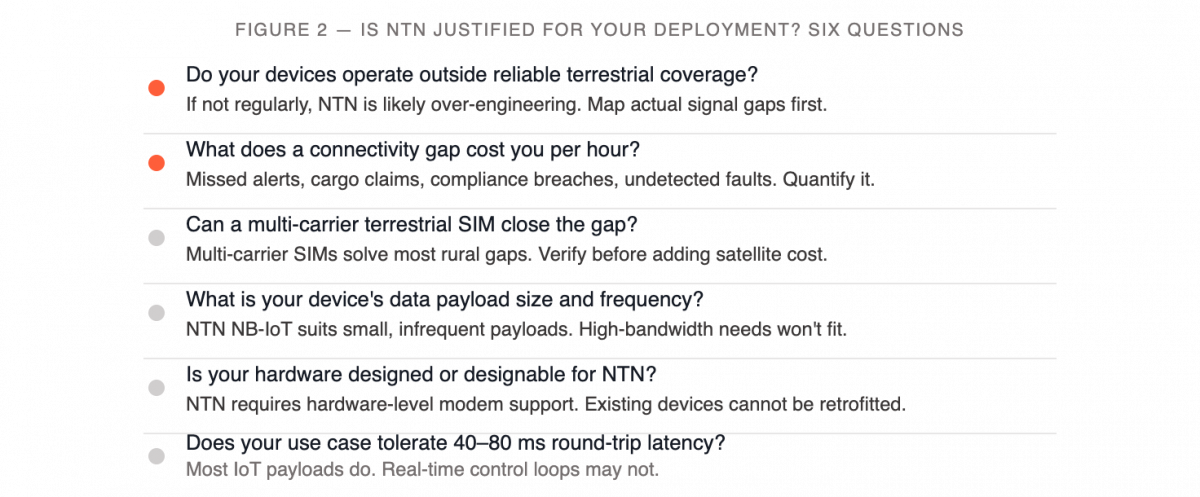
The question to answer before building the business case is: what does one connectivity gap event actually cost your operation, fully loaded? Once you have that number, the NTN premium calculation becomes straightforward. Figure 2 gives you the six questions that determine whether the case holds.
How to evaluate whether NTN is right for your deployment
The checklist in Figure 2 is designed to be used honestly. Two of the six questions are genuine filters that may lead you away from NTN: if a multi-carrier terrestrial SIM closes your coverage gaps, it’s the right answer — simpler, cheaper, no hardware change required. If your use case requires real-time control with latency under 20 ms, NTN as it stands today won’t meet that requirement.
For deployments that clear the filters, the business case typically rests on one of three value drivers.
Compliance and liability protection. In sectors with mandatory continuous monitoring requirements — pharmaceutical cold chain, pipeline integrity, hazardous materials transport — the value of NTN is not primarily operational efficiency. It’s the ability to produce an uninterrupted audit trail. Gaps in that record create liability exposure that no amount of operational cost savings offsets. If your industry has continuous monitoring requirements, NTN pays for itself in risk reduction before you count any operational savings.
Avoided exception costs. Calculate the frequency and cost of connectivity-related exceptions in your current operation: cargo claims, missed maintenance windows, unplanned truck rolls to investigate silent devices, manual data reconciliation. These costs are often absorbed by operations teams and never attributed to connectivity. Surface them, and the NTN investment often looks conservative by comparison.
Asset visibility at scale. For operators running large distributed fleets or sensor networks, the value of complete visibility is difficult to quantify but easy to observe in reverse. What decisions are you currently making without data because some portion of your fleet is always offline? What would change if that portion went to zero?
Total cost of ownership: the honest comparison
Figure 3 puts the cost structures side by side across a three-year device lifecycle — the timeframe over which most IoT hardware investments are evaluated.
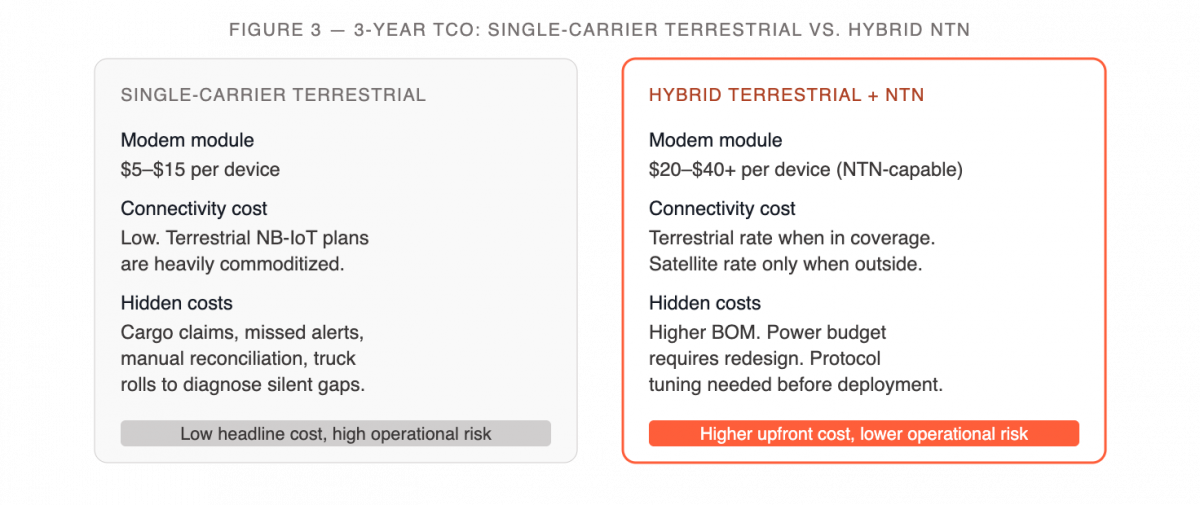
The single-carrier terrestrial option wins on headline cost at every line item. The hybrid NTN option wins on operational risk — which, for operations where connectivity gaps carry real consequences, is the metric that matters. The crossover point depends entirely on your gap frequency and your gap cost. For operations that rarely leave terrestrial coverage and face low consequences when they do, single-carrier terrestrial is the right answer. For operations where assets regularly move beyond coverage and gaps carry financial, compliance, or safety consequences, the hybrid case is usually clear.
One honest limitation worth stating: NTN connectivity pricing is still early-market. Satellite data rates for IoT are not yet commoditized the way terrestrial rates are, and they vary meaningfully between providers. Get specific pricing from your provider for your actual payload size and transmission frequency before finalizing your model. Round-number estimates at this stage of the market can be off by a factor of two or more.
Questions to ask any NTN provider
Put these to every provider you evaluate, including Simplex.
What satellite operators are you working with, and what is their coverage SLA for my specific geography? LEO coverage is orbital, not static. Get a documented coverage commitment for the regions where your devices will operate, not a general global coverage claim.
Is your NTN connectivity on the same SIM and management platform as your terrestrial connectivity? Separate SIMs and separate portals for terrestrial and satellite create operational complexity at scale. Ask specifically how fleet management, usage monitoring, and billing work when a device switches between terrestrial and satellite.
What is the per-device data rate for NTN NB-IoT transmissions, and what is the pricing model? Per-message, per-KB, and per-device-per-month pricing models produce very different bills depending on your payload size and frequency. Run your actual transmission profile through their pricing model before comparing.
What protocol configuration changes does your platform recommend for NTN latency? A provider who can’t answer this in specific technical terms hasn’t deployed NTN in production.
What happens when my device is in terrestrial coverage — does it automatically prefer terrestrial, and how is billing handled for mixed sessions? Hybrid architecture only works cleanly if the network selection and billing are handled correctly at the platform level.
5G NTN IoT is not a solution looking for a problem. It’s a connectivity layer for a specific set of deployments where the cost of being offline exceeds the cost of satellite connectivity — and where terrestrial infrastructure was never going to close the gap. For those deployments, the business case is straightforward once you account for the full cost of the status quo.
If you’re working through the numbers for a specific deployment, talk to our team — we’ll help you model the coverage split, transmission profile, and total cost before you commit. Or explore Simplex’s IoT connectivity plans to see how terrestrial and NTN pricing work together.
This article was curated by Jan Lattunen, CCO Simplex Wireless
About the Author: Jan Lattunen manages Sales and Marketing for Simplex Wireless. Jan has 20 years’ experience in working with SIM card technology and was involved in launching the eSIM in North America with major carriers and OEMs. His expertise in telecommunications is around SIM cards. On a personal note, Jan is a family man and avid cyclist with advocacy for safety in the roads. You can connect with Jan on https://linkedin.com/in/JanLattunen