







The Business Case for 5G NTN IoT
September 2, 2026
How to Choose a Natural Language Interface for IoT Network Data: A Buyer’s Guide
September 8, 2026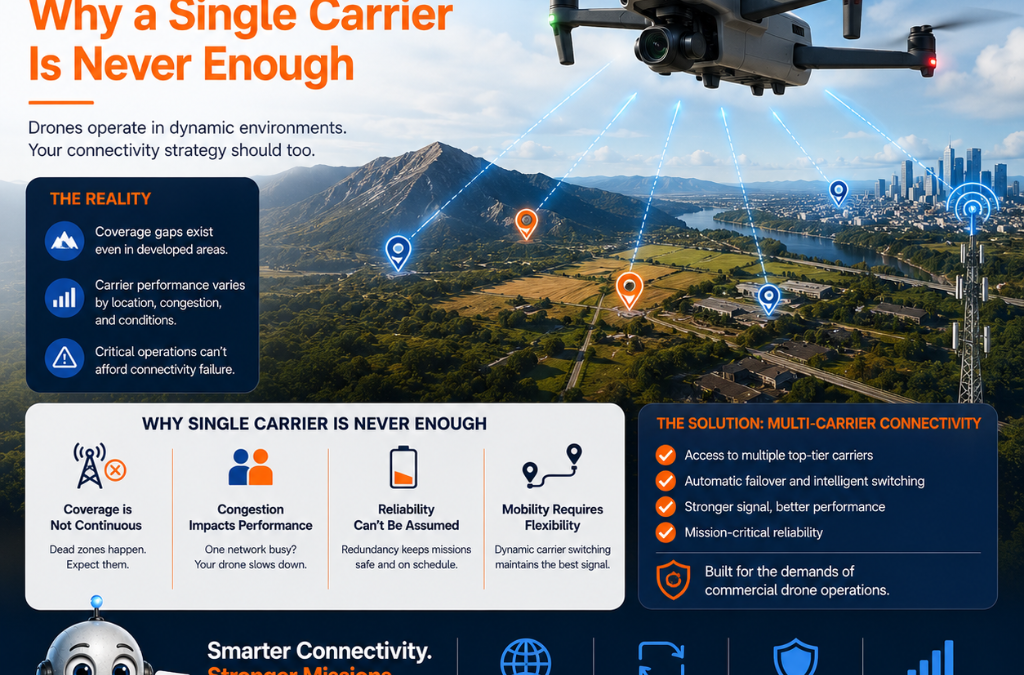
Commercial Drones and Cellular Connectivity: Why a Single Carrier Is Never Enough
As drone operations move beyond visual line of sight, the SIM card choice stops being a detail and starts being a safety decision.
Commercial drone deployments have changed significantly over the past several years. What started as close-range visual inspection work has expanded into infrastructure monitoring across remote transmission lines, precision agriculture across hundreds of acres, package delivery in urban corridors, and emergency response operations where the drone is the first asset on scene. The common thread across all of these use cases is the same: the drone is no longer something you watch fly. It’s a remote platform that has to stay connected reliably, continuously, and often far beyond where you can see it.
That shift changes the connectivity requirement entirely.
The connectivity challenge for commercial drone operators
A drone operating within visual line of sight can use direct radio links for command and control — the pilot watches the aircraft and maintains the link through dedicated RF hardware. Beyond visual line of sight (BVLOS) is a different problem. The aircraft can be kilometers away, over terrain that breaks radio contact, or operating autonomously on a pre-planned route where the pilot needs real-time telemetry but isn’t actively flying the aircraft. Cellular connectivity is what fills that gap.
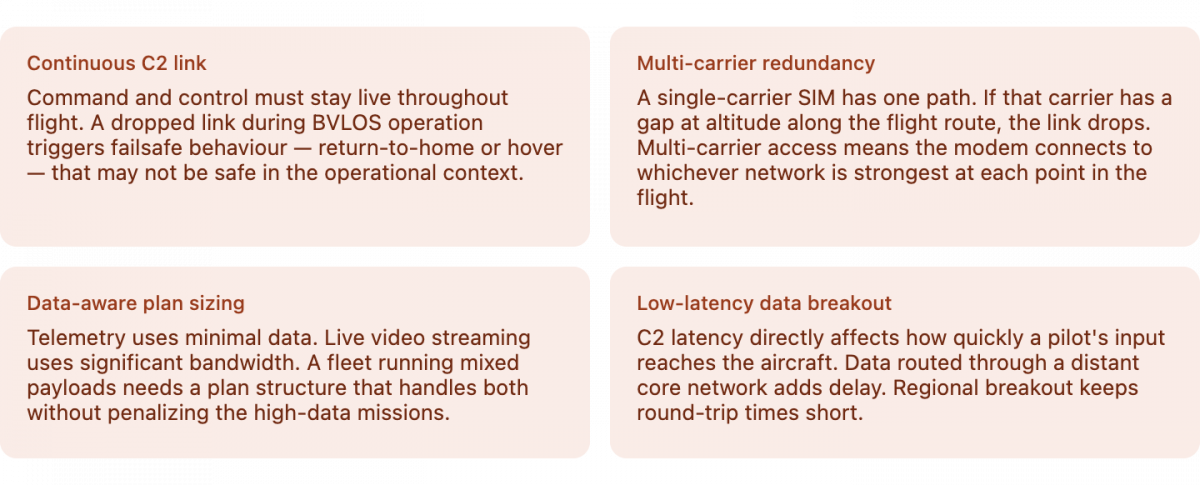
Drone cellular links carry several distinct data streams simultaneously. Command and control (C2) traffic is the critical link — the instructions the ground station sends to the aircraft and the telemetry the aircraft sends back. Lose this link and the drone enters a failsafe mode that may not be appropriate for the operational context. Alongside C2, many platforms transmit live video or still imagery, GPS position and flight data, and payload sensor readings. These streams have different bandwidth requirements and different tolerance for interruption.
The challenge is that cellular networks were not designed for aerial platforms. Tower antennas are directional, optimized to radiate signal toward the ground where devices are. At altitude, a drone may be within range of many towers simultaneously, creating interference from overlapping signals and making network handoffs less predictable than they are at ground level. Coverage that looks adequate on a map may behave differently in practice when the device is 50 meters in the air and travelling at speed.
Figure 1 — 2×2 card grid: four connectivity requirements unique to drone operations
Why consumer SIM cards fail in drone deployments
The fastest way to understand why standard SIM cards are the wrong tool for drone connectivity is to think about what a consumer SIM is optimized for. It’s designed for a single device, on a single carrier, at ground level, used by a human who can switch to Wi-Fi or wait for signal to improve. None of those assumptions hold for a commercial drone.
A single-carrier SIM connects to one network. If that network has inconsistent coverage along the flight route — particularly at the altitudes where drones operate, where antenna patterns behave differently than they do at ground level — the link degrades or drops without any fallback. The aircraft can’t switch carriers mid-flight because the SIM isn’t capable of it. Consumer prepaid SIMs compound this problem with data caps that cut service when the allocation is exhausted, which is a billing inconvenience on a phone and a safety issue on an aircraft.
Understanding how multi-carrier connectivity works at the network level is essential for anyone specifying drone connectivity. Direct bilateral roaming agreements — where the SIM provider holds agreements with each carrier individually — deliver more reliable network handoffs and better signal continuity than aggregated access through an intermediary. For a drone that may pass through the coverage zones of multiple towers during a single flight, how those transitions are managed matters.
There’s also a latency dimension. Consumer SIM traffic is typically routed through a carrier’s central core network, which may be geographically distant from the deployment site. For a pilot sending a control input and waiting for the aircraft to respond, that added round-trip time is felt. IoT-grade data breakout at regional points of presence — in the US, Europe, or APAC depending on where the fleet operates — keeps latency predictable and low.
What the right connectivity looks like for drone fleets
Three characteristics distinguish IoT connectivity that works for commercial drone operations from connectivity that doesn’t.
Multi-carrier access within each country is the most important. In the US, that means AT&T, T-Mobile, and Verizon on a single SIM, with the modem connecting to whichever carrier provides the strongest signal at any given moment in the flight. No manual selection, no single point of failure. The same principle applies globally — a drone fleet operating across multiple countries needs a SIM that doesn’t require per-country configuration or separate contracts for each market.
Right-sized data plans matter because drone payloads vary significantly. A telemetry-only mission transmits modest amounts of data — position, flight parameters, sensor readings at regular intervals. A mission streaming live HD video to a ground station or cloud platform transmits orders of magnitude more. A fleet running both types of mission needs either a pooled plan that absorbs the variability across the fleet, or a PAYG structure where each SIM is billed for actual consumption rather than a fixed allocation sized for the worst case.
Fleet management capability is the third requirement. A drone operator managing 20 or 200 aircraft needs to see per-SIM connectivity status, data consumption, and network registration in real time — not through a carrier support call, but through a management portal or API. Usage alerts that trigger when a SIM approaches its allocation limit, and the ability to adjust plan tiers without swapping hardware, are operational requirements rather than nice-to-haves.
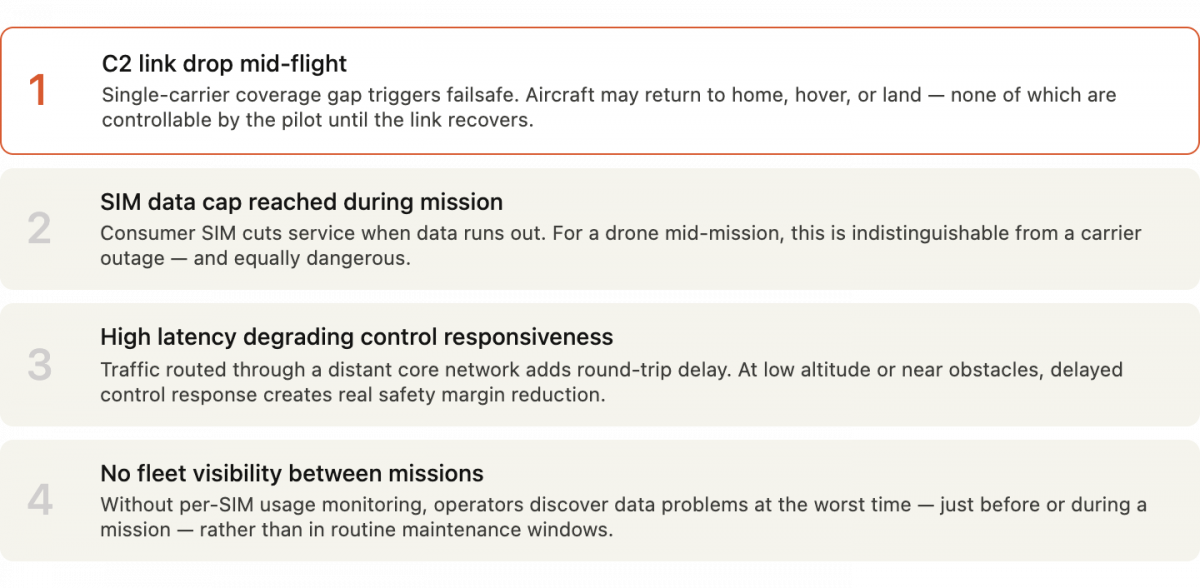
Figure 2 — Ranked list: connectivity failure modes by operational risk
How Simplex fits the drone connectivity stack
Simplex IoT SIM cards provide multi-carrier access on a single SIM — AT&T, T-Mobile, and Verizon in the US; Rogers, Bell, and TELUS in Canada; and Tier 1 networks across Europe and APAC. For a drone flying a route that crosses coverage zones, the modem connects to whichever carrier is strongest at each point without the operator needing to configure or manage anything. There’s no single carrier dependency and no manual network selection.
Data breakout is available regionally — in the US, Europe, and APAC — keeping latency predictable for real-time C2 applications. For drone operators where round-trip control latency matters, this is a meaningful operational advantage over connectivity that routes all traffic through a geographically distant core.
Plan structures cover the full range of drone operational profiles. The 100MB postpaid bundle at $0.99 per month handles telemetry-focused missions where data consumption is modest and predictable. PAYG plans suit missions with variable payloads, where some flights are telemetry-only and others stream imagery. Pooled bundles work for larger fleets where heavy-data missions in one part of the fleet are balanced by low-data missions elsewhere. No activation fees, no minimum commitments beyond 10 SIMs for postpaid plans.
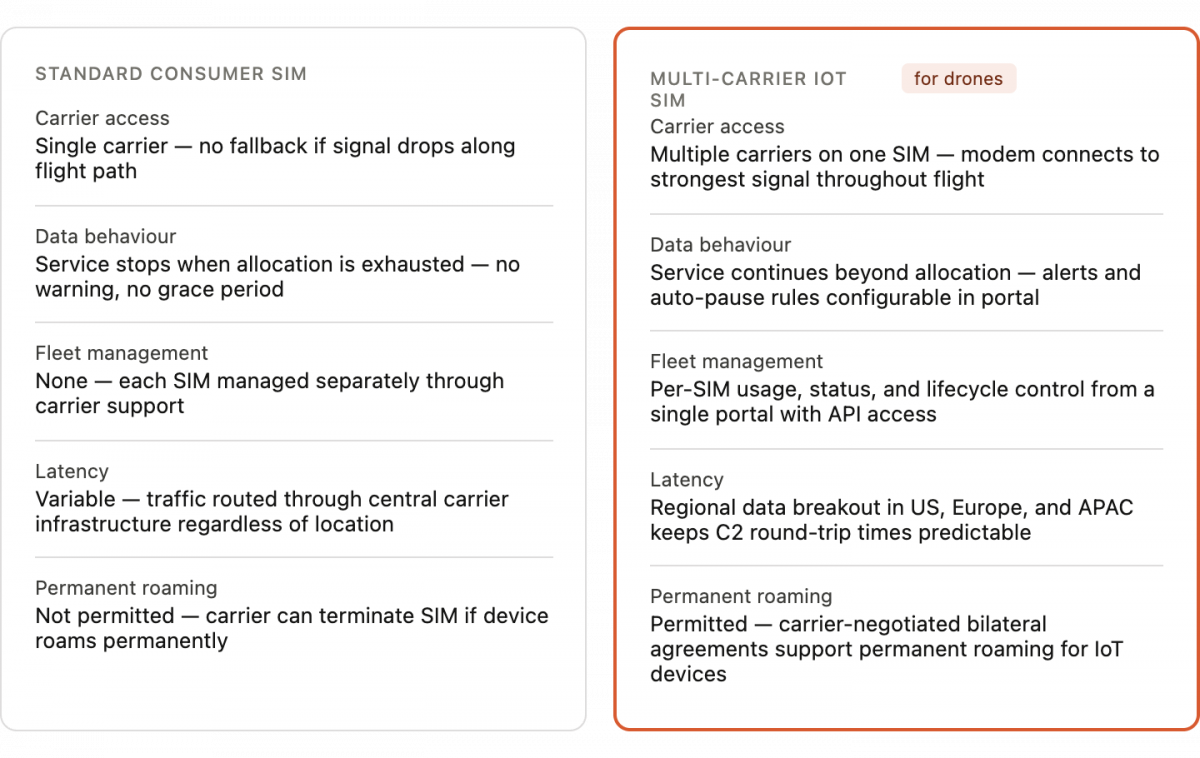
Figure 3 — Side-by-side comparison: standard SIM vs. multi-carrier IoT SIM for drone fleets
Cellular connectivity for commercial drones isn’t a feature — it’s infrastructure. The SIM decisions made during platform specification directly affect what operations are possible, how safely they can be conducted, and how the fleet scales as the operation grows. Choosing a connectivity model built for IoT deployments rather than adapted from consumer hardware is the difference between a link that holds and one that doesn’t. Explore Simplex’s drone connectivity options or get your IoT SIM to get started.
This article was curated by Jan Lattunen, CCO Simplex Wireless
About the Author: Jan Lattunen manages Sales and Marketing for Simplex Wireless. Jan has 20 years’ experience in working with SIM card technology and was involved in launching the eSIM in North America with major carriers and OEMs. His expertise in telecommunications is around SIM cards. On a personal note, Jan is a family man and avid cyclist with advocacy for safety in the roads. You can connect with Jan on https://linkedin.com/in/JanLattunen