







Cellular vs Wi-Fi for EV Chargers: Which Wins?
September 11, 2026
eIM and Multi-IMSI: Can You Run Both Strategies at Once?
One switches carriers at the network layer, the other swaps the whole SIM profile — knowing which does what changes how you build your fleet.
A fleet manager evaluating SGP.32 for the first time usually already has some multi-IMSI SIMs deployed somewhere in the field. So the question isn’t abstract: it’s “do I rip these out, or do the two systems play together?” The honest answer is that they solve different problems, sit at different layers, and in most fleets, the right answer is neither “replace” nor “combine” — it’s knowing which one you actually need for which device.
What each one actually does
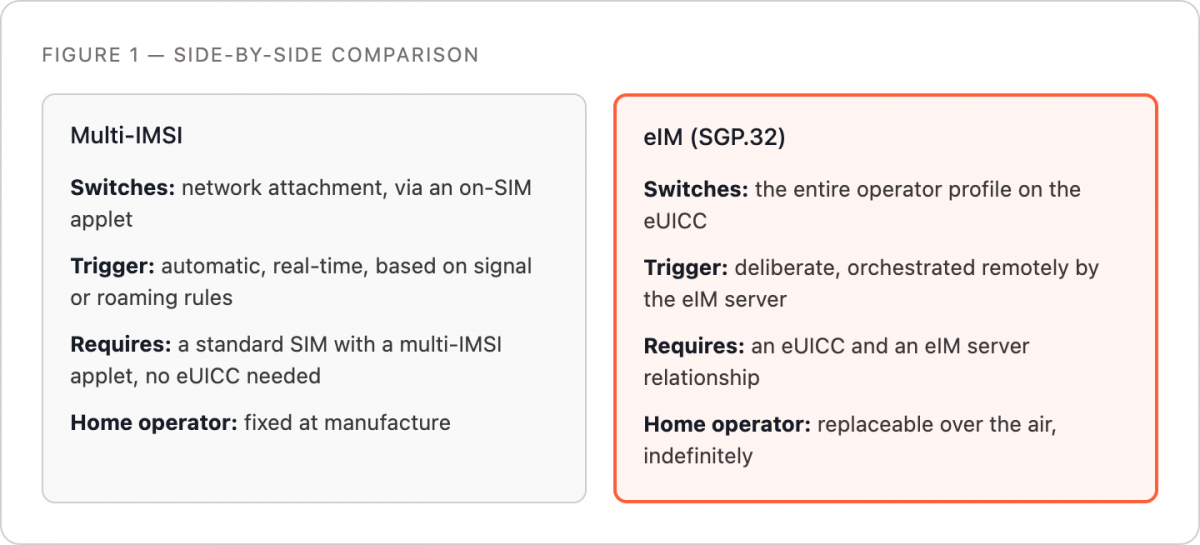
A multi-IMSI SIM stores several subscriber identities (IMSIs) on a single physical card and switches between them using an on-SIM applet. The switch happens automatically, in the background, based on signal strength or a pre-configured roaming priority list. It’s fast and doesn’t require any external server involvement once the card ships. What it can’t do is add a brand-new operator relationship after deployment — the set of IMSIs on the card is fixed at manufacture.
An eIM, the eSIM IoT Manager introduced in the GSMA’s SGP.32 specification, works at a different layer entirely. Instead of choosing among a pre-loaded set of identities, it orchestrates full profile downloads and swaps on an eUICC, the embedded SIM chip that receives and stores those operator profiles. See Figure 1 above for how the two compare mechanically. The eIM doesn’t live on the device — it’s server-side infrastructure that a fleet operator, or their connectivity provider, controls remotely, deciding when a device gets a new profile and from which operator.
The practical distinction: multi-IMSI is a SIM doing its own job quietly, choosing among options it already has. An eIM is a person, or a policy engine, making a deliberate decision to give a device an option it didn’t previously have.
Why eIM changes the calculus
Multi-IMSI has been the default answer to “what if my primary carrier goes down in this region” for years, and it still works for that narrow case. What it was never built for is renegotiating your entire connectivity contract, or onboarding a carrier that wasn’t on the card when it shipped. If a better rate becomes available in a market eighteen months into a deployment, a multi-IMSI fleet has no path to it without a physical SIM swap.
SGP.32 addresses this with two download models: direct download, where the client on the device or SIM talks straight to the profile source, and indirect download, which routes through the eIM as a central orchestrator. That indirect path is what makes eIM fundamentally different from multi-IMSI’s fixed menu — it can hand a device a profile from an operator that didn’t exist as an option on day one. For the mechanics of what actually happens during that download and activation sequence, the provisioning process itself is worth understanding before you plan around it.
Where the two actually meet in a real fleet
For most operators, this isn’t an either-or decision at the fleet level — it’s a segmentation question. Devices with tight power budgets, no eUICC, and a narrow, well-understood roaming footprint are often well served by multi-IMSI exactly as they are today. Devices with a longer service life, unpredictable regulatory exposure, or a real chance of needing a new carrier relationship down the line are the ones where an eUICC and an eIM relationship earn their keep. If you haven’t yet worked through how to choose a SIM and cellular strategy at the fleet level, that’s the right starting point before segmenting individual devices.
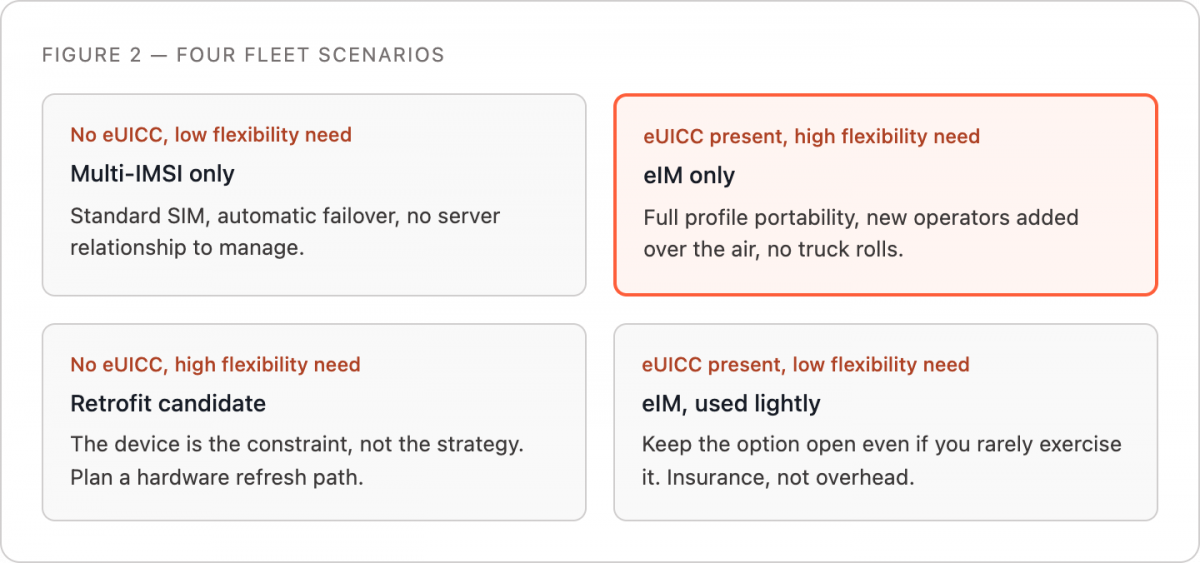
The scenario grid above (Figure 2) maps this out by two variables that matter most: whether the device carries an eUICC, and whether the fleet needs long-term carrier flexibility. Most active fleets sit across more than one of these quadrants at once, which is exactly why the two systems coexist at the portfolio level even when they never touch the same device.
Where it goes wrong
The failure mode isn’t usually technical incompatibility — it’s ownership confusion. Multi-IMSI’s applet and an eIM’s profile orchestration operate on genuinely different objects, so there’s no direct protocol collision to worry about on a properly specified eUICC. The real risk shows up in process, not silicon:
Assuming eUICC support where there isn’t any. Some fleets have devices with a multi-IMSI SIM and assume that’s “basically the same as eSIM.” It isn’t. If the hardware doesn’t carry an eUICC, there’s no eIM path available at all without a physical SIM change.
Treating multi-IMSI as a substitute for carrier renegotiation. Automatic network failover solves an outage, not a contract problem. Fleets that rely on multi-IMSI as their long-term flexibility plan tend to discover the ceiling only when they actually need a new operator relationship, usually at the worst possible time.
Losing track of which devices are which. Mixed fleets — some multi-IMSI, some eUICC-and-eIM — need a clear inventory of which strategy applies to which device population. This kind of operational discipline is exactly what teams building an in-house eIM at carrier-grade reliability had to solve for themselves before offering it to customers. Without that discipline on your side too, provisioning decisions get made against the wrong assumption.
Figure 3 above walks through the order these questions should actually get resolved for any device before a provisioning decision is made.
The bottom line
Multi-IMSI and eIM aren’t competing standards, they’re tools for different jobs, and most active fleets will run both across their portfolio simultaneously without either one interfering with the other. The mistake worth avoiding is picking one as a blanket policy for every device instead of classifying by eUICC capability and flexibility need first. Simplex’s xoSIM platform supports both IPAe and IPAd, so the classification work above doesn’t force a second vendor relationship once you’ve sorted your fleet.
This article was curated by Jan Lattunen, CCO Simplex Wireless
About the Author: Jan Lattunen manages Sales and Marketing for Simplex Wireless. Jan has 20 years’ experience in working with SIM card technology and was involved in launching the eSIM in North America with major carriers and OEMs. His expertise in telecommunications is around SIM cards. On a personal note, Jan is a family man and avid cyclist with advocacy for safety in the roads. You can connect with Jan on https://linkedin.com/in/JanLattunen