







eIM and Multi-IMSI: Can You Run Both Strategies at Once?
September 14, 2026
Why Multi-Network SIMs Don’t Guarantee EV Uptime
After reading this, you’ll know why “multi-network” on a spec sheet isn’t the same guarantee it sounds like, and what to check before you trust a SIM with your charging network’s uptime.
A charger goes dark. The dashboard shows a healthy signal bar right up until the moment it disconnects, and three other stations at the same site drop within the same minute. The SIM was sold as multi-network. It still went down with everything else on site. That gap between what “multi-network” promises and what it actually protects against is worth understanding before it costs you a truck roll, or worse, a failed charging session a driver blames on your hardware.
What “multi-network” actually means on a SIM
A multi-network SIM roams across more than one mobile network operator instead of locking a device to a single carrier. In practice, that means the SIM can pick up signal from whichever tower has the strongest reach at a given site, which solves a real problem: coverage gaps that would otherwise leave a charger unreachable. For EV charging stations spread across highway corridors, parking structures, and retail lots, that flexibility is genuinely valuable.
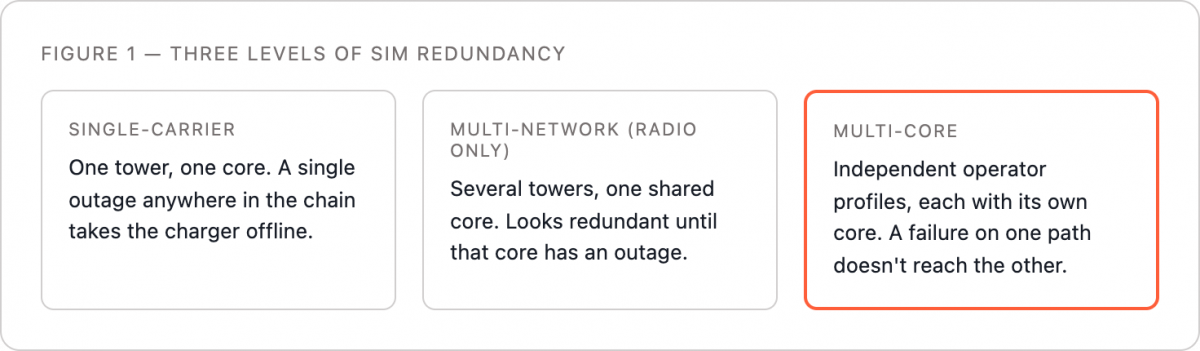
The word to watch is “roams.” Roaming describes radio access, which network tower the device talks to. It says nothing about what happens after that tower hands the connection off to the rest of the network.
The hidden single point of failure: shared core infrastructure
Here’s the part a spec sheet doesn’t show. Behind the radio layer, most multi-network SIMs still route every session through a single mobile core, the backend infrastructure that handles authentication, session management, and data routing regardless of which tower the charger connected to. If that core has a bad day, radio diversity doesn’t help. Every charger on that SIM provider’s network can go down at once, even though each individual charger appears to have a strong connection.
This is the distinction between radio diversity and core independence, and it’s the one that decides whether “multi-network” is a real redundancy strategy or a marketing term. Understanding why comes down to how the SIM’s underlying network relationship is structured. A SIM provider that resells access through one carrier partnership, however many networks that partnership lets a device roam across, still depends on that one partnership’s infrastructure holding up.
The four ways EV chargers actually go down
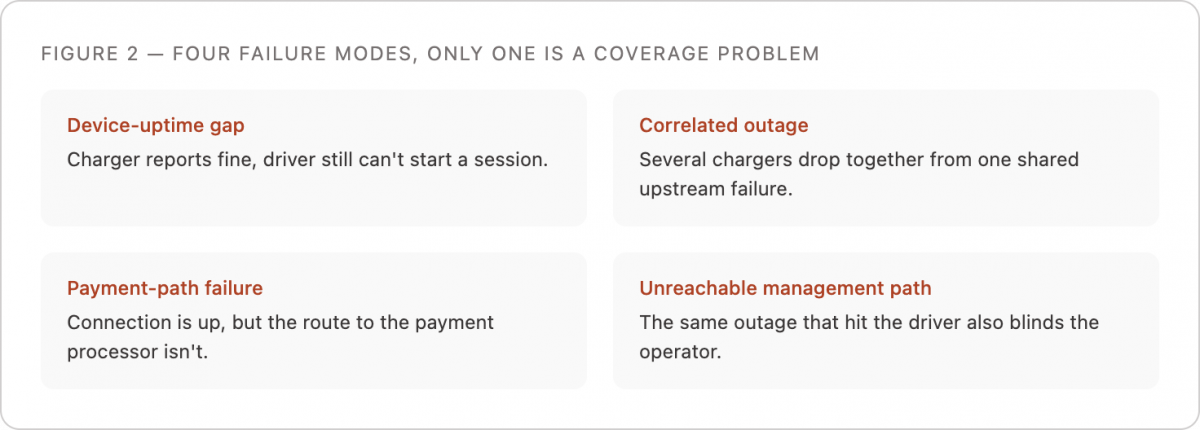
Not every outage looks the same, and lumping them together is how operators miss the pattern. Four distinct failure modes show up in charging networks, and only one of them is a coverage problem at all.
A device-uptime gap is when the charger reports itself as available to the backend, but a driver still can’t start a session, because the failure sits somewhere between the two, not in either system alone. A correlated site or estate-wide outage is when several chargers drop within the same window because they share one upstream dependency, not because each one failed independently. A payment-path or authorization failure is when the connection is technically up, but the specific route to a payment processor or authentication service is down. And an unreachable management path is when nobody can remotely diagnose or reboot the charger, because the same outage that broke the driver’s session also broke the operator’s visibility into it.
Only the first kind gets caught by a stronger radio signal. The other three are architecture problems, and they’re the ones that make “the SIM said it had coverage” a frustrating thing to hear from a vendor after a bad night.
What true redundancy requires
Real redundancy means the SIM carries independent operator profiles, each with its own core network, its own authentication path, and its own routing, not just multiple radio options sitting on top of one shared backend. If one profile’s core has an outage, the device fails over to a genuinely separate infrastructure path, not a different antenna pointed at the same failure.
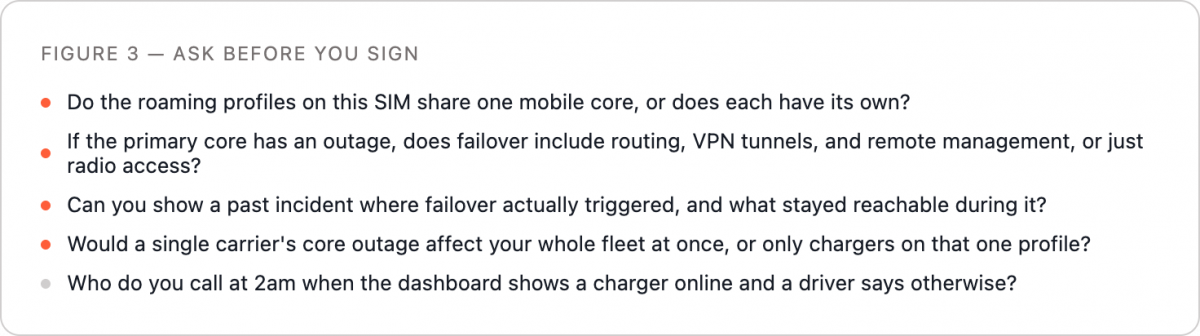
That distinction also determines what happens during a switch. A profile change that doesn’t correctly re-establish routing, VPN tunnels, and remote management access isn’t a completed failover, it’s a connection that looks recovered on paper while the operator still can’t reach it.
Evaluating a connectivity provider’s failover architecture
Before signing a multi-year contract on the promise of multi-network resilience, a short list of direct questions does more good than another line on a spec sheet.
If you’re comparing providers on exactly this question, our engineering team can walk through your site list and show you where carrier partnership structure actually matters for your fleet, and what a correlated outage would cost versus the truck roll a single bad SIM decision can trigger.
This article was curated by Jan Lattunen, CCO Simplex Wireless
About the Author: Jan Lattunen manages Sales and Marketing for Simplex Wireless. Jan has 20 years’ experience in working with SIM card technology and was involved in launching the eSIM in North America with major carriers and OEMs. His expertise in telecommunications is around SIM cards. On a personal note, Jan is a family man and avid cyclist with advocacy for safety in the roads. You can connect with Jan on https://linkedin.com/in/JanLattunen