







Best IoT Connectivity Management Platforms for Enterprises: Pick the One You Won’t Have to Replace
November 10, 2026
Retrofitting Installed Signage for eSIM: SGP.32 Without Replacing Hardware
How to bring eSIM remote management to media towers, kiosks, and displays that are already in the field, and what to check before you start.
Signage hardware is built to stay in place for years. The connectivity decisions made on install day have to stay with it, whether or not they still make sense.
Why long-lived signage installs outlast their SIM strategy
A media tower or kiosk can stay where it is long after the carrier contract, the pricing, and the coverage around it have changed. With a conventional SIM holding a single carrier profile, changing carriers means replacing SIMs in the field, one enclosure at a time.
Regional rules add to the problem. Simplex’s article on large-scale deployments notes that some countries restrict permanent roaming, and names Brazil, India, Turkey, and the UAE as examples. Its answer is a SIM that can switch to a local subscription over the air. If your displays could ever move into markets like these, the SIM inside them needs to be able to change.
SGP.32 and the eIM in plain terms
SGP.32 is the GSMA’s eSIM specification for IoT. It introduced the eSIM IoT Manager (eIM), a server that handles profile lifecycle operations for the embedded SIM chips (eUICCs) inside devices. Simplex’s explainer on the eIM lists the operations as push, enable, disable, and delete, and says they happen without user interaction or mediation by a mobile network operator (MNO). The eIM also sits between your fleet and the SM-DP+ servers, where operator profiles are stored.
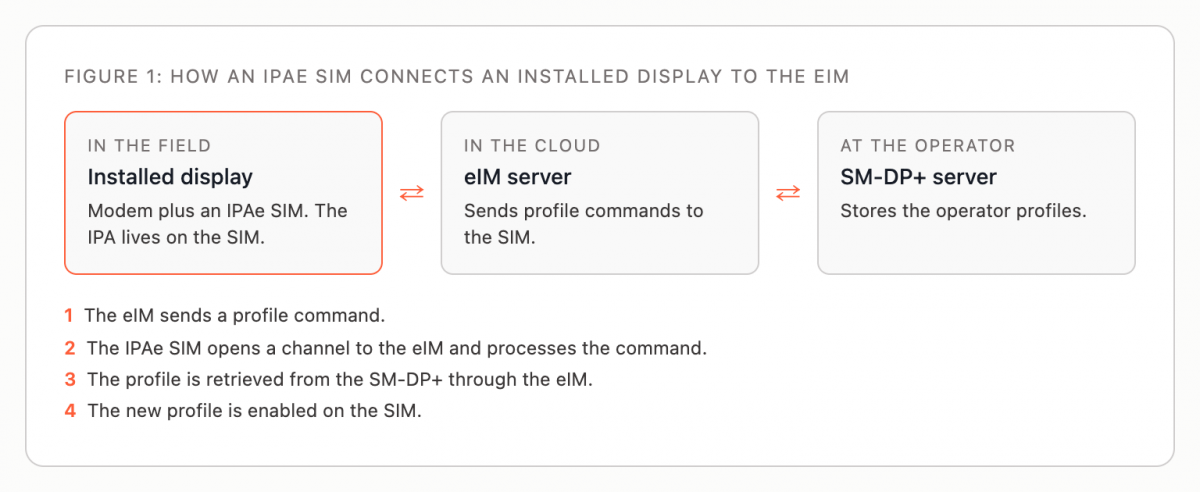
To act on those commands, the device needs an IoT Profile Assistant (IPA). It talks to the eIM and can live in one of two places. Either it’s in the device’s software (IPAd), or it’s built into the SIM itself (IPAe). That choice decides whether an older display can take part.
Where the IPAe SIM fits for older devices
IPAd is a device-side capability. Per Simplex’s comparison of IPAe and IPAd, adding it after deployment typically means a firmware or operating system change. IPAe is a SIM-side capability, so you carry it with you when you swap the card. If your existing hardware doesn’t have an IPA, a turnkey IPAe SIM lets you bring SGP.32 to deployed devices without a hardware refresh.
The same article names the one configuration change on the modem side: BIP and STK, two SIM-to-modem communication features, need to be active. Once they are, the IPAe SIM opens the channel, contacts the eIM, and processes profile commands on its own, without help from the host device.
Check one thing before you buy. Simplex warns against assuming any eUICC-based SIM includes IPAe. A SIM can comply with the older SGP.22 specification without carrying an IPAe client for SGP.32. Ask the vendor to confirm IPAe is present, and ask which eIM configurations they support. Figure 1 shows how the pieces connect in a retrofit.
Switching carriers or regions without touching the enclosure
Once the IPAe SIM is in place, a change of carrier becomes a software task. On Simplex’s eSIM management platform, you choose which carrier profile to download, enable, switch, or delete. The profile installs over the air onto the SIM, with no physical access needed. You can also update profiles or roll back remotely from one dashboard.
The same mechanism covers regional compliance. If a display moves into a market that restricts permanent roaming, a local subscription profile can replace the old one without a technician visit.
Two honest limits apply. First, a retrofit still needs one physical SIM swap per display to install the IPAe SIM. After that, changes are remote. Second, a new profile only helps if the new carrier actually reaches the enclosure, so test coverage on the device just as you would for any SIM.
Standalone eIM vs bundled connectivity
With a bundled setup, you buy the SIM, the connectivity, and the management from one provider. It’s simple, but your management platform and your carrier are tied together. With a standalone eIM, management is separate from connectivity, so you can change the carrier without changing the platform that manages it.
Simplex’s xoSIM approach is the standalone model. It’s independent of MNOs and SIM manufacturers. You can use Simplex connectivity in 191 countries or bring your existing connectivity, with providers such as Hologram or floLIVE named as examples. If you already have SIMs with IPAe support or devices with IPAd clients, they can be integrated into the Simplex eIM.
Whichever eIM you evaluate, ask what it supports. Simplex’s own platform handles IPAe, IPAd, direct and indirect downloads, and both JSON and ASN.1 bindings, and it has been tested for interoperability with eUICC manufacturers including Kigen, STMicroelectronics, and Valid. Ask any provider for the same list: which IPA variants, which bindings, and which manufacturers they’ve tested with.
A rollout plan for existing fleets
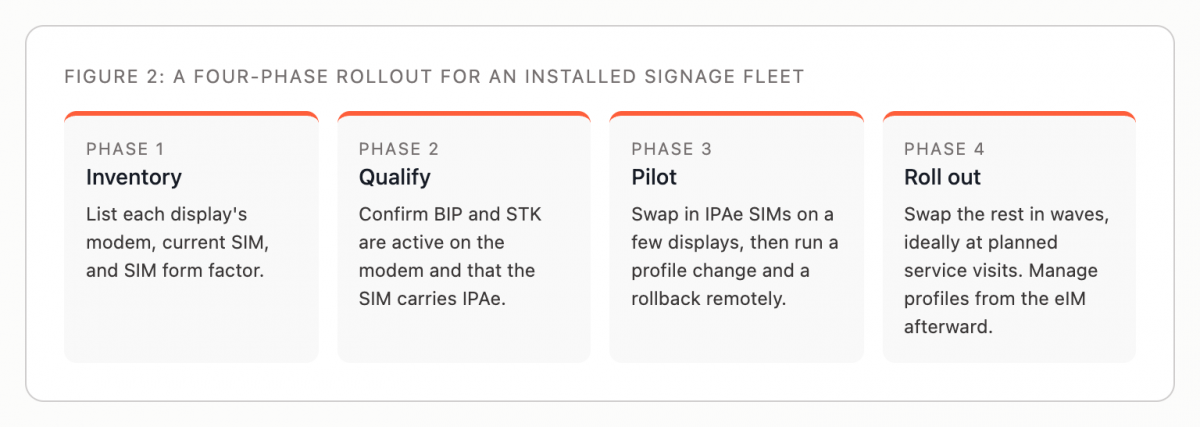
A fleet retrofit works best in small steps. Figure 2 lays out four phases. The order is my suggestion, built on the checks above.
Installed signage doesn’t have to stay tied to the connectivity choice made on install day. A one-time SIM swap per display buys you the ability to change carriers, regions, and plans from a console afterward. To see how that works on your own fleet, explore Simplex’s eSIM management or talk to our engineering team.
This article was curated by Jan Lattunen, CCO Simplex Wireless
About the Author: Jan Lattunen manages Sales and Marketing for Simplex Wireless. Jan has 20 years’ experience in working with SIM card technology and was involved in launching the eSIM in North America with major carriers and OEMs. His expertise in telecommunications is around SIM cards. On a personal note, Jan is a family man and avid cyclist with advocacy for safety in the roads. You can connect with Jan on https://linkedin.com/in/JanLattunen