







What Can You Actually Ask Your IoT Network? A Field Guide to Natural Language Queries
August 10, 2026
MFF2 vs 2FF/3FF/4FF vs eSIM: Choosing a SIM Form Factor
August 13, 2026
What Is 5G NTN IoT? A Simple Guide
The cellular coverage you’ve built your IoT deployment around covers about 20% of the Earth’s surface. This article explains what 5G NTN (Non-Terrestrial Network) IoT is, how it works, and what deploying it actually means in practice.
Your temperature sensors work. Your fleet trackers work. Your remote monitoring devices work — right up until the moment they leave the cellular footprint. Shipping containers crossing the Pacific, pipeline monitors in the Alaskan interior, agricultural sensors three counties from the nearest tower: for all of them, connectivity ends where the coverage map ends.
5G NTN IoT changes that equation. It extends the 5G standard into space, giving IoT devices a path to stay connected almost anywhere on Earth — not by replacing terrestrial cellular, but by sitting alongside it.
Here’s what you actually need to know.
What 5G NTN is — and how it works
NTN stands for Non-Terrestrial Network. It’s the 3GPP standards framework — published in Release 17, frozen in March 2022 — that defines how 5G protocols operate via satellite rather than via ground-based towers. The key word is standards. This isn’t a proprietary satellite system bolted onto IoT. It’s the same 5G protocol stack your existing cellular devices already use, extended to communicate with Low Earth Orbit (LEO) satellites instead of cell towers.
Figure 1 shows the path a data packet takes from an NTN-enabled IoT device to your backend.
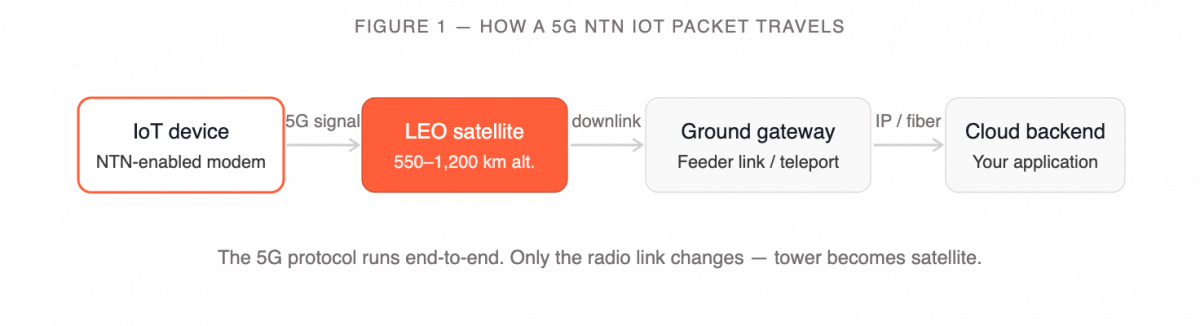
The device transmits a 5G signal upward to a satellite in Low Earth Orbit — typically orbiting between 550 and 1,200 kilometers altitude. That satellite relays the signal down to a ground gateway (also called a feeder link or teleport), which connects to the public internet or a private backbone. From there, the data reaches your application just as it would from any cellular connection.
The device’s role is familiar: it needs an NTN-capable modem chipset. The satellite’s role is to behave, from the network’s perspective, like a very high-altitude cell tower. The 5G core network treats it as such.
One critical technical distinction: 5G NTN IoT deployments use the IoT-class radio technologies defined in 3GPP Release 17 — specifically NB-IoT (Narrowband IoT) and LTE-M (also called eMTC). These are low-data-rate, low-power protocols designed for sensors and trackers that send small packets infrequently. The goal of 5G NTN for IoT is not high throughput. It is reliable, low-power connectivity in locations where no tower exists. The satellite architecture used is transparent payload — sometimes called bent-pipe — meaning the satellite relays signals directly to a ground gateway rather than doing any processing in orbit.
How this differs from terrestrial cellular
The honest answer is: considerably in some ways, minimally in others. Figure 2 lays out the key differences side by side.
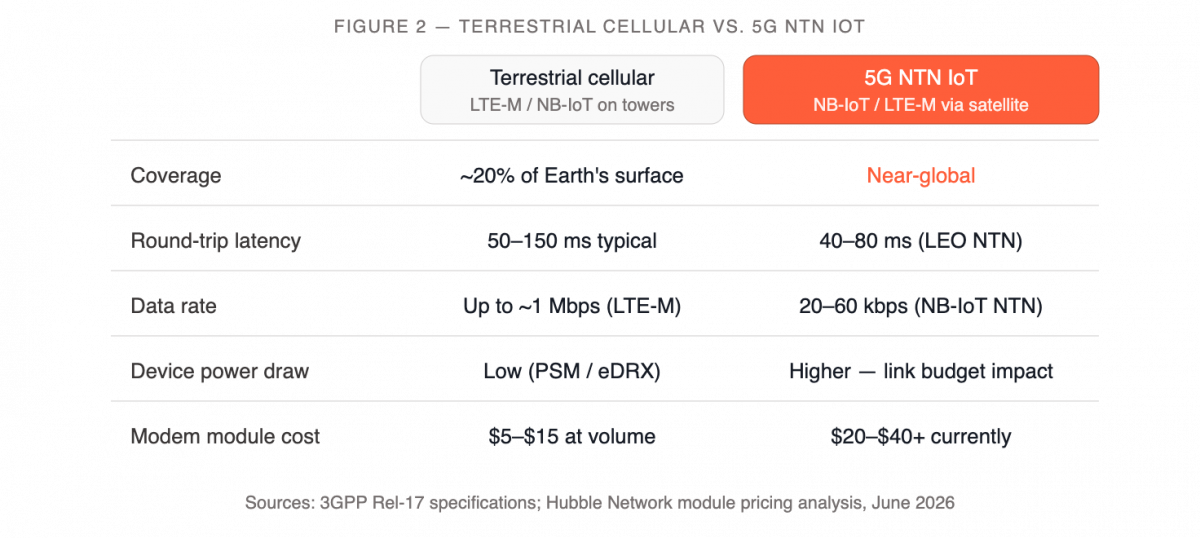
Coverage is where NTN wins outright. Terrestrial LTE-M and NB-IoT cover populated areas well. NTN covers the other 80%.
Latency is better than many people expect. LEO NTN round-trip times are in the range of 40–80 milliseconds — comparable to a congested terrestrial network. This is a meaningful improvement over GEO satellite systems, which introduce 600 ms or more. For most IoT payloads — sensor readings, location pings, status updates — LEO NTN latency is not a limiting factor. It becomes relevant for real-time control loops, where even 80 ms may be too long.
Data rate is adequate for IoT. NB-IoT NTN delivers 20–60 kbps in good conditions. For devices transmitting small sensor payloads every few minutes, that’s more than sufficient.
Power is the honest challenge. Communicating with a satellite requires more transmit power than communicating with a tower a few kilometers away. Free-space path loss is significantly higher at 550–1,200 km than at typical terrestrial distances. This affects battery life and thermal design. Devices running years on a small battery over terrestrial NB-IoT will need their power budget reworked for NTN. NTN-capable chipsets also require an onboard GNSS receiver for Doppler pre-compensation — another power draw that needs to be factored in at the hardware design stage.
Module cost is currently elevated because the market is early. Terrestrial NB-IoT modules have been commoditized to $5–$8 at modest volumes. NTN-capable modules — built on platforms like Qualcomm’s 212S or MediaTek’s MT6825 — run $20–$40+ as of 2026. That gap will close as chipset vendors scale production, but it’s a real BOM consideration today.
What this means in practice for IoT teams
The right question isn’t “should we use NTN?” It’s “which devices in our fleet are worth putting NTN on, and when?”
Most deployments will be hybrid. Devices operating in areas with terrestrial coverage run on LTE-M or NB-IoT as primary — cheaper, lower power, lower latency. NTN takes over when those devices move into uncovered areas, or serves as permanent primary connectivity for assets that are always remote. The multi-carrier SIM strategy already familiar from terrestrial deployments applies directly here: your SIM determines which networks — terrestrial and satellite — a device can access, subject to roaming agreements.
New hardware designs have the cleanest path. NTN support is being integrated into chipsets alongside terrestrial IoT radio support. If you’re designing a new product with a multi-year lifecycle, the decision is whether to include an NTN-capable chipset now. The incremental BOM cost is the trade-off against future connectivity flexibility.
Existing deployed devices cannot be software-upgraded to NTN — it requires hardware. For fleets already in the field, NTN is a consideration for the next hardware generation, not a retrofit.
SIM and connectivity management follows the same approach as terrestrial IoT. NTN-capable devices use a SIM to authenticate on the network, and that SIM can be managed remotely using eSIM and SGP.32 just as it would be on a terrestrial device. The connectivity stack above the radio layer doesn’t change. Simplex Wireless is building NTN connectivity into the same IoT SIM management platform customers already use for terrestrial SIMs — fleet visibility and plan management work the same way regardless of whether a given device is connecting via tower or satellite.
Protocol configuration needs deliberate attention. Even at 40–80 ms round-trip, NTN latency is higher than the terrestrial baseline most IoT firmware is tuned for. MQTT keep-alive intervals, TCP timeout parameters, and CoAP retransmission timers should all be reviewed and adjusted before deploying terrestrial-configured firmware onto NTN hardware.
Where 5G NTN IoT deployments go wrong
Figure 3 summarises the four most common deployment mistakes. Each one is fixable — but only if you see it coming.
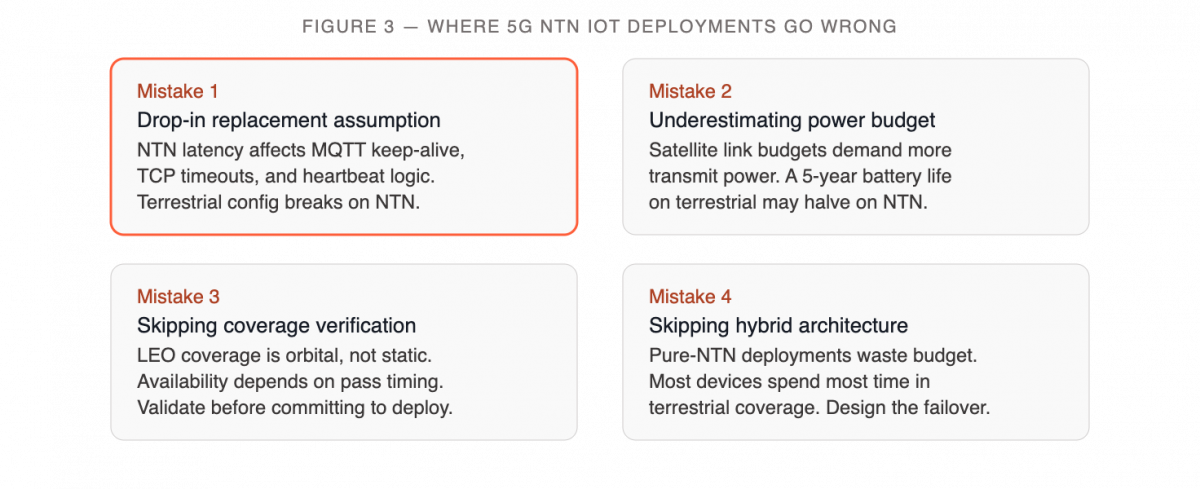
Treating NTN as a direct terrestrial replacement. Even at LEO latencies of 40–80 ms, the jump from typical terrestrial performance is enough to break application logic that wasn’t designed for it. Review every timer, keep-alive interval, and retransmission setting before deploying.
Underestimating power budget impact. A device that runs for five years on a small battery over terrestrial NB-IoT may only run for half that on NTN. The satellite link requires more transmit power. NTN chipsets also require a GNSS receiver running continuously to pre-compensate for Doppler shift — a power draw that doesn’t exist in terrestrial designs. Model this at the hardware design stage, not during field testing.
Ignoring the orbital nature of LEO coverage. Unlike a terrestrial tower that sits fixed in one location, LEO satellites are in constant motion. Coverage at a given location depends on when a satellite passes overhead. The major NTN operators publish coverage schedules and availability SLAs — read them, and verify against your specific deployment geography. The same principle that applies to terrestrial coverage maps applies here too: coverage maps don’t tell the full story. Test in the actual deployment environment.
Building pure-NTN instead of hybrid. Most assets spend most of their operating life within terrestrial coverage. A device that routes everything through satellite — when terrestrial is available, cheaper, and lower-power 90% of the time — is solving the wrong problem. The right architecture uses terrestrial connectivity by default and falls over to NTN when coverage ends. That failover requires deliberate firmware logic: checking for terrestrial signal first, switching to NTN only when needed, and switching back when terrestrial becomes available again.
5G NTN IoT is a real, deployable standard — not a roadmap item. 3GPP Release 17 is ratified. Chipsets are sampling and shipping. Constellations are live. The question for most IoT teams isn’t whether to engage with it, but when and for which use cases.
For Simplex Wireless customers, NTN connectivity is coming to the same IoT connectivity platform you’re already running — same SIM management, same portal, same pricing transparency. If you’re evaluating whether NTN fits a current or upcoming deployment, talk to our team.
This article was curated by Jan Lattunen, CCO Simplex Wireless
About the Author: Jan Lattunen manages Sales and Marketing for Simplex Wireless. Jan has 20 years’ experience in working with SIM card technology and was involved in launching the eSIM in North America with major carriers and OEMs. His expertise in telecommunications is around SIM cards. On a personal note, Jan is a family man and avid cyclist with advocacy for safety in the roads. You can connect with Jan on https://linkedin.com/in/JanLattunen