







The eIM Is the First Enterprise System eSIM Has Ever Had
August 17, 2026
What Your IoT SIM Dashboard Should Show You (And What to Do When It Doesn’t)
August 20, 2026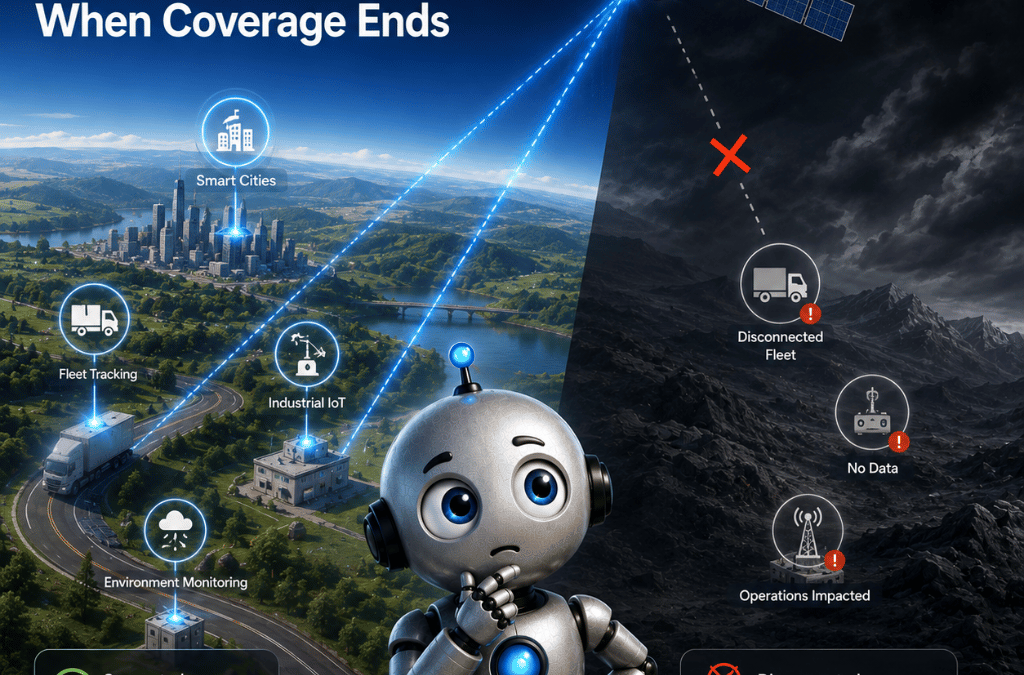
Why Traditional IoT Stops Working When Coverage Ends
Most IoT failures aren’t hardware failures. They’re coverage failures — and they happen without warning.
A GPS tracker shows a truck leaving a distribution center in Kansas City. Three hours later, it shows the truck arriving at a depot in Denver. What happened in the 400 miles in between? Nothing — at least, nothing your system recorded. The device was running. The sensors were sampling. But somewhere along I-70, the cellular signal dropped, and the data stream stopped. By the time coverage returned, the connection had long since timed out.
This is one of the most common — and least visible — failure modes in deployed IoT. Understanding why it happens, and what you can do about it, starts with understanding how cellular connectivity actually works for IoT devices.
How cellular IoT connectivity works — and where it breaks
A cellular IoT device connects to the network the same way a smartphone does: it powers on, its SIM (Subscriber Identity Module) authenticates with a carrier, and the device registers on the network. Once registered, it can send and receive data.
The difference is that IoT devices are designed for environments where cellular infrastructure is inconsistent. A smartphone user who loses signal notices immediately and usually moves somewhere with better coverage. A soil sensor bolted to a fence post in rural Nebraska has no such option.
When a cellular IoT device — running NB-IoT (Narrowband IoT), LTE-M, or standard LTE — moves beyond the footprint of its registered carrier, the sequence in Figure 1 plays out.
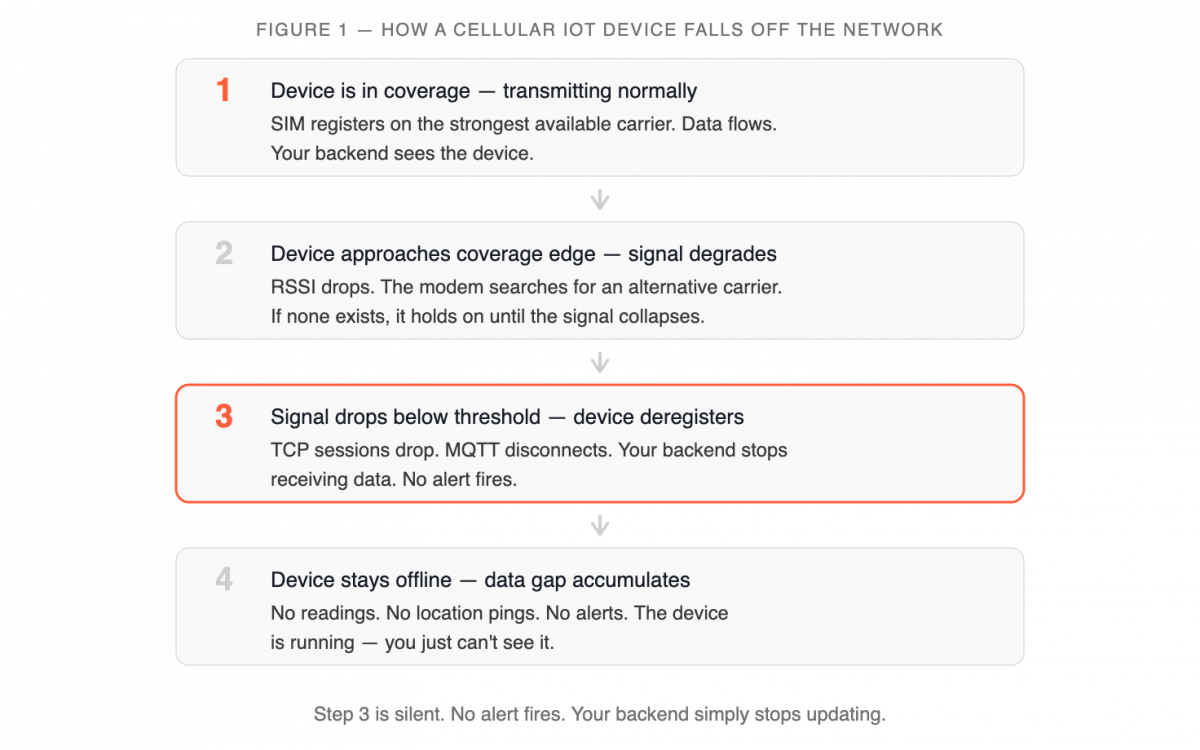
The critical moment is step 3. The modem deregisters silently. No alarm fires in your application. No error message appears. From your backend’s perspective, the device simply stops sending data. Whether that silence lasts two minutes or two days depends entirely on how long the device stays outside coverage — and whether your monitoring logic is configured to detect the absence of data, not just the presence of bad data.
Many deployments aren’t. Most alerting systems are built around threshold breaches — a temperature too high, a pressure reading too low. A device that stops reporting entirely slips through, because the value never changes: it just doesn’t arrive.
Why IoT makes this problem worse than it is for consumer devices
Consumer cellular devices are designed around the assumption that the user is mobile and will return to coverage. The network and the device both reflect this. When a smartphone loses signal, it enters a low-power search mode, periodically scanning for available carriers. When coverage returns, it re-registers and resumes operation, usually within seconds.
IoT devices face a different set of constraints. Many are battery-powered and designed to transmit infrequently — hourly, or even daily — using protocols like NB-IoT or LTE-M with Power Saving Mode (PSM) enabled. PSM allows the modem to power down almost completely between transmissions, extending battery life to years. The trade-off is that when the device wakes to transmit and finds no coverage, it may exhaust its search window, fail to register, and go back to sleep. The next transmission attempt might be an hour away. The gap in your data grows.
The other compounding factor is single-carrier SIM behavior. Many IoT deployments use SIM cards provisioned to a single carrier. When that carrier’s signal ends, the device has nowhere to go. Figure 2 shows the difference in outcome between a single-carrier SIM and a multi-carrier SIM when terrestrial coverage ends.
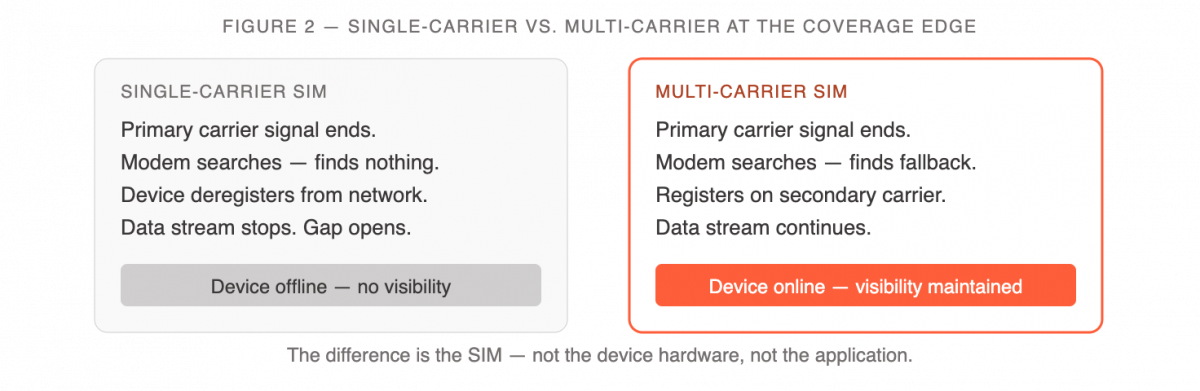
The device hardware is identical in both scenarios. The firmware is identical. The only difference is the SIM — and whether it carries agreements with more than one carrier in that geography.
This is why coverage maps routinely mislead. A map from Carrier A showing strong coverage in a region tells you nothing about what happens when your device drifts outside Carrier A’s footprint into an area covered only by Carrier B or C. For a single-carrier SIM, that difference is total: connected versus not connected.
Where the consequences show up
Coverage loss isn’t a theoretical problem. Figure 3 shows four industries where it translates directly into operational and financial cost.
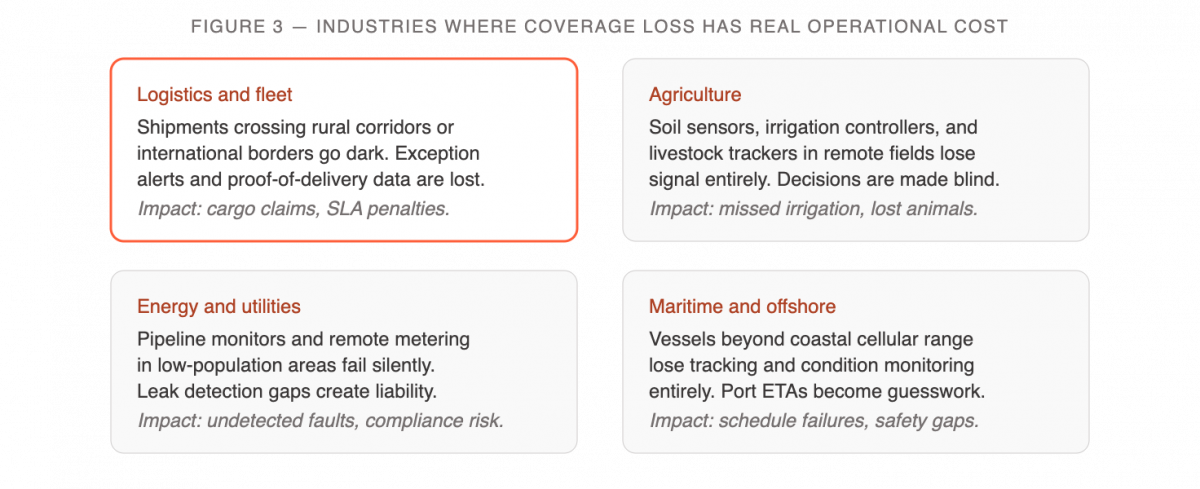
Each of these industries shares a structural reality: the assets that matter most are often in the places with the worst coverage. A fleet truck that never leaves a metro area is easy to track. The one that matters — the one carrying temperature-sensitive pharmaceutical cargo across a rural stretch — is the one most likely to go dark.
The pattern repeats across sectors. The pipeline segment most likely to develop a fault is in a remote basin with no cellular infrastructure nearby. The livestock tracker most likely to matter is on an animal that wandered to the edge of the property, beyond the coverage boundary. The container most likely to be needed in an exception workflow is the one that spent 12 hours in a dead zone.
This is the core problem: traditional terrestrial IoT connectivity is designed around where infrastructure already exists. Many of the things worth monitoring are in places where infrastructure doesn’t.
What to do about it
Three steps, in order of impact.
1. Audit where your devices actually lose signal — not where the map says they should.
Coverage maps are modeled predictions, not field measurements. Before deploying at scale, test devices on the routes and locations they’ll actually operate in. Log RSSI (Received Signal Strength Indicator) over time. Identify the gaps. This is the only way to know whether your coverage problem is solvable with a better SIM or whether it requires a different connectivity layer entirely — such as 5G NTN satellite connectivity for genuinely remote applications.
2. Switch to a multi-carrier SIM for any device that moves or operates outside major population centers.
A multi-carrier IoT SIM carries roaming agreements with multiple carriers and selects the strongest available signal automatically. In most rural coverage gaps, the problem isn’t that no carrier reaches the area — it’s that your SIM only talks to one of them. Switching to a multi-carrier SIM resolves this without any hardware or firmware change.
3. Build absence-of-data alerting into your monitoring logic.
Your application should treat silence as a signal, not a neutral state. If a device that normally reports every 15 minutes goes 45 minutes without a transmission, that should trigger an alert — even if the last reading was within normal range. Most IoT middleware platforms support heartbeat monitoring. If yours doesn’t, configure it at the application layer. A data gap is not a non-event. It’s information about where your coverage ends.
The coverage map will always look better than the field reality. Traditional cellular IoT connectivity is designed for the 20% of the Earth’s surface that terrestrial networks cover well. The other 80% — and the assets operating at the edges of the 20% — requires a deliberate connectivity strategy, not the assumption that one carrier’s footprint is enough.
If you’re seeing unexplained data gaps in your IoT deployment, explore Simplex’s multi-carrier IoT SIM plans — or get in touch to talk through what’s happening in your specific geography.
This article was curated by Jan Lattunen, CCO Simplex Wireless
About the Author: Jan Lattunen manages Sales and Marketing for Simplex Wireless. Jan has 20 years’ experience in working with SIM card technology and was involved in launching the eSIM in North America with major carriers and OEMs. His expertise in telecommunications is around SIM cards. On a personal note, Jan is a family man and avid cyclist with advocacy for safety in the roads. You can connect with Jan on https://linkedin.com/in/JanLattunen