







Why Traditional IoT Stops Working When Coverage Ends
August 19, 2026
Five Questions Every IoT Team Asks Their Network (and Why They Usually Take Too Long to Answer)
August 24, 2026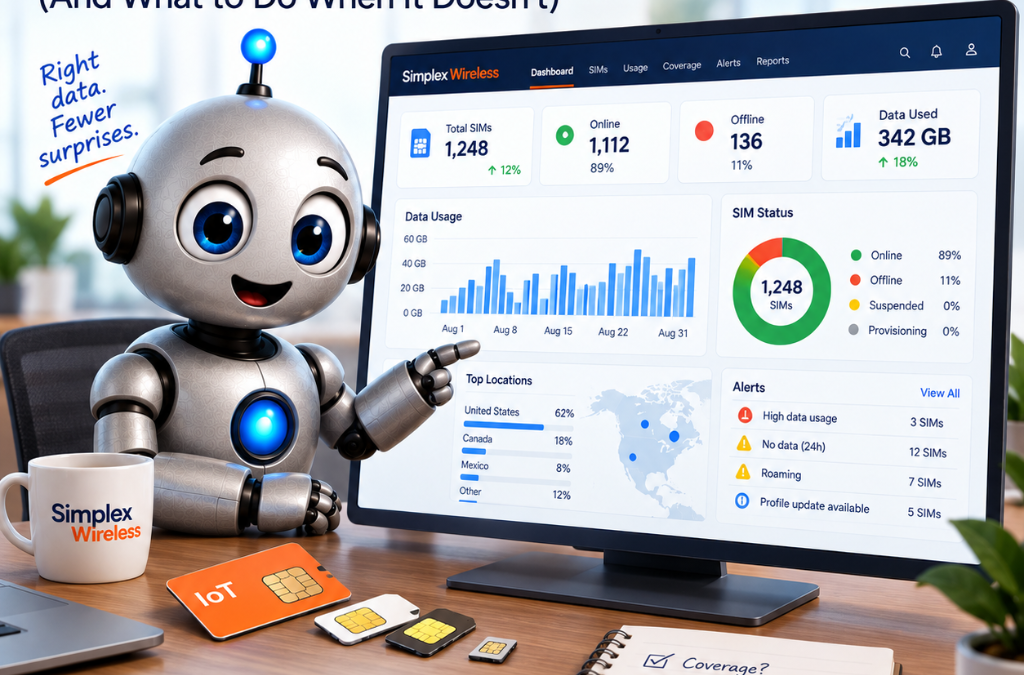
What Your IoT SIM Dashboard Should Show You (And What to Do When It Doesn’t)
A SIM management portal is operational infrastructure. If you can’t see your fleet in real time, you’re already behind.
If your current portal shows you a list of SIM cards and a monthly data total, you don’t have a fleet management tool. You have a billing summary dressed up as a dashboard. The gap between those two things is where outages go undetected, where fraudulent usage compounds, and where a five-minute fix becomes a truck roll.
This article lays out what a SIM management portal should actually do — so you can evaluate what you have, identify what’s missing, and know what to ask for.
The Six Things Your Portal Must Show You
A SIM management portal earns its name by giving you genuine operational control over your fleet. That means six specific capabilities. The absence of any one of them is a gap that costs real time and money.
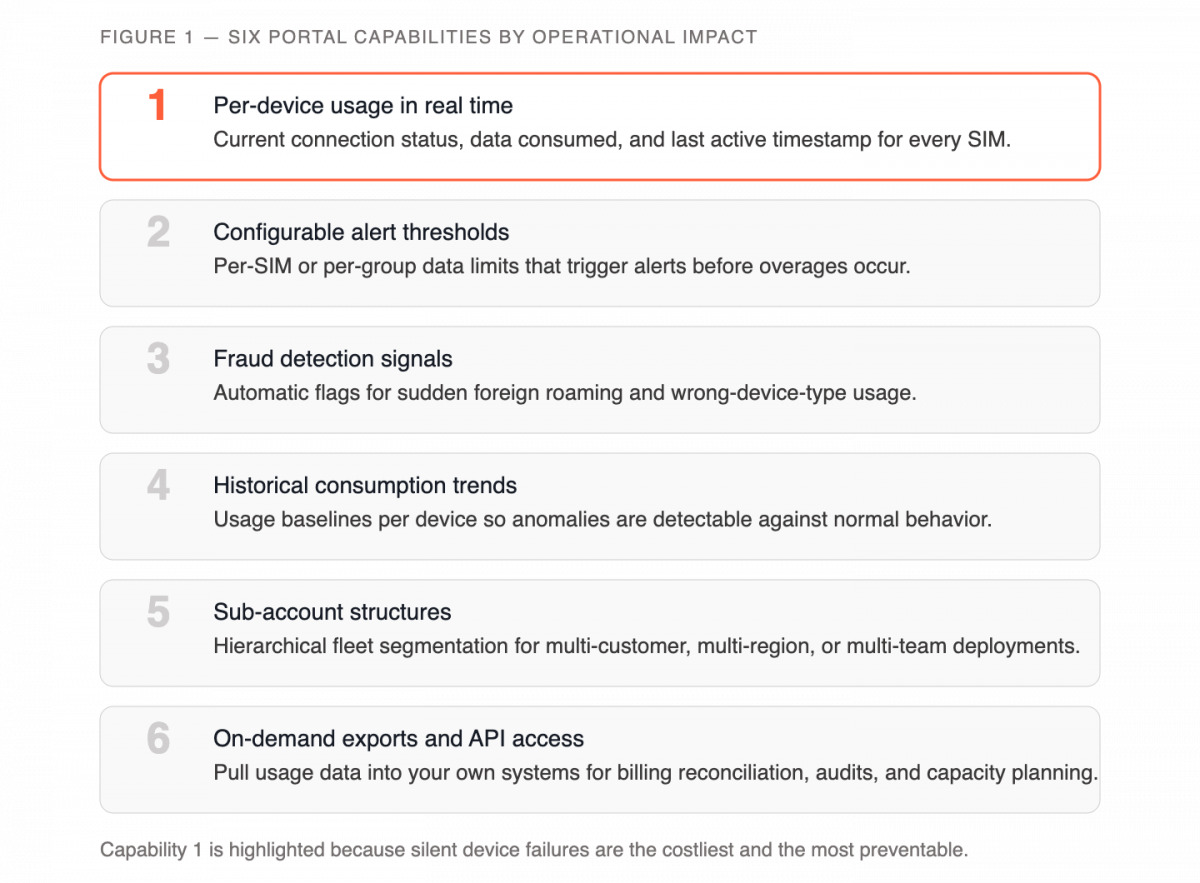
Per-device usage in real time. Not yesterday’s data. Not a 15-minute delay. Every device in your fleet should be visible with current connection status, data consumed in the current billing period, and last active timestamp. When a device goes dark, you should know within minutes — not when a customer calls.
Historical consumption trends. Real-time data tells you what’s happening now. Historical trends tell you what’s normal so you can detect what isn’t. A device that typically sends 50 MB per month and suddenly consumes 2 GB has a problem. You can only see that if you have history to compare against.
Configurable alert thresholds. The portal should let you set data consumption limits per SIM or per group, and send an alert when a device crosses them. This is the difference between proactive operations and reactive firefighting. An alert at 80% of a plan limit gives you time to act. Finding out at 150% means you’re already dealing with a bill.
Fraud detection signals. This is where most low-end portals fall short entirely. Your portal should flag sudden foreign roaming — a device that was connecting in Ohio showing up on a network in another country without explanation. It should also detect wrong-device type usage: a SIM provisioned for a utility meter consuming gigabytes of data is almost certainly in a different device than the one it was assigned to. Simplex’s portal surfaces both of these automatically.
Sub-account structures. If you operate a fleet with multiple device types, customer accounts, or geographic regions, you need to be able to segment visibility accordingly. A sub-account lets a managed service provider see only their own devices. It lets an operations team see only the devices they’re responsible for. Without it, a 10,000-device fleet is an undifferentiated list.
On-demand exports. Billing reconciliation, capacity planning, and audit trails all require data you can pull and work with outside the portal. On-demand CSV or API export isn’t an advanced feature — it’s baseline.
What Happens Without These Capabilities
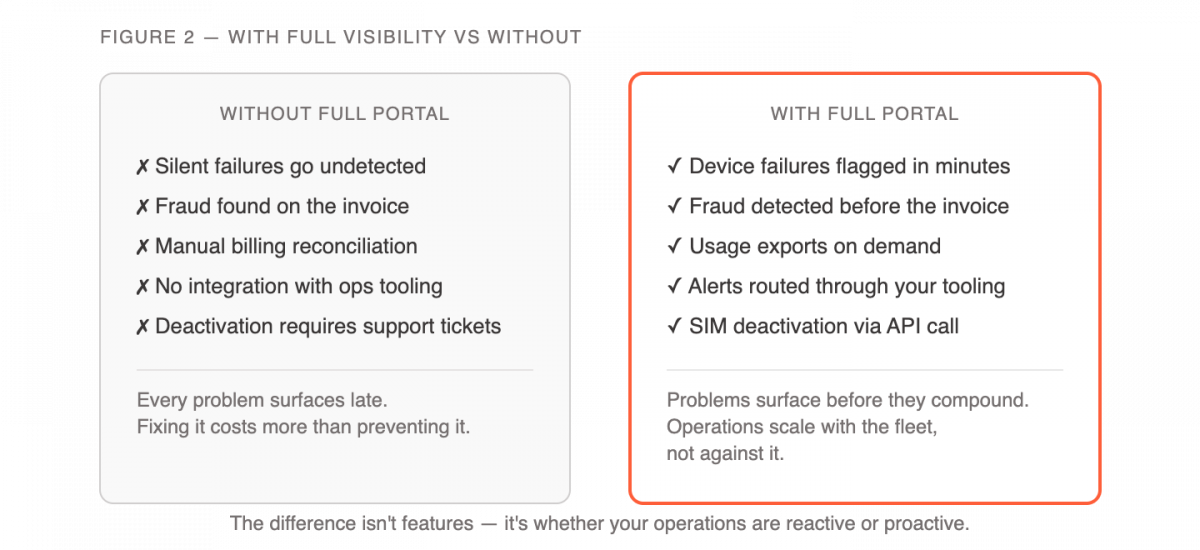
The cost of a poor portal isn’t always visible on a single line of a P&L. It shows up in aggregated operational drag — support tickets that shouldn’t have been raised, truck rolls that could have been remote fixes, bill shock from usage that was visible in the data for weeks before it became a problem.
The most serious failure mode is what’s sometimes called silent device failure. A device stops transmitting data. Its SIM remains active and appears connected at the network level. Nothing in your billing changes because the SIM is still registered. Nobody raises a ticket because no alert fired. The device could be offline for days or weeks before a field technician checks on it or a downstream system flags the missing data. A portal with real-time per-device visibility catches this immediately. A portal without it doesn’t catch it at all.
The fraud case is equally instructive. A SIM provisioned for a utility meter sits inside an enclosure that gets broken into. Someone removes the SIM and puts it in a tablet. Data consumption goes from roughly 5 MB per month to several gigabytes in days. Without wrong-device detection, you find out when the overage invoice arrives. With it, you find out within hours and can deactivate the SIM before the damage compounds. The Simplex management portal surfaces this automatically, flagging the device type mismatch as soon as the consumption pattern departs from provisioned behavior.
The billing opacity problem is subtler but persistent. If your portal can’t export usage data on demand, you’re reconciling invoices manually against whatever the carrier provides. For fleets of a few hundred SIMs this is annoying. For fleets of thousands, it’s a material operational cost.
API Access Is Not a Premium Feature
A portal without API access is a closed system. Every action that can’t be automated stays manual: pulling usage reports, adjusting data caps, deactivating SIMs when devices are decommissioned, integrating fleet status into your own monitoring stack.
For small deployments, manual portal operations are manageable. For anything above a few hundred devices, the absence of API access compounds with scale. An operations team managing 2,000 devices shouldn’t be logging into a portal to deactivate 50 SIMs when a batch of hardware is retired. That’s an API call.
The API also matters for alerting. Your SIM provider’s built-in alerts are useful, but they’re not integrated into your existing incident management system. If you use PagerDuty, OpsGenie, or any on-call rotation tooling, you need API access to route SIM alerts through the same channels as every other infrastructure event. A SIM going dark should trigger the same workflow as a server going down. Without API access, it doesn’t.
Sub-Accounts: Why Fleet Structure Matters at Scale
Sub-accounts are the feature that separates a portal built for small deployments from one built for organizations running connected hardware at any real scale.
The use cases are straightforward. A managed service provider deploying IoT devices on behalf of multiple end customers needs each customer to see only their own devices — not the full fleet. A company running both a fleet tracking product and an asset monitoring product wants separate billing and separate alert channels for each. A team responsible for devices in Europe doesn’t need visibility into devices in North America.
Without sub-account support, the only way to achieve any of this is to run separate accounts with separate billing relationships — which means separate invoices, separate support contacts, and no aggregate view when you need one. Sub-accounts give you the hierarchy: a parent account with full visibility, and child accounts with scoped visibility and their own administrators.
The operational cost of not having this scales with fleet size and organizational complexity. It’s barely noticeable at 100 devices. At 5,000 devices across three business units, it becomes a genuine management problem.
What to Do When Your Current Portal Falls Short
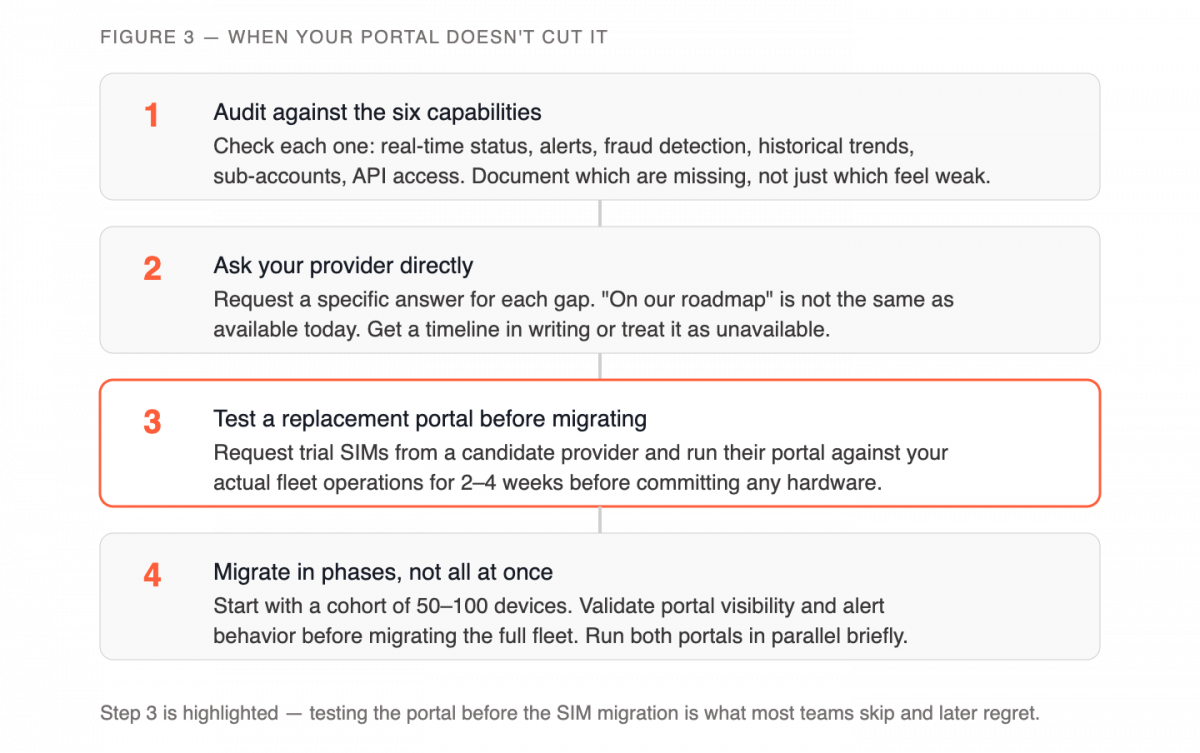
The honest answer is that not every SIM provider has invested meaningfully in their portal. Many legacy providers treat it as a secondary product — something that exists to show you’ve been billed correctly, not something designed to run fleet operations.
If you’re evaluating your current portal against the six capabilities above and finding gaps, the question is whether those gaps are fixable within your current provider relationship or whether they represent a structural limitation of their platform.
Ask directly: does the portal have per-device real-time status? Is there API access for programmatic SIM management? Can you configure alert thresholds per SIM? Does fraud detection flag device type mismatches automatically? If the answers are no, that’s not a roadmap item — it’s an architectural gap that’s unlikely to close.
For teams assessing a provider switch, the consumer SIM vs IoT SIM comparison covers the management layer difference in detail. And for the business case behind investing in proper fleet visibility before outages occur, the real cost of connectivity failures post in this series quantifies what poor visibility actually costs.
What the Simplex Portal Provides
The Simplex management portal is included with every IoT SIM at no additional cost. It’s not a paid upgrade or an enterprise tier — it’s part of the product.
It gives you real-time per-device status, historical consumption data, configurable alert thresholds, automatic fraud detection for sudden foreign roaming and wrong-device type usage, sub-account creation for fleet segmentation, full API access for programmatic management, and on-demand usage exports. The portal also handles BYOO (Bring Your Own Operator) — if you have existing carrier SIMs you’re not ready to migrate, you can bring them under the same dashboard without changing the underlying carrier relationship.
Support is US-based in Atlanta, Georgia. When something goes wrong in your portal, you talk to the people who built and manage the platform.
If your current portal doesn’t give you what you need, take a look at what the Simplex IoT SIM includes at simplexwireless.com/iot-data-sim.
This article was curated by Jan Lattunen, CCO Simplex Wireless
About the Author: Jan Lattunen manages Sales and Marketing for Simplex Wireless. Jan has 20 years’ experience in working with SIM card technology and was involved in launching the eSIM in North America with major carriers and OEMs. His expertise in telecommunications is around SIM cards. On a personal note, Jan is a family man and avid cyclist with advocacy for safety in the roads. You can connect with Jan on https://linkedin.com/in/JanLattunen