







Five Questions Every IoT Team Asks Their Network (and Why They Usually Take Too Long to Answer)
August 24, 2026
IoT SIM Providers Compared: Simplex vs. Hologram, 1NCE, Twilio Super SIM, Soracom, and EMnify
August 28, 2026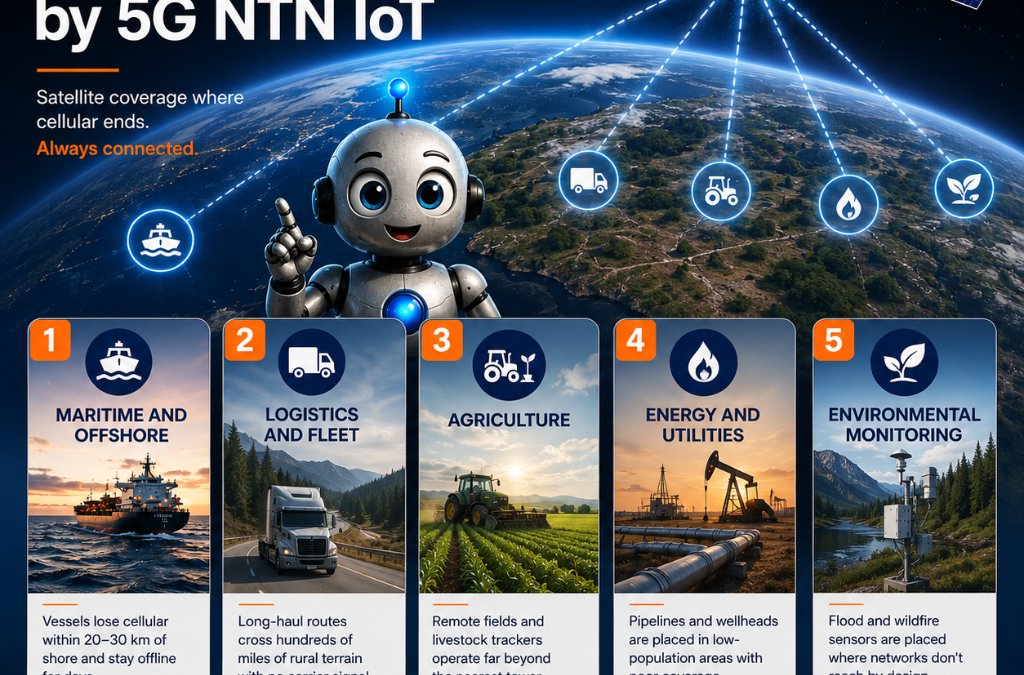
5 Industries Being Transformed by 5G NTN IoT
Cellular IoT works well where cell towers exist. The industries that need it most are often in the places where they don’t.
The promise of IoT is visibility — knowing where your assets are, what condition they’re in, and when something needs attention. That promise holds in cities, in warehouses, in manufacturing facilities. It breaks down the moment your assets move into the 80% of the Earth’s surface that terrestrial cellular networks don’t cover. 5G NTN (Non-Terrestrial Network) IoT — the 3GPP standard that routes IoT data through LEO satellites instead of ground-based towers — is changing what’s possible for the industries where that breakdown has been most costly.
Five industries are seeing the clearest transformation. They share a common problem: the things they most need to monitor are precisely the things that end up out of range.
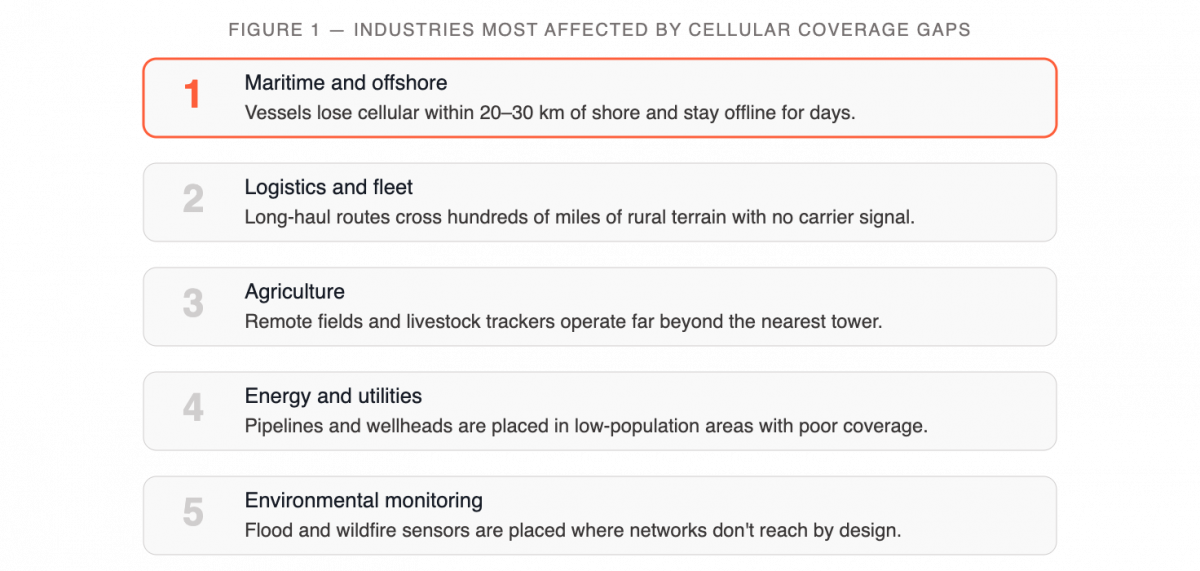
The industries most severely affected by coverage gaps aren’t evenly distributed. Figure 1 ranks them by what proportion of their typical operating environment falls outside reliable terrestrial coverage.
1. Maritime and offshore
A container ship leaving the Port of Los Angeles loses cellular connectivity within 20–30 kilometers of the coastline. From that point until it reaches its destination port — days or weeks later — any IoT device on board that relies on terrestrial cellular is offline. Temperature sensors on reefer containers, fuel consumption monitors, cargo condition trackers: all of them go dark.
The consequences are practical and expensive. Cold chain integrity records have gaps. Exception handling for damaged or shifted cargo can’t happen in transit. Port scheduling relies on last-known position rather than real-time location. Insurance claims require documentation that doesn’t exist because the data was never transmitted.
5G NTN IoT changes this by giving shipboard devices a connectivity path that doesn’t depend on coastal infrastructure. NB-IoT (Narrowband IoT) sensors transmit small payloads — temperature readings, position pings, hull condition data — via LEO satellite at regular intervals throughout the voyage. The data arrives at your operations center continuously, not in a burst when the vessel re-enters port waters.
The business impact is specific: cold chain compliance records become uninterrupted, cargo exception alerts fire in real time rather than after the fact, and port ETAs are calculated from live position data rather than last-known location extrapolation. For operators moving temperature-sensitive cargo — pharmaceuticals, perishables, chemicals — continuous visibility is not a convenience. It’s a compliance requirement.
2. Logistics and fleet
Long-haul trucking crosses terrain that no carrier has been paid to cover well. Rural stretches of I-70 through Kansas, I-90 through Wyoming, Highway 1 through the Canadian interior — these corridors carry enormous freight volumes and have consistent cellular dead zones measured in hours, not minutes.
Figure 2 shows what a single long-haul route looks like for a logistics operator, with and without NTN coverage.
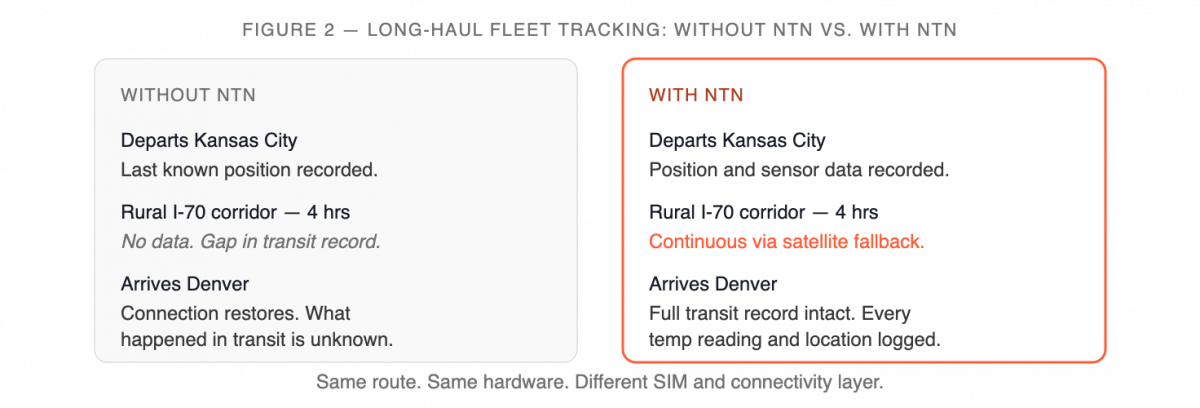
The gap isn’t just a data inconvenience. For temperature-controlled freight, a four-hour visibility gap is a four-hour period during which a refrigeration failure could go undetected and unresponded to. For high-value cargo, it’s a period during which a route deviation or theft goes unlogged. For fleet operators under ELD (Electronic Logging Device) compliance requirements in the US, it creates record-keeping complications that require manual reconciliation.
Multi-carrier terrestrial SIMs close some of these gaps by accessing whichever carrier has the strongest signal in a given location. But in genuine dead zones — where no carrier reaches — only a satellite fallback keeps the device online. NTN-capable hardware with a hybrid connectivity architecture connects terrestrial-first and switches to satellite automatically when terrestrial coverage ends. The device doesn’t know it switched. Neither does your application. The data stream is uninterrupted.
For fleet operators, this translates to complete transit records, real-time exception alerting regardless of location, and the ability to prove chain of custody across the entire route — not just the portions where towers exist. Explore Simplex’s transportation and fleet connectivity for more on how multi-carrier SIMs perform across long-haul routes.
3. Agriculture
Precision agriculture depends on data from places that were never designed with cellular infrastructure in mind. A large arable farm in the US Midwest might span several thousand acres, with soil sensors, weather stations, irrigation controllers, and livestock trackers distributed across terrain that sits well outside the coverage footprint of the nearest carrier.
The conventional workaround is LoRaWAN gateways placed at the farm’s perimeter, aggregating sensor data locally and transmitting via whatever cellular signal is available. This works until the gateway loses signal, or until an asset — a livestock tracker, a mobile irrigation unit — moves beyond the gateway’s range. At that point, data stops.
5G NTN IoT removes the dependency on local gateway placement. Sensors and trackers with NTN-capable modems communicate directly with satellites. A soil moisture sensor bolted to a post in the middle of a 5,000-acre property transmits its readings on schedule, regardless of where the nearest tower or gateway sits. Livestock trackers report location continuously, including when animals stray to property edges or adjacent land.
The operational shift is from reactive to continuous. Irrigation decisions get made on live soil data, not on readings from the last time connectivity was available. Livestock location is known in real time, not discovered during a manual headcount. Equipment utilization is tracked across the full property, not just the areas with signal. See Simplex’s connected agriculture coverage for more on how this applies to specific farm IoT deployments.
4. Energy and utilities
Pipelines, wellheads, substations, and renewable energy installations share a locational reality: they’re built where the energy resource is, not where the infrastructure is. A gas pipeline running through a remote basin, a wind farm on an exposed plateau, a substation serving a rural distribution network — all of them generate operational data that needs to reach a control center continuously, and all of them are likely to have poor or no terrestrial cellular coverage.
The consequences of connectivity gaps in energy infrastructure are more severe than in most other sectors. A pressure anomaly on a pipeline that goes undetected for four hours because the monitoring sensor was offline is not just a data gap — it’s a liability event. A substation fault that doesn’t trigger an alarm until the device re-enters coverage is hours of unplanned outage that could have been caught and responded to immediately.
5G NTN IoT gives remote energy infrastructure the same always-on monitoring that urban infrastructure already has. Pipeline pressure sensors, flow meters, and corrosion monitors transmit continuously via satellite. Anomalies trigger alerts within minutes regardless of where the asset sits. Maintenance teams dispatch based on real data, not scheduled inspection cycles that assume the monitoring will catch what it can between visits. Simplex’s industrial IoT connectivity covers how this applies to remote energy and utilities deployments.
5. Environmental monitoring
Environmental monitoring has a fundamental placement problem: the sensors that matter most are in the locations that are hardest to connect. Flood early warning sensors belong in remote river catchments, not in town centers where connectivity is easy. Wildfire detection sensors belong in wilderness areas. Air quality monitors belong in industrial corridors, some of which have poor urban fringe coverage. Wildlife tracking collars belong on animals that move freely across landscapes with no regard for carrier footprints.
Traditional environmental monitoring networks solve this with a combination of satellite modems (expensive, proprietary, high power draw) and LoRaWAN gateways (limited range, requires local infrastructure). 5G NTN IoT offers a third path: standards-based, low-power connectivity using NB-IoT protocols over satellite, with the same SIM management infrastructure used for terrestrial IoT.
Figure 3 shows what this changes in concrete operational terms across four of these five industries.
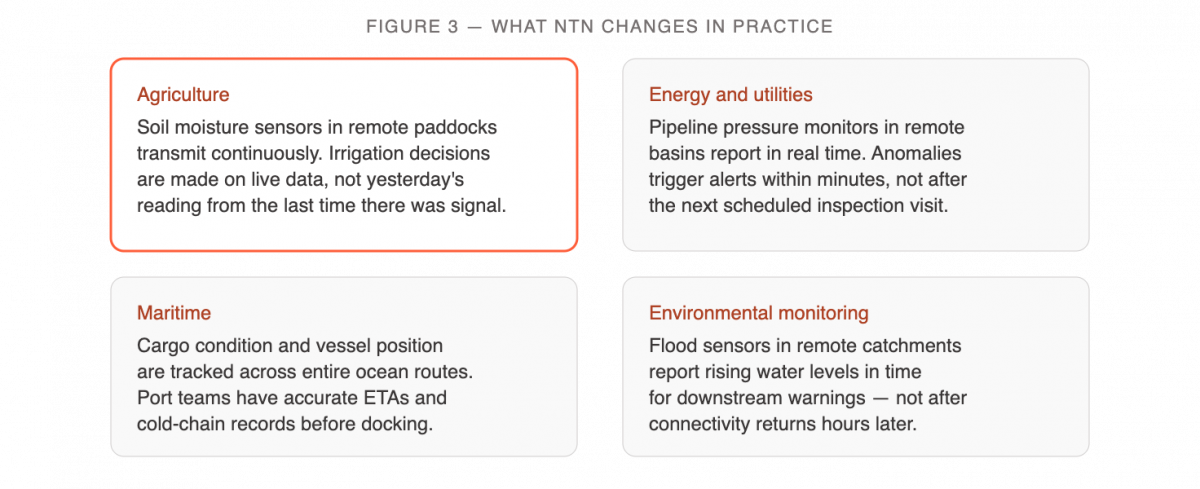
For environmental monitoring specifically, the shift is from delayed awareness to real-time response. A flood sensor that can only transmit when cellular returns is useless for early warning. A wildfire detection sensor that goes offline during a dry wind event is precisely the sensor that needs to be online. 5G NTN IoT makes it possible to place sensors where they’re needed and get data from them reliably — not where connectivity happens to exist.
These five industries aren’t early adopters experimenting with satellite IoT. They’re sectors with long-standing connectivity problems that terrestrial networks were never designed to solve. 5G NTN IoT — built on the same 3GPP standards as the cellular infrastructure these industries already use — gives them a practical path to continuous visibility across the full geography of their operations.
Simplex Wireless is bringing NTN connectivity to the same platform our customers already use for terrestrial IoT SIM management. Get in touch if you’re evaluating NTN for a specific deployment, or explore our IoT connectivity options to see how terrestrial and satellite connectivity work together.
This article was curated by Jan Lattunen, CCO Simplex Wireless
About the Author: Jan Lattunen manages Sales and Marketing for Simplex Wireless. Jan has 20 years’ experience in working with SIM card technology and was involved in launching the eSIM in North America with major carriers and OEMs. His expertise in telecommunications is around SIM cards. On a personal note, Jan is a family man and avid cyclist with advocacy for safety in the roads. You can connect with Jan on https://linkedin.com/in/JanLattunen