







Testing SGP.32 Before You Scale: A Stage-by-Stage Pilot From Factory to Field
October 1, 2026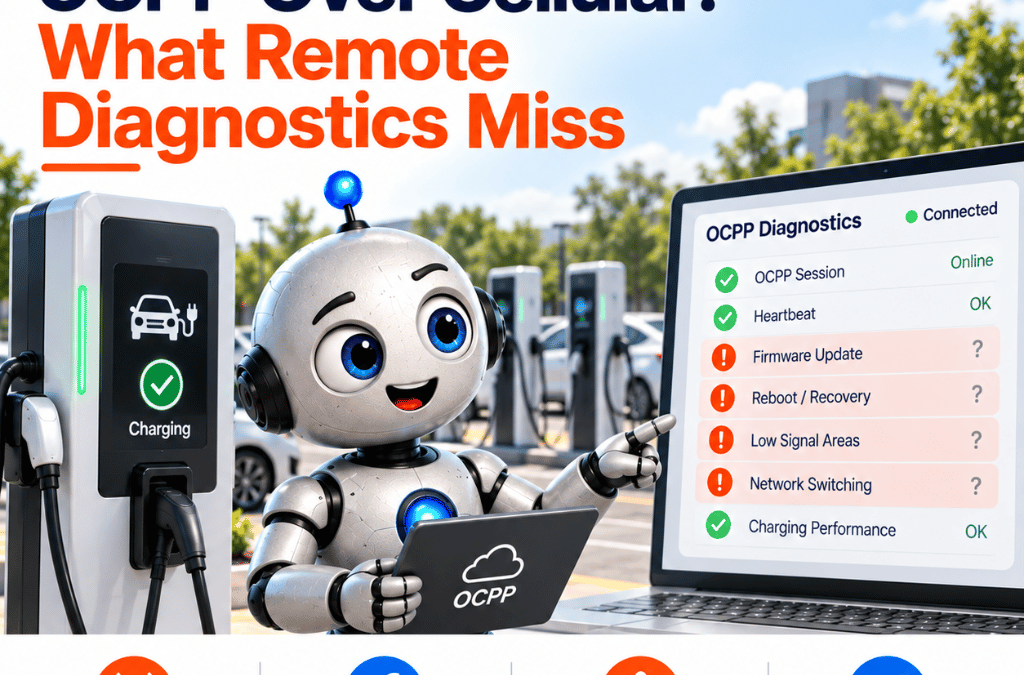
OCPP Over Cellular: What Remote Diagnostics Miss
After reading this, you’ll know exactly where the gap sits between “OCPP says the charger is fine” and “the driver couldn’t start a session,” and what to monitor to close it.
A charger reports a clean heartbeat. Session status: available. Then a driver plugs in and nothing happens. The operator pulls up the dashboard, sees green across the board, and has no idea where to even start looking. This isn’t a rare edge case, it’s the predictable result of watching only one layer of a system that has several.
OCPP tells you about the charger. Not the connection.
OCPP, the Open Charge Point Protocol, is the standard that lets EV chargers talk to a central management system: reporting status, transactions, availability, and errors, and accepting remote commands like start, stop, or firmware updates. It’s the layer charging network operators watch most closely, and for good reason. It’s also, by design, only reporting on what the charger itself knows.
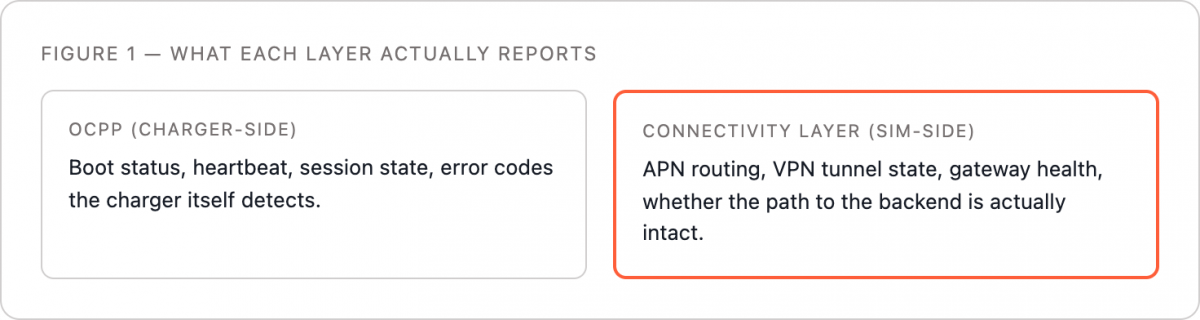
OCPP can tell you the charger booted successfully, that it’s not mid-session, and that its last heartbeat came through on schedule. What it can’t tell you is whether the network path underneath that heartbeat is healthy, or one dropped packet away from failing the next transaction. That path lives beneath OCPP, not inside it, and if nothing is watching that layer, an operator only finds out about a problem when a driver reports one.
Where the blind spot sits: between the SIM and the backend
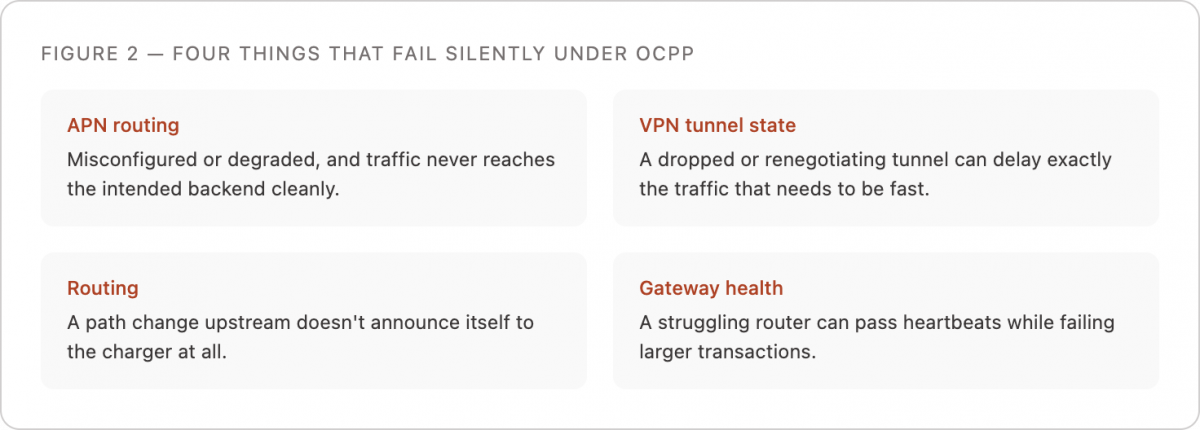
Between the charger’s OCPP client and the backend management system sits a stack most dashboards never surface: the SIM’s APN configuration that governs how the connection gets routed, any VPN tunnel encrypting that traffic, the routing itself, and the health of the gateway or router handling the cellular link. Any one of these can degrade without ever showing up as a charger-side error, because from the charger’s point of view, it’s still sending its heartbeat successfully.
Why a charger can report “available” and still fail a session
The mechanics are straightforward once you separate the layers. A heartbeat only needs a thin, intermittent connection to succeed, a small packet, sent occasionally, that either gets through or times out and retries. A payment authorization or a session-start command needs a stable, low-latency path held open long enough to complete the round trip. A connection degraded enough to still pass heartbeats can fail exactly the traffic that matters to the driver standing at the charger, and OCPP has no visibility into that difference. It only knows the last heartbeat succeeded.
This is compounded on cellular links because registration and handoff behavior isn’t instantaneous. A modem re-registering after a brief signal drop can look fine on the next heartbeat while having missed the exact window a driver tried to authenticate.
Building a full-stack view: OCPP plus connectivity telemetry
Closing this gap means pairing OCPP data with telemetry from the connectivity layer itself, and this is where most fleets are underserved. A SIM management platform worth using surfaces more than a green or red status dot: signal quality trends per site, APN and VPN tunnel state, data session duration and drop frequency, and gateway-level health separate from the charger’s own reporting.
Cutting truck rolls with combined visibility
The payoff for combining these views isn’t just faster root-cause analysis, it changes what a technician needs to do about a report of a failed session. Without connectivity telemetry, “the driver says it didn’t work” usually means a site visit to find out why, because OCPP alone gave no clue. With it, an operator can often see the degraded tunnel or the gateway that was struggling before the driver ever called, and that difference is the gap between a dispatched truck roll and a five-minute remote fix.
For EV charging operators running fleets across dozens or hundreds of sites, that combined view isn’t a nice-to-have. It’s the difference between chasing every complaint one call at a time and catching the pattern before it becomes one.

If your team is still troubleshooting failed sessions one driver complaint at a time, talk to our engineering team about what connectivity telemetry would show you before the next call comes in.
This article was curated by Jan Lattunen, CCO Simplex Wireless
About the Author: Jan Lattunen manages Sales and Marketing for Simplex Wireless. Jan has 20 years’ experience in working with SIM card technology and was involved in launching the eSIM in North America with major carriers and OEMs. His expertise in telecommunications is around SIM cards. On a personal note, Jan is a family man and avid cyclist with advocacy for safety in the roads. You can connect with Jan on https://linkedin.com/in/JanLattunen