







Multi-Carrier SIM Failover for Push-to-Talk Radios: How It Works
October 12, 2026
What Is a Connectivity Management Platform?
It decides whether a question about your fleet takes one query or three carrier logins.
Picture 40 devices in a warehouse going quiet at once. The first job is working out whose problem it is, so you open one carrier portal, then another, then a spreadsheet of ICCIDs (the serial number printed on each SIM). By the time you find the SIM that burned through its data pool, the shift is over.
What a connectivity management platform is, and how it works
A connectivity management platform (CMP) is software that sits between your devices’ SIM cards (Subscriber Identity Modules) and the carrier networks they connect to. It gives you one interface and one API (application programming interface) for every SIM in the fleet, instead of a separate login for each mobile network operator (MNO).
The work falls into four jobs. Lifecycle covers activating, suspending, re-planning, and retiring SIMs. Visibility covers session status, data used per device, which network each SIM attached to, and where it is roaming. Control covers usage caps and alerts that act before the invoice does. Billing turns usage records from several carriers into one invoice you can reconcile. Figure 1 shows where the platform sits.
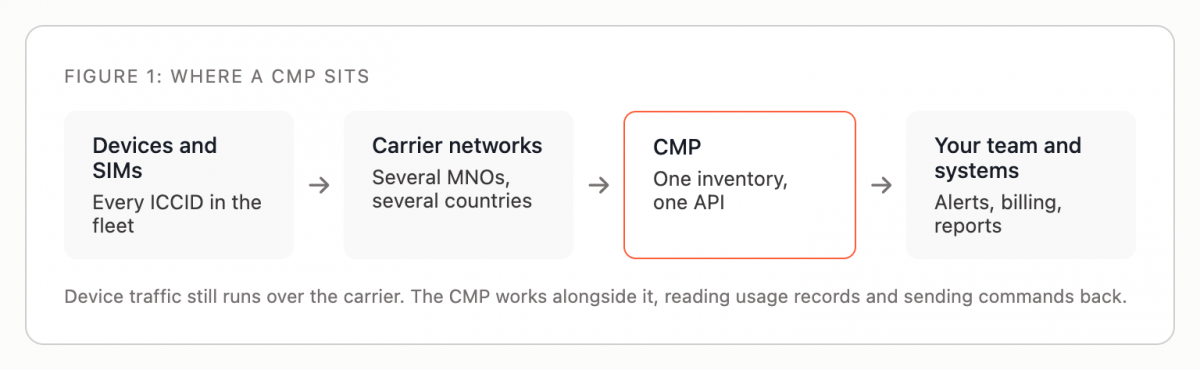
Figure 1: Where a CMP sitsDevices and SIMsEvery ICCID in the fleet→Carrier networksSeveral MNOs, several countries→CMPOne inventory, one API→Your team and systemsAlerts, billing, reportsDevice traffic still runs over the carrier. The CMP works alongside it, reading usage records and sending commands back.
Under the hood, a CMP typically reads each carrier’s usage and session records and sends commands back, such as suspend or change plan. Every action available in the portal should also exist in the API, because nobody at fleet scale clicks through 10,000 rows. Our guide to what a dashboard should show lists the views worth demanding.
One boundary worth drawing: a CMP is not an eSIM IoT Remote Manager (eIM). A CMP manages subscriptions and connections on the connectivity side. An eIM manages which carrier profiles sit on an eSIM (embedded SIM) under SGP.32, the GSMA specification for IoT remote provisioning. You can run one without the other, though fleets that switch carriers over the air tend to want both, because every new profile still has to show up in your management view.
Why it matters for IoT specifically
A phone has an owner who notices when it stops working. An IoT device has none. It sits inside an EV charger, a trailer, or a field sensor, and nobody knows it dropped off the network until something downstream breaks. That one difference changes what management has to do.
Consumer plans assume a person watches the line, one carrier is enough, and a monthly bill is the feedback loop. A fleet inverts each assumption. Devices span carriers and countries, per-device data use is tiny but multiplied across thousands of SIMs, and one misbehaving unit can drain a pool shared by hundreds. The CMP is where you notice.
It is also where your bargaining position in a carrier relationship lives. If your only view of the fleet is your carrier’s own portal, switching carriers means losing history, alerts, and integrations all at once. A carrier-neutral CMP keeps them with you, which is why carrier lock-in shows up as a cost long before a contract renews. Simplex’s Bring Your Own Operator (BYOO) service follows that logic to its end: you keep your existing MNO contracts and manage them in one portal.
What goes wrong
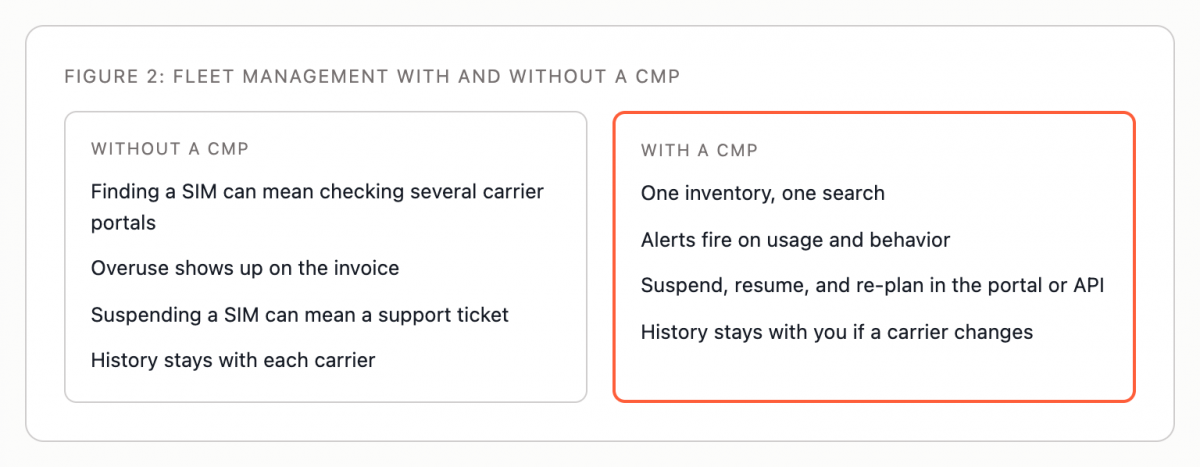
Most CMP failures are quiet. Five patterns are worth knowing, and Figure 2 sets the before and after side by side once they are fixed.
The runaway device. A firmware bug puts a device into a retry loop, and it spends data meant for a shared pool. Without a per-device threshold, you learn about it from the invoice.
“Active” does not mean online. A SIM’s status usually shows whether the subscription is enabled, not whether the device has a session. Teams read the green status as health and miss silent devices.
The API gap. The portal can suspend a SIM; the API can’t. Automation stalls, and someone ends up scripting a browser.
Border crossings. A device on a truck crosses into another country and starts roaming. If nothing alerts on foreign roaming, the first signal is a charge.
Zombie SIMs. Inventory lives in a spreadsheet that drifts from reality, and decommissioned SIMs keep billing because nobody canceled them.
What to do about it
Three steps, before you buy or renew anything.
First, build one inventory: every SIM, its ICCID, carrier, plan, and the person who owns it. If producing that list takes more than an afternoon, you’ve found your first requirement.
Second, time your most common questions. Which SIM used the most data last week? How many devices are online in Germany right now? Which devices haven’t connected in a day? If each answer takes a login and a spreadsheet, that’s the cost to fix. The questions every IoT team asks their network make a good starting list.
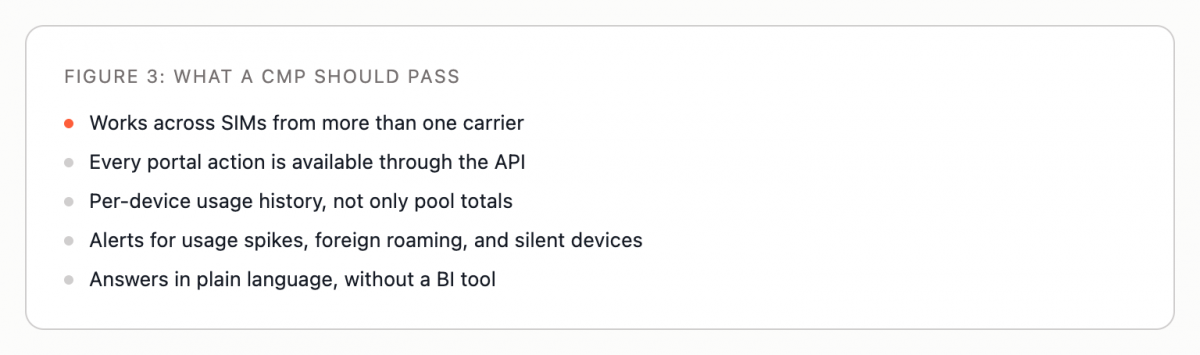
Third, set thresholds before deployment, not after the first surprise: per-device usage ceilings, roaming alerts, and a silent-device alert. Then test them by pushing a trial SIM past its cap and confirming the alert fires. Figure 3 turns the three steps into a pass/fail test for any platform you evaluate.
Figure 3: What a CMP should passWorks across SIMs from more than one carrierEvery portal action is available through the APIPer-device usage history, not only pool totalsAlerts for usage spikes, foreign roaming, and silent devicesAnswers in plain language, without a BI tool
Back in the warehouse, a CMP turns those 40 silent devices into one filter and one list. The Simplex portal covers data consumption trending, real-time usage, sub-accounts, and alerts for sudden foreign roaming and rogue device behavior, and it works with your existing carrier contracts through BYOO. Explore the Simplex portal to see what that view looks like for your fleet.
This article was curated by Jan Lattunen, CCO Simplex Wireless
About the Author: Jan Lattunen manages Sales and Marketing for Simplex Wireless. Jan has 20 years’ experience in working with SIM card technology and was involved in launching the eSIM in North America with major carriers and OEMs. His expertise in telecommunications is around SIM cards. On a personal note, Jan is a family man and avid cyclist with advocacy for safety in the roads. You can connect with Jan on https://linkedin.com/in/JanLattunen