







Keeping Public Venue Screens Online: IoT Connectivity for Arenas, Airports and Libraries
October 9, 2026
Multi-Carrier SIM Failover for Push-to-Talk Radios: How It Works
A single dropped carrier shouldn’t mean a dropped crew. Here’s what actually happens inside a PTT radio when the network switches underneath it.
A Push-to-Talk over Cellular (PoC) radio only works if the SIM inside it has signal. Lose that signal mid-shift and the radio isn’t a radio anymore — it’s a brick with a talk button. Most teams don’t find this out in a lab. They find out on a jobsite, in a parking structure, or on the edge of a coverage area, exactly when the call mattered.
What a Multi-Carrier SIM Actually Does for a PoC Device
A standard SIM ties a device to one carrier’s network, permanently. If that carrier has a dead zone at the loading dock, a tower outage during a storm, or congestion during a shift change, the radio goes silent until the SIM’s one and only network comes back. There’s no fallback, because there’s nothing to fall back to.
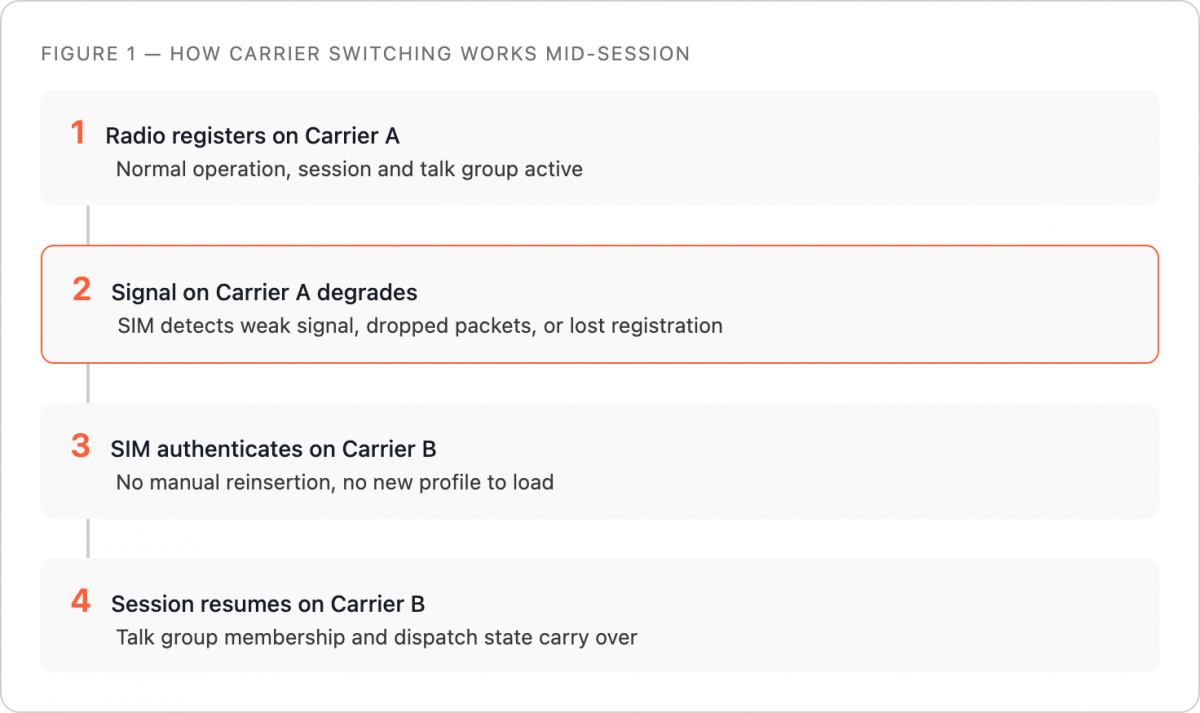
A multi-carrier SIM is provisioned across several networks at once — typically the major U.S. carriers — and picks whichever one is strongest at that moment. The mechanism isn’t exotic: the SIM continuously reads signal quality and, when the current network degrades past a threshold, authenticates on the next-best carrier without anyone touching the device. This is the same failure mode we’ve written about for IoT devices in general — a PTT radio is just a version of it where the outage is audible in real time instead of showing up as a gap in a data log.
Why This Matters More for PTT Than for a Phone
A phone call that drops gets redialed. A push-to-talk session doesn’t work that way — it’s a half-duplex, always-on channel where the whole point is that pressing a button gets you through instantly, to one person or the whole crew. If the network drops for even a few seconds during that press, the message doesn’t queue and retry. It just doesn’t arrive, and nobody involved necessarily knows that.
This is also where PoC radios reveal what they really are: connected computers running an app, not analog walkie-talkies. Some of them run full Android, which is its own management challenge — we’ve covered what that means for data usage and control — but the connectivity layer underneath is what determines whether any of that software works at all. Security patrols moving between buildings, construction crews spread across a site, delivery fleets crossing county lines — all of them cross coverage boundaries that a single carrier simply doesn’t cover evenly. A multi-carrier SIM is the thing that makes “nationwide” an honest claim instead of a marketing one.
What to Check Before Choosing a Multi-Carrier PTT SIM
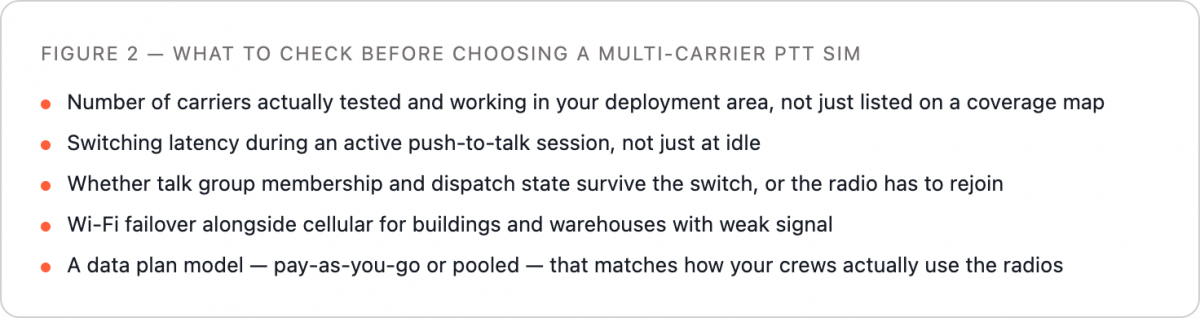
Not every SIM sold as “multi-network” behaves the same way once it’s actually deployed. A few things separate the ones that work from the ones that just say they do — see Figure 2 below for the full list.
The two worth calling out specifically: how many networks are actually tested and working, not just named on a spec sheet, and how the switch behaves during an active session rather than only at idle. A provider claiming three carriers but only routinely reaching one in your service area isn’t giving you failover — they’re giving you a single point of failure with extra steps. Coverage maps themselves are notoriously optimistic, which is exactly why real-world testing matters more than the marketing page.
The other detail buyers often skip is who’s actually behind the multiple networks. A SIM that reaches three carriers through three separate wholesale agreements behaves differently under load than one built on direct network partnerships negotiated for exactly this purpose — ask how the switching decision gets made, and by whom.
Multi-Carrier vs. Wi-Fi Failover: Using Both
Wi-Fi failover gets marketed alongside multi-carrier support, and it’s worth having, but the two aren’t interchangeable. Wi-Fi only helps where there’s a known network to join — inside a warehouse, an office, a facility with configured access points. It does nothing for a crew on a highway, a farm, or a construction site with no infrastructure at all. Cellular is the layer that covers the radio everywhere; Wi-Fi is a useful supplement indoors, not a replacement outdoors. See Figure 3 below.
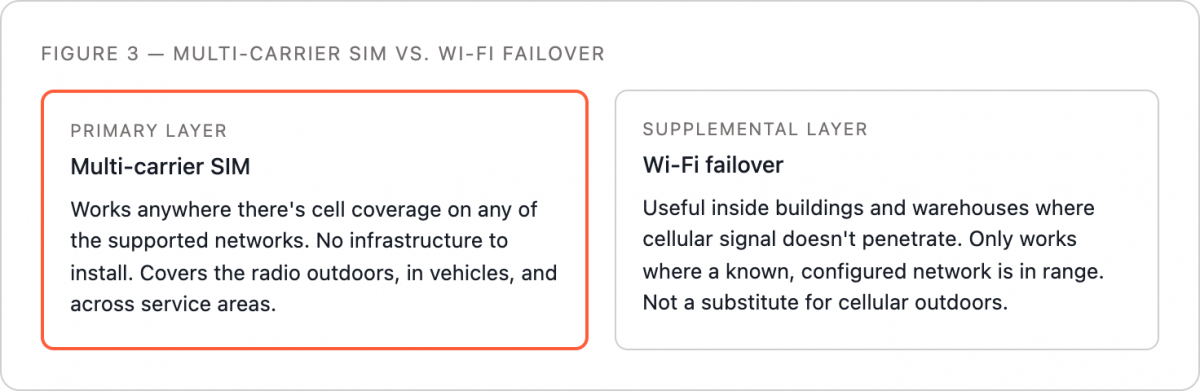
The right setup uses both, in the right order: multi-carrier cellular as the default connection, Wi-Fi as an automatic assist in buildings where cell signal doesn’t reach. Radios configured with only one of the two will have predictable blind spots — indoors, or outdoors, depending on which one got left out.
How Simplex’s Multi-Network SIM Fits PoC Deployments
Simplex’s PTT SIM cards carry the same multi-network access we build into every IoT SIM: automatic selection across the major U.S. carriers, with data breakout points in the USA, Europe, and APAC for fleets that operate outside a single country.
A dropped carrier is a bad time to find out your SIM only had one network to fall back on. If your team is evaluating connectivity for a PoC deployment, our engineering team can walk through exactly how the failover behaves in your coverage area before you commit a fleet to it.
This article was curated by Jan Lattunen, CCO Simplex Wireless
About the Author: Jan Lattunen manages Sales and Marketing for Simplex Wireless. Jan has 20 years’ experience in working with SIM card technology and was involved in launching the eSIM in North America with major carriers and OEMs. His expertise in telecommunications is around SIM cards. On a personal note, Jan is a family man and avid cyclist with advocacy for safety in the roads. You can connect with Jan on https://linkedin.com/in/JanLattunen