







Commercial Drones and Cellular Connectivity: Why a Single Carrier Is Never Enough
September 3, 2026
What Is a Bootstrap SIM Profile and Why Does It Matter for IoT Deployments?
September 9, 2026
How to Choose a Natural Language Interface for IoT Network Data: A Buyer’s Guide
A team that picks the wrong tool here doesn’t just waste a subscription. They keep the ticket queue, keep the spreadsheet exports, and add a chat window on top that answers a narrower set of questions than the one it replaced. Getting this decision right means the difference between a genuine shift in how a team works and a feature nobody opens after the first week.
Conversational interfaces for IoT network data are a young enough category that vendors describe the same capability in very different ways, and it is not always obvious from a product page how much of the underlying data a tool actually reaches. This guide lays out the criteria worth checking before you commit, the mistakes buyers commonly make, how Simplex Wireless’s SimplexAI stacks up against each one, and the questions worth asking any vendor, including us.
What to Evaluate
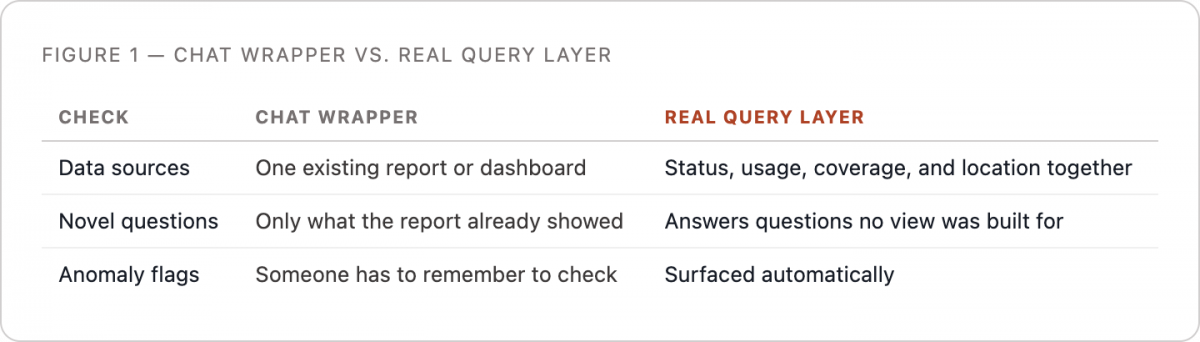
Breadth of queryable data. The core question is whether the tool queries your real operational data directly or sits in front of a single existing dashboard with a chat window bolted on. A conversational layer worth adopting should reach across device status, usage and consumption, carrier and technology coverage, and cell-level location data, not just one of those.
Accuracy on numeric answers. A tool that gets a usage number or a device count wrong is worse than no tool at all, because it is trusted by default. Ask how the vendor validates numeric responses and whether the answer is drawn from live account data or an approximation.
Anomaly and trend detection. Static answers to static questions are useful, but the higher-value case is a tool that proactively flags a data spike or a change in drop rate before someone thinks to ask. Confirm whether this is a real capability or a manual query someone still has to remember to run.
Coverage and technology lookup. For any team deploying across countries, the ability to confirm operator support for a given cellular technology, such as LTE-M, LTE, or 5G, matters as much as anything about your own fleet. Check how many operators and countries this actually spans, and whether it’s kept current as operator networks change.
Geolocation precision. If the tool offers cell tower location lookup, confirm what it is actually resolving. A network cell ID and a live map are useful for narrowing down where a device is connecting from; they are not the same as GPS-precise device location, and a vendor should be clear about that difference.
Access control. Because natural language removes the barrier of needing to know a dashboard or a query language, more people on a team will use the tool, which is the point. That only works if access can be scoped by role the same way report permissions would be in any other system.

Common Pitfalls
The most common mistake is confusing a chat wrapper for a real query layer. Plenty of tools put a conversational front end on a single existing report and call it an AI assistant. It answers the two or three questions that report already covered, in a slightly friendlier format, and nothing else. Ask directly what data sources sit behind the chat before assuming the answer.
The second is assuming natural language means zero setup. Even a genuine conversational layer needs to be connected to your account and device data, and someone on your team should confirm what that connection process actually looks like rather than assuming it is instant.
The third is skipping the access control question until after rollout. A tool that works well for one person testing it can turn into a problem once the whole team has access to account-wide data with no role-based limits, particularly for account and billing information.
How SimplexAI Addresses Each Criterion
On data breadth, SimplexAI answers questions across four connected areas: real-time device and session status, usage and consumption by device, country, APN, or operator, carrier and technology coverage across 100-plus operators worldwide, and cell tower location by MCC, MNC, and cell ID. It is built to query these as one system rather than as separate reports with a chat interface stapled on top.
On accuracy, answers are drawn from live account and network data rather than a cached snapshot, so a usage or device-count answer reflects the current state of your account at the time you ask.
On anomaly detection, SimplexAI automatically flags unusual traffic spikes and changes in drop rate, rather than requiring someone to remember to check for them.
On coverage lookup, the platform covers LTE-M, LTE, 5G, and other cellular technologies across its operator network, so a question like whether a specific carrier supports a specific technology in a specific country returns a direct answer rather than a manual carrier-by-carrier check.
On geolocation, cell tower location from MCC, MNC, and cell ID renders as a live map popup. Worth stating plainly: this identifies the cell a device is connecting through, which is useful for network-level troubleshooting and rough positioning, and it is not a substitute for GPS-based device tracking if that’s what a specific use case requires.
On access, the interface is built to work the same way for network ops, support, sales, and management, which means the honest limitation is on your side of the equation, not ours: it is worth deciding upfront what each role should be able to ask before turning access on broadly.
Questions to Ask Any Provider
Put these to every vendor you’re evaluating, including us:
- What data sources does the conversational layer actually query, and can you show me the underlying reports it draws from?
- How is a numeric answer validated before it’s returned, and what happens if the underlying data is delayed or incomplete?
- Does anomaly detection run automatically, or does someone have to trigger a check?
- How many carriers and countries does your coverage lookup actually cover, and how often is that data refreshed?
- What does cell tower location actually resolve to, and how is that different from device-level GPS tracking?
- Can access be scoped by role, and what does that setup process look like?
- What’s a question this tool can’t answer today?
The Decision, Simplified
The right choice here is not the tool with the longest feature list. It’s the one that reaches the data you actually need, gets the numbers right, and tells your team the truth about what it can’t do yet. Run the six criteria above against every vendor on your shortlist, including Simplex, and the decision gets a lot less abstract.
See what SimplexAI actually answers, or talk to our team about connecting it to your account.
This article was curated by Jan Lattunen, CCO Simplex Wireless
About the Author: Jan Lattunen manages Sales and Marketing for Simplex Wireless.
Jan has 20 years’ experience in working with SIM card technology and was involved
in launching the eSIM in North America with major carriers and OEMs. His expertise
in telecommunications is around SIM cards. On a personal note, Jan is a family man
and avid cyclist with advocacy for safety in the roads. You can connect with Jan on
https://linkedin.com/in/JanLattunen