







Why Multi-Network SIMs Don’t Guarantee EV Uptime
September 17, 2026
What Your IoT Connectivity Quote Doesn’t Show You: A Line-by-Line Cost Worksheet
Every connectivity quote leads with a headline number: a rate per megabyte, a flat fee per device, sometimes a bundled annual price. That number is the easiest thing to compare across vendors side by side. It’s also the least reliable predictor of what a fleet will actually cost once it’s running.
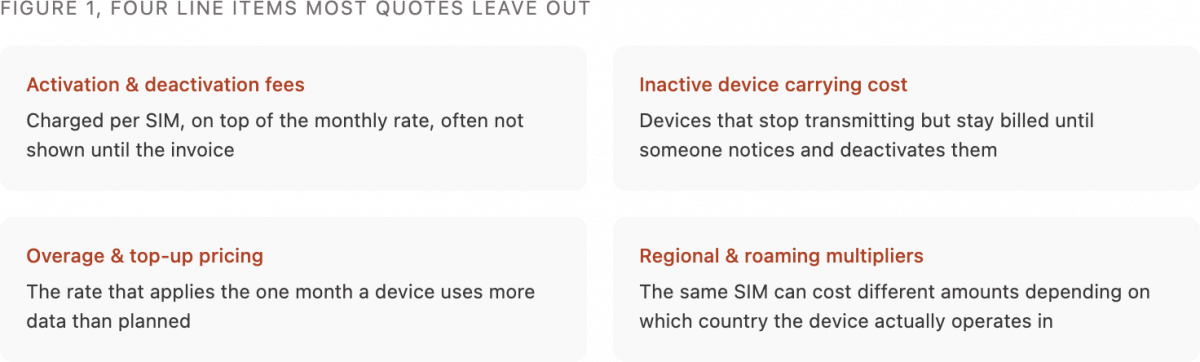
The gap between the quoted rate and the real bill usually isn’t fraud or fine print, though it happens. More often it’s a line item nobody priced into the comparison at procurement time: a fee for activation, a device that went quiet six months in but is still billed, an overage the one month traffic spiked. None of those show up on the rate card (Figure 1). All of them show up on the invoice. What follows is a way to model total cost before you sign, not after your first quarterly bill surprises you.
What actually determines total cost
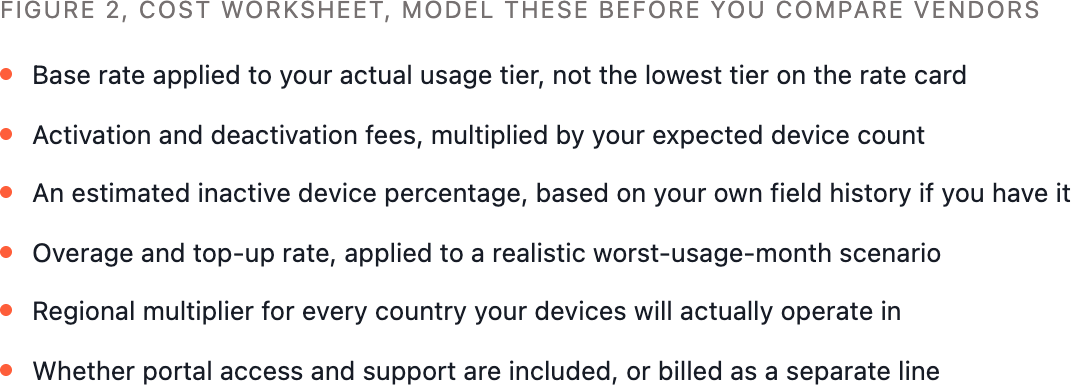
The base rate, and the model behind it. Part of the base rate depends on which pricing structure fits your traffic, pay-as-you-go, pooled, or prepaid. That choice matters, and it’s covered in depth in why your IoT SIM bill runs higher than it should. It’s one variable in the total, not the whole calculation, which is why it isn’t the focus here.
Activation and deactivation fees. Charged per SIM, separate from the monthly rate, and easy to miss when a quote only shows the recurring cost.
Inactive device carrying cost. The quiet one. A device that stops transmitting doesn’t stop being billed unless someone catches it and deactivates the SIM. At fleet scale, this is often the single largest gap between quoted and actual spend.
Overage and top-up pricing. What happens the month a device uses more data than planned, and whether that rate is disclosed up front or discovered on the invoice.
Regional and roaming multipliers. The same SIM, same plan, can cost meaningfully different amounts depending on which country the device actually operates in.
Support and portal access. Whether fleet visibility and account support are included in the base rate or billed as a separate line.
Common pitfalls
Comparing only the advertised rate across vendors, without running it against your own usage pattern first.
Not budgeting for the devices that go quiet. Most cost comparisons assume every deployed device stays active and billed correctly, which almost no real fleet does.
Treating regional pricing as flat. A plan that looks identical on the rate card can behave very differently once devices are spread across multiple countries.
How Simplex addresses each line item
Simplex’s IoT SIM pricing is published, not quoted case by case, and structured modularly around what a deployment actually needs rather than sold as a fixed bundle. Activation isn’t hidden inside a separate fee schedule; it’s part of the same published rate.
On inactive devices, Simplex’s portal surfaces devices that have gone quiet so they can be deactivated deliberately rather than discovered on an invoice, which is the silent cost fleet operations teams spend the most time chasing.
On pooled data specifically, Simplex’s data pooling lets high-usage and low-usage devices offset each other inside one deployment, which changes the overage math significantly for mixed fleets.
On regional pricing, coverage runs across 190-plus countries and 500-plus networks under one rate structure, so the multiplier a buyer needs to model is disclosed up front rather than negotiated per region after the fact.
On support and portal access, visibility into usage and device status is part of the base offering rather than a paid add-on.
One limit worth naming: no vendor, Simplex included, can hand you an accurate inactive-device percentage on day one. That number comes from your own deployment’s field behavior, not from a rate card, and it’s usually the single biggest swing factor in which pricing model actually wins. Simplex can model it with you once you have even rough field data, but we can’t estimate it blind, and any provider who quotes you a confident number without asking about your device history is guessing.
Questions to ask about pricing
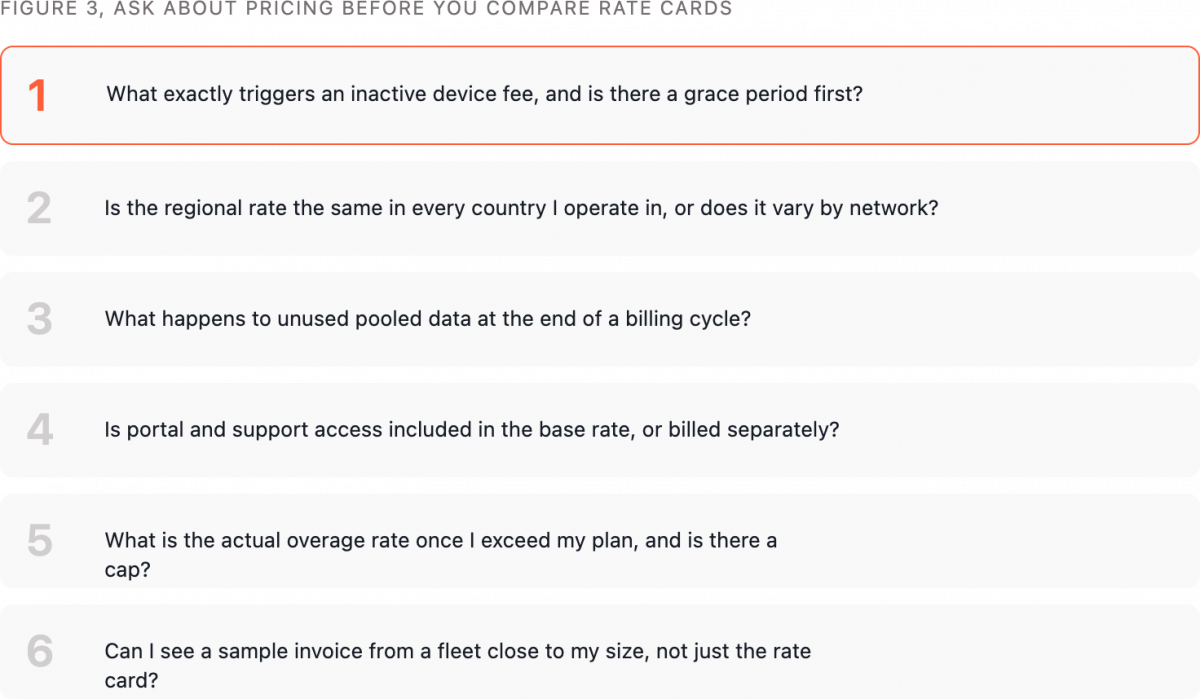
Put these to any vendor, not just Simplex, before you compare a rate card:
The bottom line
The rate card tells you what a vendor charges. It doesn’t tell you what your fleet will cost, because that depends on variables only your deployment history can supply: how many devices go quiet, how usage spikes in a bad month, how spread out your fleet actually is by country.
Send Simplex your device count, the countries you operate in, and your expected monthly usage per device, and we’ll build a real cost comparison against your numbers instead of a guess against a rate card.
This article was curated by Jan Lattunen, CCO Simplex Wireless
About the Author: Jan Lattunen manages Sales and Marketing for Simplex Wireless. Jan has 20 years’ experience in working with SIM card technology and was involved in launching the eSIM in North America with major carriers and OEMs. His expertise in telecommunications is around SIM cards. On a personal note, Jan is a family man and avid cyclist with advocacy for safety in the roads. You can connect with Jan on https://linkedin.com/in/JanLattunen