







Can You Change Your IoT Connectivity Provider Without Replacing Your SIMs?
October 23, 2026
Consolidating Multiple IoT Carrier Accounts: A Phased Rollout Guide
How to bring existing operator accounts into one management view without switching providers, starting with a small pilot group.
Fleets rarely start with several carrier accounts. They arrive there through acquisitions, product lines, or regional launches, and each account brings its own portal, invoice cycle, alert settings, and support route. Consolidating them is less about a new tool than about sequencing: what to connect first, what to check, and what not to assume.
What consolidation actually changes
With separate accounts, a simple question, such as which SIMs used data last month across the whole fleet, means exporting from each portal and reconciling by hand. Alerts live in different places, and a support issue starts with working out which carrier to call.
Bring Your Own Operator (BYOO) is Simplex’s approach to that problem. Existing operator accounts are connected to one management portal, while the SIMs, the contracts, and the carrier relationships stay where they are. As Simplex’s piece on what a SIM dashboard should show you puts it, existing carrier SIMs come under the same dashboard without changing the underlying carrier relationship. The BYOO product page describes the capability in more detail.
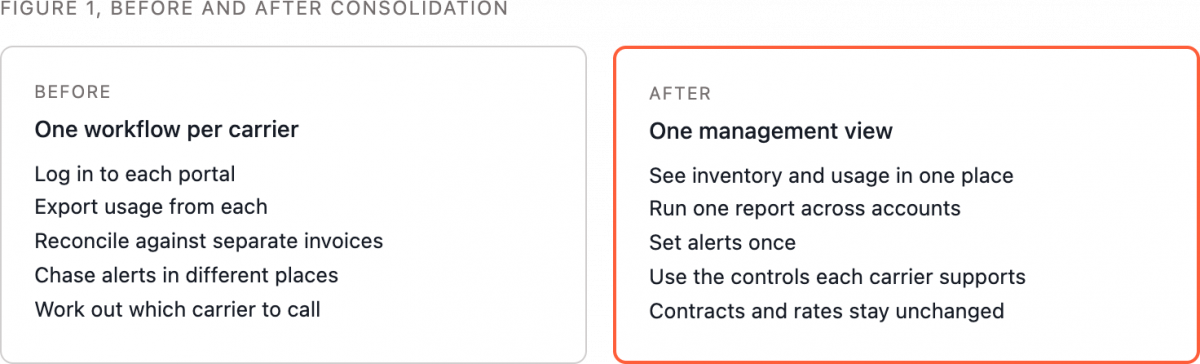
That makes it different from changing providers. Switching moves SIMs and contracts. BYOO adds a management layer on top of both. What can be brought together is inventory, usage visibility, reporting, and whichever controls the underlying carrier platform allows. What does not change is each account’s rates, contract terms, and network. Figure 1 shows the before and after.
How this differs from switching providers
A provider switch is a migration. SIMs are replaced or re-provisioned, contracts are renegotiated or exited, and devices are exposed to risk during the move. It is sometimes the right answer, and Simplex’s writing on the hidden cost of carrier lock-in covers when it is. It is also the slowest and riskiest way to get visibility.
Consolidation is a smaller step. Nothing on the device changes, and no carrier has to agree to anything you are not already allowed to do with your own account. That makes it a reasonable first move for teams who are not ready to switch but want to see the whole fleet, and it produces consolidated data you can use in later provider decisions, including a due-diligence review like the one in Simplex’s guide to evaluating an IoT SIM provider.
The catch is that the layer can only be as capable as each underlying account allows. Carrier platforms differ in what they expose, and that is the main thing to check before you start.
What this means in practice
Three requirements decide how smooth the integration is.
Integration access. Each carrier account needs to be connected using credentials or an API the carrier platform supports. Confirm which platform each account runs on, and check Simplex’s supported list for those platforms, since the list can change.
Permissions. Decide up front whether each connection is read-only or allows control actions such as suspending a SIM. Read-only is the safer starting point for a first pass. Give each connection only what it needs, and record who inside your organization holds each credential, so that offboarding a person does not break an account.
Carrier differences. Functions vary by platform. Usage visibility may be available everywhere, while a specific control may be supported on some accounts and not others. Get the supported functions for each account in writing rather than assuming they match.
Before you connect any account, confirm five things: the platform it runs on, the written list of supported functions, whether the connection is read-only or allows control, who owns the credentials, and the contract end date and notice period alongside the SIM count.
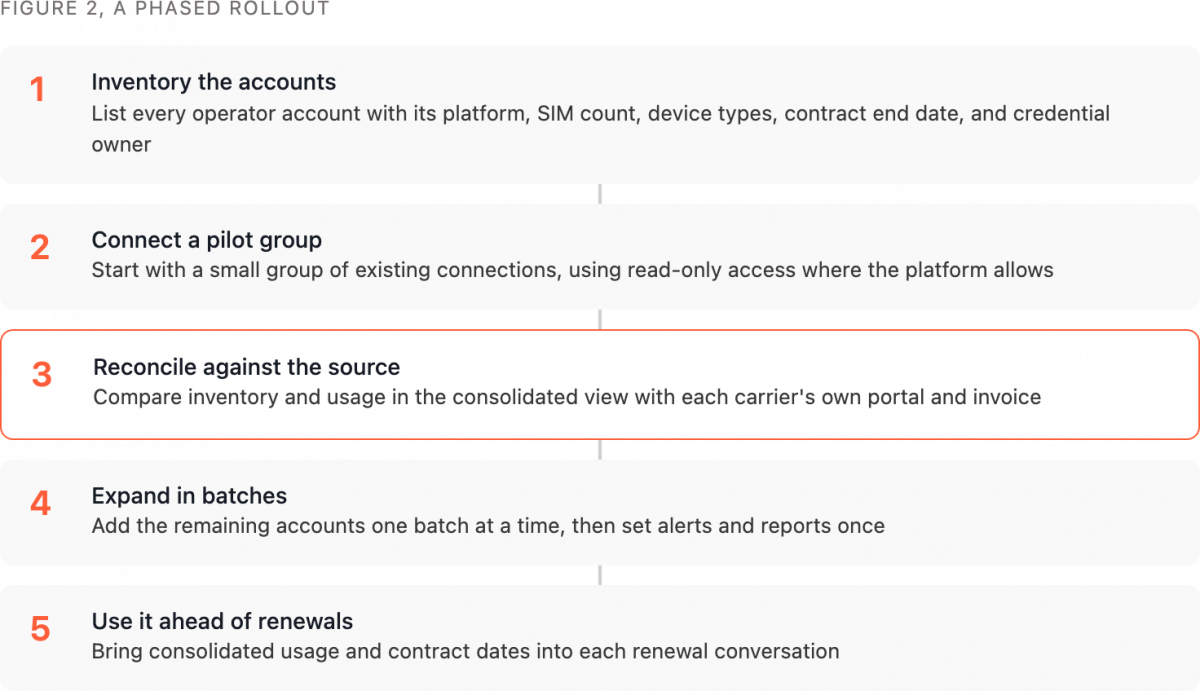
Then roll out in phases, starting with a small group of connections rather than the whole fleet. Figure 2 shows the sequence, with reconciliation highlighted because it is the step that tells you whether the consolidated data can be trusted.
Where it goes wrong
The most common mistake is assuming every control works on every account. A team sets up an alert or a bulk action, it works on one carrier’s SIMs, and it silently does nothing on another’s. Test each function on the pilot group before you rely on it.
A second is skipping reconciliation. If inventory in the consolidated view does not match a carrier’s own records, the cause is usually a duplicated or stale SIM record or a delay in usage data. It is better to find that with a small group than after the whole fleet is connected.
A third is credential sprawl. Carrier logins often belong to individuals or to a long-departed contractor, and an account can drop out of the view when that person leaves. A fourth is treating consolidation as a substitute for a decision. It gives you the data to renegotiate or switch, but it does not change a rate on its own.
Consolidating carrier accounts works best as a series of small, checkable steps. Start with a few connections, prove that the numbers match, and expand only once you trust what the combined view shows.
If you are running several operator accounts today, Simplex can assess which of them can be integrated, what functions each would support, and where a pilot group should start.
This article was curated by Jan Lattunen, CCO Simplex Wireless
About the Author: Jan Lattunen manages Sales and Marketing for Simplex Wireless. Jan has 20 years’ experience in working with SIM card technology and was involved in launching the eSIM in North America with major carriers and OEMs. His expertise in telecommunications is around SIM cards. On a personal note, Jan is a family man and avid cyclist with advocacy for safety in the roads. You can connect with Jan on https://linkedin.com/in/JanLattunen