







How to Use an eIM to Switch Local Profiles for IoT Compliance: Go Local Without the Truck Roll
November 2, 2026
Robot Mowers at the Edge of Coverage: How Multi-Carrier SIMs Keep Fleets Reachable
A grounds contractor runs robot mowers across 40 properties, and on Tuesday morning three of them stop reporting. Nothing on the dashboard says whether they’re broken, stuck, or simply out of signal, so the only way to find out is to send a truck. That’s the price of a connection that works almost everywhere.
Why mowers are hard to reach
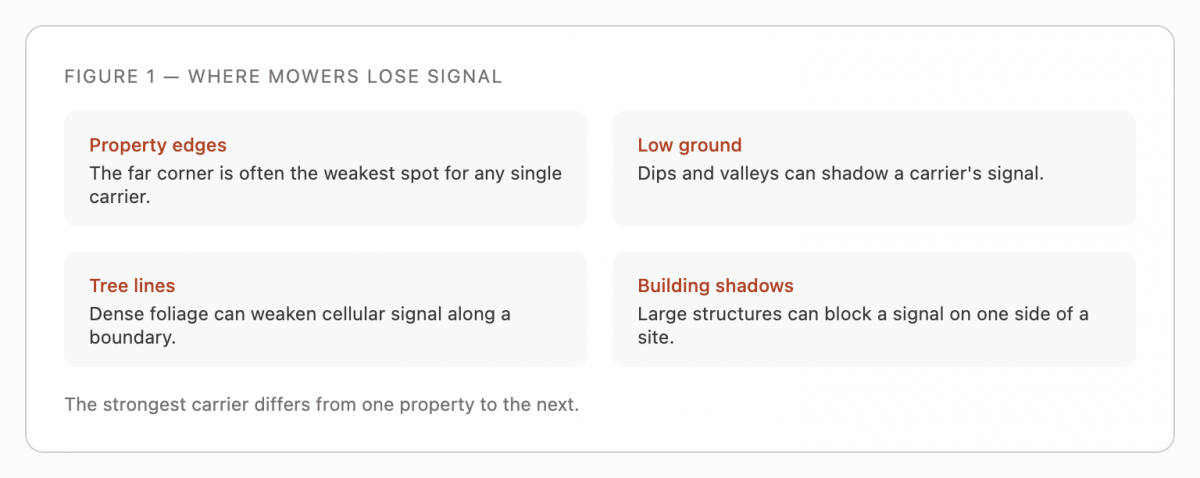
Mowers do their work at the edges of a property, which is where signal is weakest. Figure 1 above lists the usual suspects: far corners, low ground, tree lines, and the shadow of a large building. None of these are rare on a lawn.
The harder problem is scale. A fleet spans many properties, and the carrier that’s strongest at one site often isn’t the strongest at the next. A manufacturer selling across regions meets the same pattern at a larger scale. Outdoor machines that move around share this problem, as we found when we looked at commercial drones and cellular connectivity.
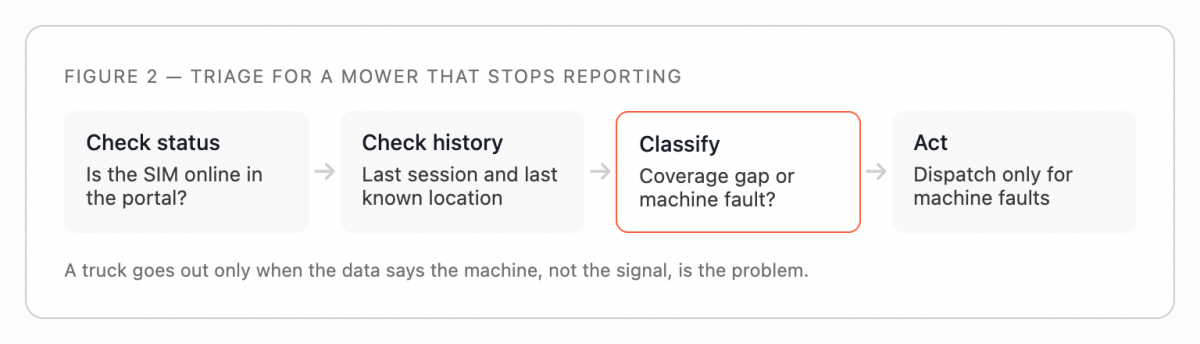
What turns a coverage gap into a cost is the missing diagnosis. A silent mower could be a dead zone or a dead machine, and the service team can’t tell which. Every unnecessary site visit is a truck, a technician, and a customer waiting, and every missed fault is a mower that stays broken for days.
Why a single-carrier SIM makes it worse
A SIM (subscriber identity module) tied to one carrier is a bet that the carrier covers every property the mower will ever visit. For a fleet, that’s a separate bet at every site, and the odds only worsen as the fleet grows.
The workaround is a SIM variant for each carrier and region, which brings its own overhead. As we explain in our piece on global rollouts and cost control, each carrier means different pricing, access point name (APN) settings, dashboards, and support processes. The operations team ends up managing carriers instead of mowers.
What reliable mower connectivity looks like
A multi-carrier SIM can use more than one carrier’s network within a country. When the carrier that’s strongest at the main building has nothing at the far fence line, the mower’s modem has other permitted networks to try. One SIM covers the fleet across sites, so there’s one contract, one APN, and one inventory.
Visibility closes the other half of the gap. The Simplex portal shows whether a SIM is online, and SimplexAI, our natural-language assistant for fleet data, can pull up a device’s session history and last known location. That lets a service team separate a coverage gap from a machine fault before anyone drives anywhere. Our guide to what your IoT SIM dashboard should show you covers what to look for.
There are limits. A multi-network SIM works as a roaming SIM, so the mower’s roaming setting has to be allowed, and the first connection can take slightly longer than on a local single-network SIM. And no SIM fixes a place where no carrier has coverage. Ask also whether a provider’s networks sit behind one partnership or several, the question we cover in why multi-network isn’t a guarantee.
How Simplex fits mower fleets
Networks. In the USA, one Simplex SIM can use AT&T, T-Mobile, and Verizon. Across Europe and APAC it covers Tier 1 networks, with access to 500+ networks in 191 countries.
Configuration. Every network uses the same APN, simplex.iot, so mower settings don’t change when the network does.
Plans. Flexible data plans are built for IoT workloads, so you pay for the data your mowers actually use, across warranty periods and service expansions.
Form factors. The SIMs come in each form factor, including MFF2, the standard SIM sizes, and eSIM.
The contractor’s three silent mowers shouldn’t need a truck to be understood. A SIM that can use more than one network, and a portal that says whether it’s online, turns Tuesday’s mystery into a quick check. See how Simplex SIMs for robot lawn mowers are built for that job.
This article was curated by Jan Lattunen, CCO Simplex Wireless
About the Author: Jan Lattunen manages Sales and Marketing for Simplex Wireless. Jan has 20 years’ experience in working with SIM card technology and was involved in launching the eSIM in North America with major carriers and OEMs. His expertise in telecommunications is around SIM cards. On a personal note, Jan is a family man and avid cyclist with advocacy for safety in the roads. You can connect with Jan on https://linkedin.com/in/JanLattunen