








Retrofitting Installed Signage for eSIM: SGP.32 Without Replacing Hardware
November 16, 2026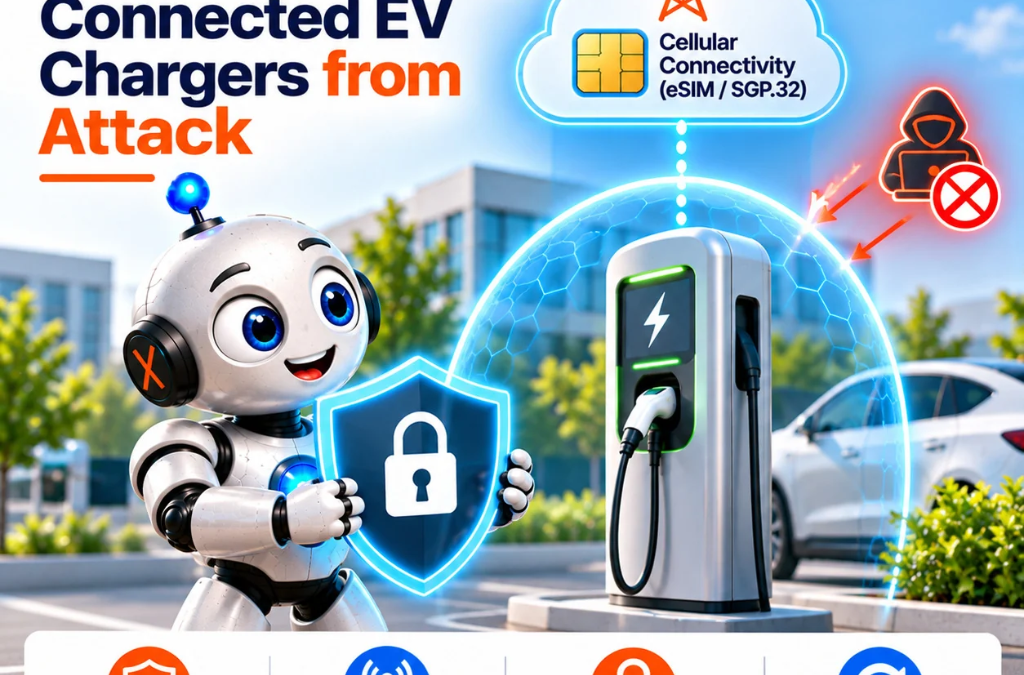
Securing Cellular-Connected EV Chargers from Attack
After reading this, you’ll know which security layers actually protect an EV charger over cellular, and what a practical checklist for a fleet operator looks like.
An EV charger handles payment card data, connects to a public network, and sits unattended in a parking lot twenty-four hours a day. That combination makes it a more attractive target than most people assume, and cellular connectivity, done right, is one of the strongest defenses available. Done casually, it’s just another public-internet device with a SIM card in it.
Why EV chargers are an attractive target
Every transaction at a charger touches payment card data, and many touch personally identifiable information tied to an account or vehicle. Add to that the charger’s role as a grid-adjacent device, one of potentially thousands reporting into a central management system, and a single compromised unit becomes a foothold, not just a nuisance. An attacker who gets into one charger’s admin interface or intercepts unencrypted traffic isn’t just stealing from that transaction, they’re probing for a path into the backend that manages the entire fleet.
This is worth taking seriously before a deployment ships, not after an incident. The connectivity choice a charger ships with either closes most of this exposure by default or leaves it wide open.
The public-internet problem (and why an APN fixes it)
A charger that routes its traffic over the public internet is discoverable. Anyone scanning for open ports or exposed services can find it, the same way any device with a public IP address is findable. Most EV chargers don’t actually need a public IP at all; they need to reach one specific backend, not the open internet, and every unnecessary exposure beyond that backend is pure attack surface with no operational benefit.
An APN, an access point name that defines how a cellular connection gets routed, is the mechanism that closes this gap. A private APN keeps a charger’s traffic off the public internet entirely, routing it through a dedicated path to the operator’s own infrastructure instead. A charger on a private APN simply isn’t visible to a public internet scan, because it was never on the public internet to begin with.
SIM-level controls that contain a breach
Network-layer protection reduces exposure, but it doesn’t eliminate the value of controls at the SIM itself, especially for containing a problem once one occurs. A SIM-to-charger assignment list, mapping every SIM to the exact device it’s installed in, turns a suspicious activity alert into an immediate, specific action: deactivate that one SIM, not guess which of thousands might be compromised. Restricting SIM-to-SIM communication within the APN limits how far a single compromised device can reach even if it is breached, containing the blast radius to that unit instead of the fleet.
None of this works if nobody’s watching for it. A SIM management platform that surfaces per-device activity, not just aggregate fleet health, is what turns an anomaly into a fast, targeted response instead of a slow, fleet-wide investigation.
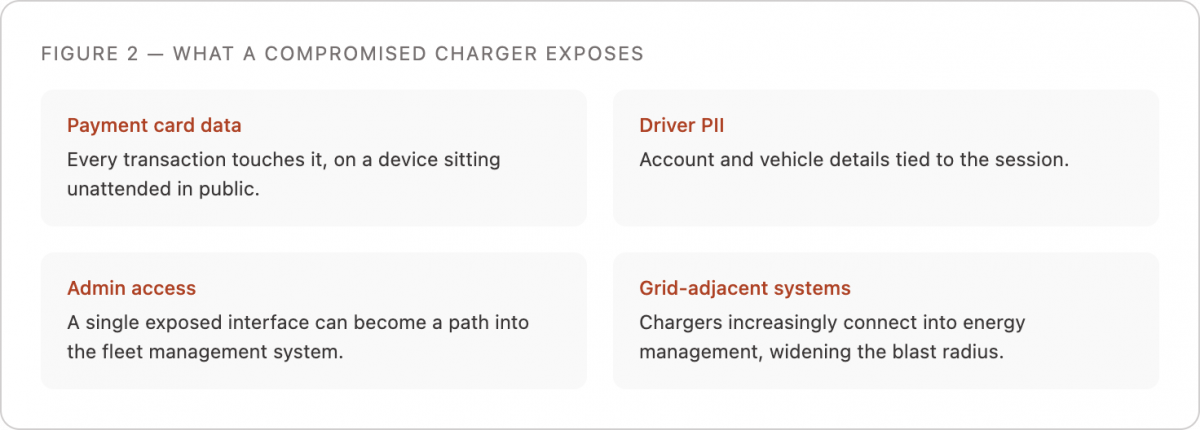
A practical security checklist for charging network operators
None of this requires a security team the size of a bank’s. It requires a short set of controls, consistently applied across every unit in the fleet, from day one of deployment rather than retrofitted after an incident.
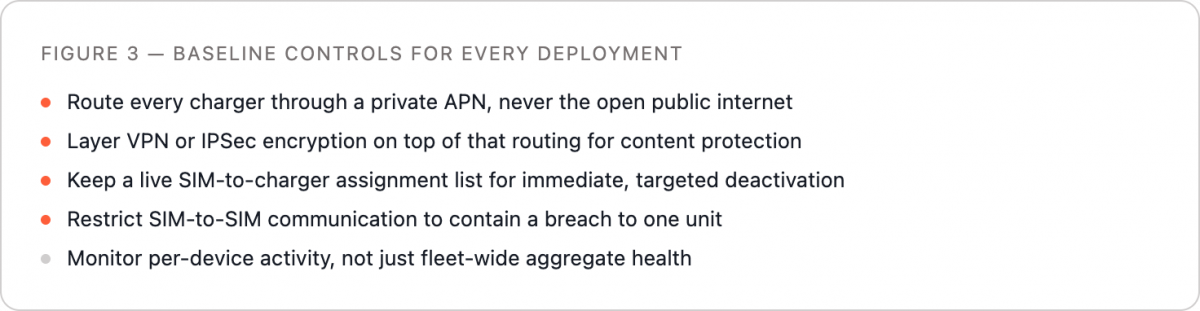
None of these controls require touching the charger hardware itself, which matters for EV charging operators with units already installed across a service area. If you’re evaluating whether your current SIM setup actually closes these gaps or just assumes it does, talk to our engineering team about what a private APN and SIM-level containment would look like for your fleet.
This article was curated by Jan Lattunen, CCO Simplex Wireless
About the Author: Jan Lattunen manages Sales and Marketing for Simplex Wireless. Jan has 20 years’ experience in working with SIM card technology and was involved in launching the eSIM in North America with major carriers and OEMs. His expertise in telecommunications is around SIM cards. On a personal note, Jan is a family man and avid cyclist with advocacy for safety in the roads. You can connect with Jan on https://linkedin.com/in/JanLattunen