






What Is a Connectivity Management Platform?
October 15, 2026
eSIM for EV Chargers: Retrofitting with SGP.32
After reading this, you’ll know why EV chargers are a strong fit for SGP.32, and what to check before committing a fleet to an eIM provider.
An eSIM, an embedded or software-based SIM that replaces a physical, removable card, isn’t new. What’s new is SGP.32, the GSMA specification that finally builds remote carrier management for IoT devices the way it should have worked from the start. For EV chargers specifically, a device class that sits in the field for years and is expensive to physically revisit, that specification solves a problem that’s been costing operators money since the first unit shipped.
Why EV chargers are a natural fit for SGP.32
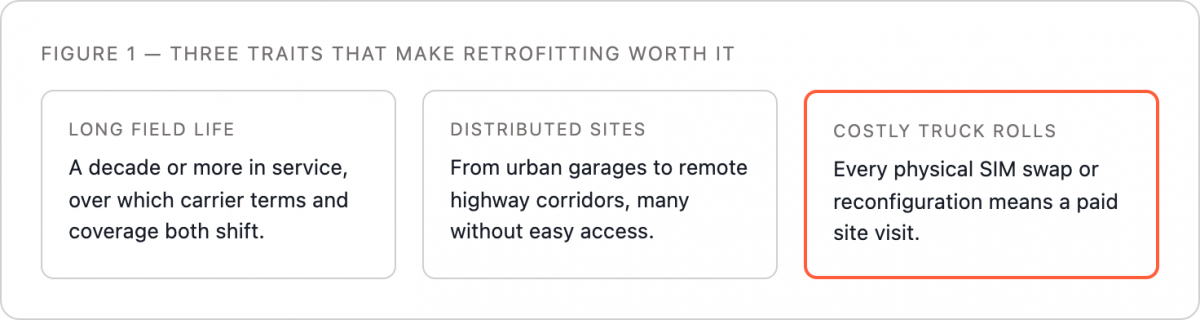
Three things about EV chargers make them an obvious candidate for this standard. They stay in the field for years, often a decade or more, over which network conditions, carrier pricing, and coverage all shift. They’re distributed across sites that range from urban parking structures to remote highway corridors, many without convenient physical access. And a technician visit to swap a SIM or reconfigure a modem, a truck roll, costs real money every time it happens, multiplied across however many chargers need the same fix.
If you want SGP.32 explained from first principles before going further, we’ve covered the standard itself in detail elsewhere. This piece stays focused on what it means specifically for a charging fleet already in the ground.
What changes with an eIM: remote profile management explained
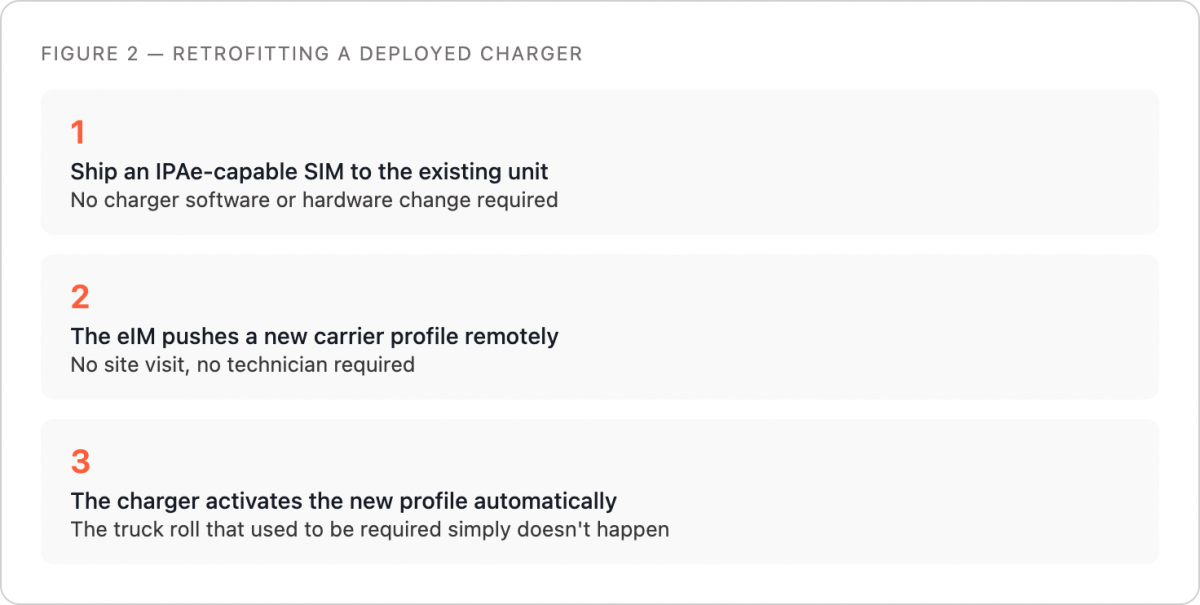
SGP.32 introduces the eIM, a management server that handles carrier profiles remotely instead of requiring physical access to the device. An eIM is what actually lets an operator switch carriers over the air, sending a new profile to the charger’s eSIM and activating it without anyone touching the hardware. For a fleet manager, that turns a carrier change from a truck-roll-per-unit project into a remote operation that can, in principle, be pushed to an entire site or region at once.
Retrofitting existing chargers without replacing hardware
The retrofit question is usually the one that stalls a fleet upgrade before it starts: does moving to SGP.32 mean replacing chargers already installed in the field? For units built with the right SIM-side support, the answer is no. IPAe, the SIM-side implementation of SGP.32’s profile assistant function, handles the profile management logic on the SIM itself rather than requiring changes to the charger’s own software or hardware.
Carrier independence: renegotiating rates without a site visit
The operational win compounds into a commercial one. A fleet locked to a single carrier by physical SIM logistics has no real negotiating leverage at contract renewal, since switching means paying for truck rolls across every affected site. A fleet on an eIM-managed eSIM can move carriers, or split a fleet across multiple carriers by region, without that cost standing in the way. That changes the conversation at renewal time from “what can we tolerate” to “what’s actually the best rate available this year.”
What to ask an eIM provider before you commit a fleet
Not every eIM is built the same way, and the difference matters more once a fleet depends on it for years. The most important distinction is whether the eIM was built in-house by a team with SIM and carrier-grade platform expertise, or assembled by relying on a single EUM (eUICC manufacturer) or MNO (mobile network operator) for the pieces that actually make profile switching work.
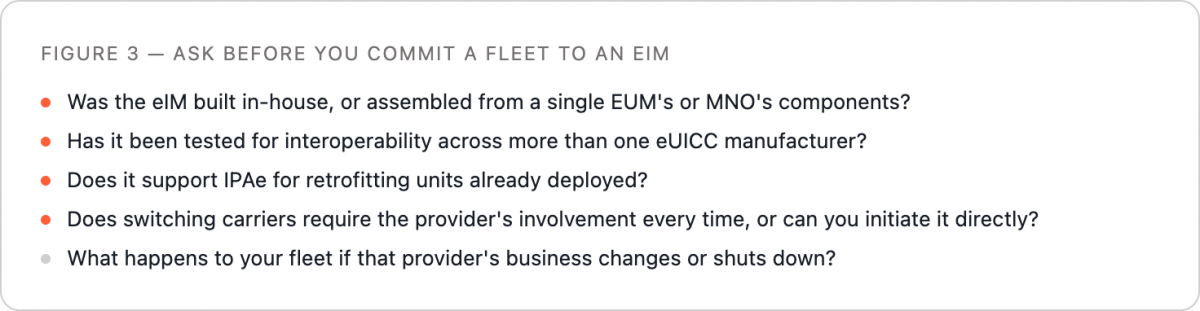
An eIM built by a team that’s tested against multiple eUICC manufacturers, rather than one, is generally a stronger long-term bet than one tied to a single manufacturer’s roadmap. We’ve written a fuller checklist for evaluating an eIM provider if you want to go deeper before signing anything.
For a fleet of EV chargers already in the field, the retrofit question isn’t whether SGP.32 is worth adopting, it’s whether the provider behind it can actually deliver a retrofit without a truck roll to every site. Talk to our engineering team if you want to walk through what that looks like for your fleet specifically.
This article was curated by Jan Lattunen, CCO Simplex Wireless
About the Author: Jan Lattunen manages Sales and Marketing for Simplex Wireless. Jan has 20 years’ experience in working with SIM card technology and was involved in launching the eSIM in North America with major carriers and OEMs. His expertise in telecommunications is around SIM cards. On a personal note, Jan is a family man and avid cyclist with advocacy for safety in the roads. You can connect with Jan on