







1NCE High Data IoT Review vs. Simplex Wireless: Terms Compared
October 28, 2026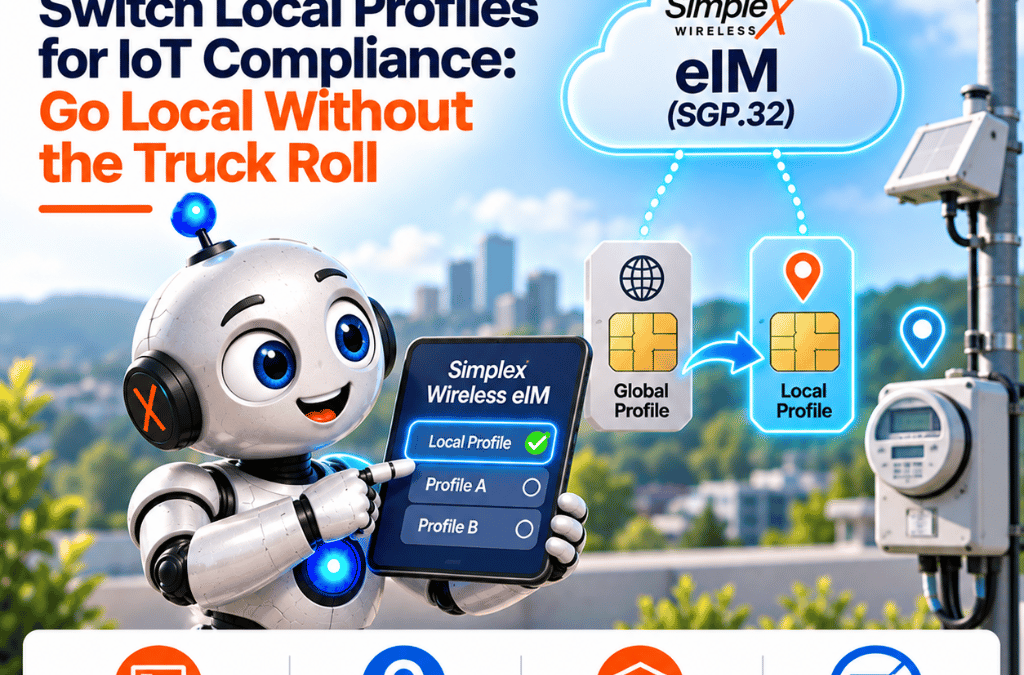
How to Use an eIM to Switch Local Profiles for IoT Compliance: Go Local Without the Truck Roll
After reading this, you’ll be able to plan a compliant profile switch for a device heading into a market that restricts permanent roaming, and you’ll know what the eIM does and what it can’t do for you.
A device built in one country and deployed in another connects as a visitor. That works until a regulator, or the visited operator, decides visitor status has an expiry date. Then a fleet that behaved in testing goes quiet in a single market, and the fix on paper is a SIM swap in a place you can’t easily send anyone.
Why a roaming SIM has an expiry date
Roaming is what a SIM does when it attaches to a network other than the one it’s registered to. For a traveler that lasts a week. For an IoT device it can last the product’s whole life, because the SIM is registered in one country and the device works in another. That’s permanent roaming, and some regulators don’t allow it. Providers have long leaned on roaming to widen coverage, and where restrictions apply, the result can be steep data charges or devices removed from the network.
The details vary by country, and they change. Brazil, Turkey, and Nigeria are widely reported to have explicit restrictions. In China, India, Saudi Arabia, and the UAE, connectivity services must come from a locally registered operator, which gets to a similar place through licensing. Treat any country list, including this one, as a starting point, and confirm each market with your local operator or counsel before you deploy.
The compliant answer is a local identity: an operator profile issued by a carrier licensed in the country, loaded onto the device’s eUICC (embedded universal integrated circuit card, the reprogrammable SIM chip). The device then attaches as a subscriber, not a visitor, and the difference is practical. A visitor’s status can be limited or cut in restricted markets, and its traffic can be billed at roaming rates. A local subscriber sits on the local operator’s rate card, and compliance rests on the profile and the local rules you’ve verified. SGP.32, the GSMA specification for IoT remote SIM provisioning, makes loading that profile a remote operation, run by an eSIM IoT Remote Manager (eIM).
The old fixes, and what the eIM changes
Before SGP.32 there were two ways to go local, and both had a cost. The first was a country-specific SIM: a different SKU, or a physical swap, for every restricted market, which means truck rolls and inventory sorted by destination. The second was a multi-IMSI SIM, which carries several operator identities and switches between them at the network layer. It works well, but those identities are typically set when the SIM is made, so a new market can mean a new SIM. Our piece on eIM and Multi-IMSI explains when to run both.
The eIM changes the unit of work. Instead of swapping a SIM, you push a profile. The device ships once with a starting profile, and when it lands in a restricted market the eIM tells the device’s IPA (IoT Profile Assistant, the local agent that carries out its instructions) to download the local operator’s profile from that operator’s SM-DP+ (Subscription Manager Data Preparation Plus, the server that prepares and delivers profiles) over IP. No visit, no new SKU, and the choice of local operator is yours.
How to run a compliant switch
Here is the switch itself, from first power-up to local subscriber. The first connection is typically on a bootstrap profile, which roams only until the switch happens. Figure 1 follows the sequence step by step.
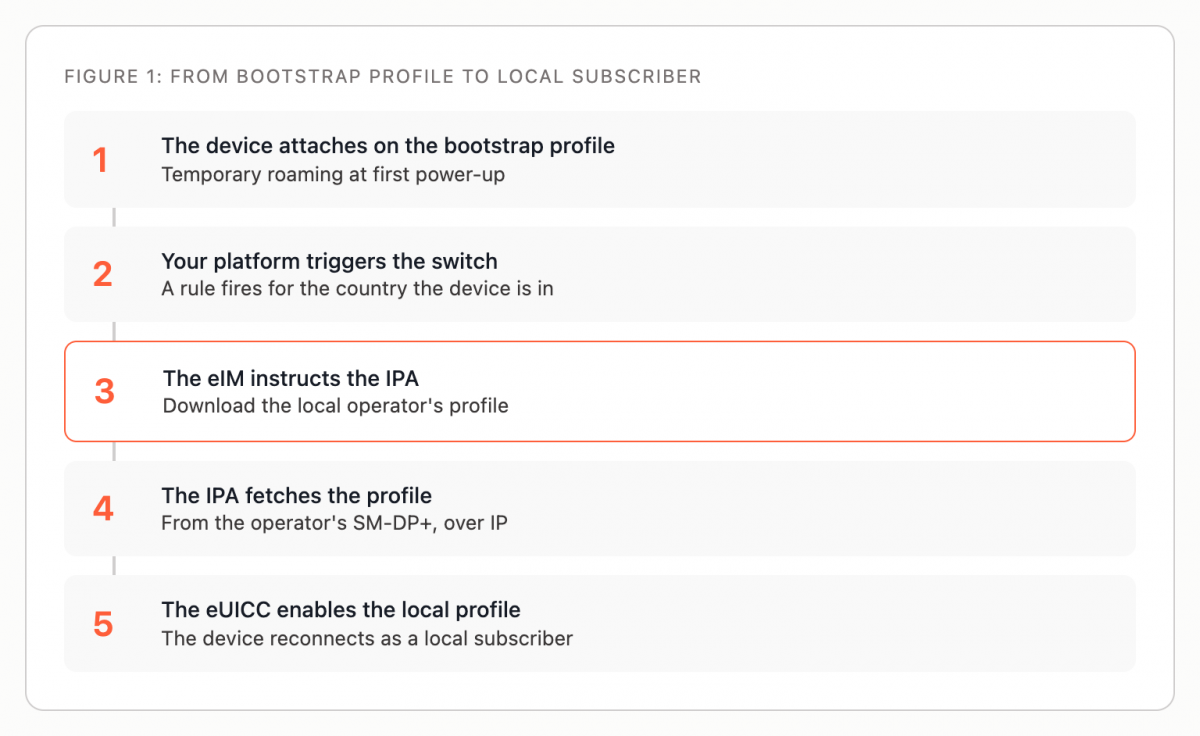
Notice where the eIM sits: step three. It issues the instruction, but it doesn’t create the local connectivity. That comes from the operator profile you arranged in advance. Three habits make the switch boring, which is the goal.
Map your markets first. List every country on your roadmap and mark which restrict permanent roaming, using your local operator or counsel as the source of truth, not a blog post.
Switch before the visitor window closes. Trigger the switch as soon as a device is in a restricted market, rather than waiting for the visited network to push back. If the roaming connection is cut first, the device may not be able to reach the eIM or the profile server at all.
Pilot per country. Run a small batch through the whole path before you switch a fleet. Our stage-by-stage SGP.32 pilot lists what to verify from factory to field.
Where local profile switches go wrong
Expecting the eIM to supply the carrier. The eIM manages profiles on the eUICC. It doesn’t decide whose network those profiles connect to, so you still need an operator licensed in the market.
Provisioning rules, not just roaming rules. Some markets also regulate who may provision eSIM profiles at all. Turkey, for example, is reported to require eSIM provisioning to go through Turkish operators. Confirm that your profile source is allowed in each market you ship to.
No fallback. A switch that fails halfway with no connection left is a truck roll in disguise. Decide in advance what the device does if the download fails, and test that path on your pilot batch, not on your fleet.
Where Simplex fits
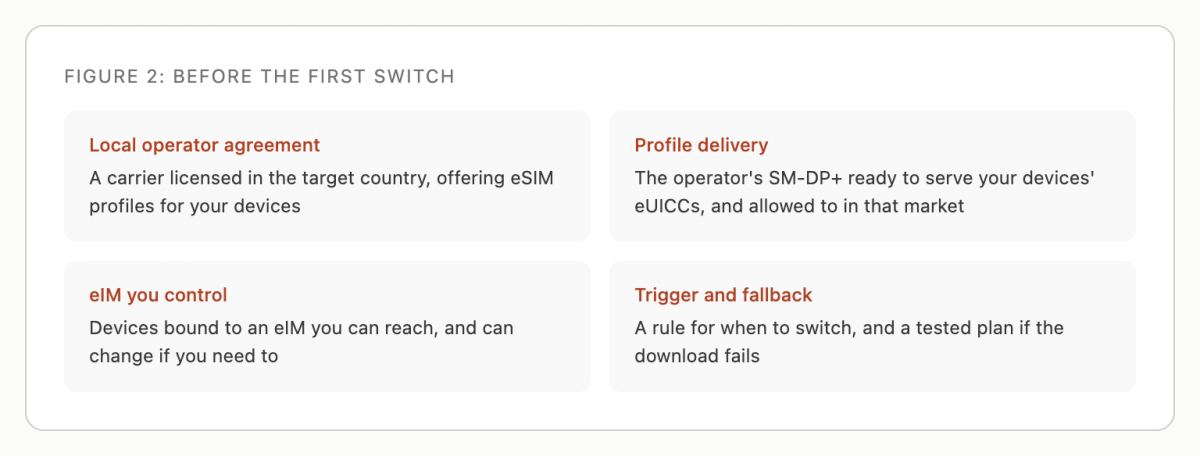
Simplex built its eIM in-house in the US and sells it as a stand-alone service that works with any MNO’s (mobile network operator’s) eSIMs. That suits this problem: you bring the local operators, and the eIM runs the switch. It supports both IPAe (the IPA inside the eUICC) and IPAd (the IPA on the device), and it has been interoperability tested with four eUICC manufacturers, three of which we can name: Kigen, STMicroelectronics, and VALID. We can’t make a regulator’s rules flexible. We can make the compliance fix a software operation instead of a site visit. Figure 2 is the pre-flight list we’d run before the first switch.
Go local, stay put
A compliant fleet doesn’t need a technician in every market. It needs a local operator, a trigger, and an eIM that can move a profile on command. If you have devices heading into restricted markets, talk to our engineering team and bring your country list.
This article was curated by Jan Lattunen, CCO Simplex Wireless
About the Author: Jan Lattunen manages Sales and Marketing for Simplex Wireless. Jan has 20 years’ experience in working with SIM card technology and was involved in launching the eSIM in North America with major carriers and OEMs. His expertise in telecommunications is around SIM cards. On a personal note, Jan is a family man and avid cyclist with advocacy for safety in the roads. You can connect with Jan on https://linkedin.com/in/JanLattunen