






TEST PAGE
November 4, 2026
Best IoT Connectivity Management Platforms for Enterprises: Pick the One You Won’t Have to Replace
A dashboard that looks good in a demo is the easy part. Here is how to find the platform that still works at 20,000 SIMs and 2 a.m.
Nobody falls in love with a connectivity management platform (CMP) on an ordinary Tuesday. They fall for it in a demo: clean dashboard, tidy data, one friendly engineer clicking only the buttons that work. Then the pilot ends, the fleet grows to 20,000 SIMs (Subscriber Identity Modules), and the platform you chose quietly becomes load-bearing. Every alert rule, billing export, and API (application programming interface) integration points at it, and moving later means touching all of them.
A bad choice rarely fails loudly. It fails as a tax: an invoice nobody can reconcile, an API call that doesn’t exist so a contractor scripts around it, a carrier change that takes a quarter because the history can’t leave. If you already manage 1,000 or more SIMs, you may recognize one of these from your current provider. This guide gives you six criteria, three traps, and seven questions that sort platforms quickly. The framework works whoever you buy from, including us.
Six things to test before you fall for a dashboard
A dashboard is the easy part to build and the easy part to love. These six decide whether you’re still happy at 20,000 SIMs. None needs a vendor to define it for you, and each one you can test.
Carrier neutrality and redundancy. Ask whose SIMs the platform actually manages. A platform tied to one carrier inherits that carrier’s outages and its price list. Count the networks each SIM can reach per country, and check whether you can bring your own contracts. Reaching several networks is only half the job, since multi-network SIMs don’t guarantee uptime without steering and monitoring on top.
API completeness. Every portal action needs an API twin: activate, suspend, change plan, pull usage, set thresholds. Read the documentation before the demo, not after the contract. A vendor that publishes it openly is telling you something.
eSIM readiness. Even if your fleet is physical SIMs today, the first eSIM (embedded SIM) is coming. The platform must show profile state next to subscription state and work with an eIM (eSIM IoT Remote Manager) under SGP.32, the GSMA specification for IoT remote provisioning. Our explainer on what an eIM does covers who does what.
Visibility and access control. Per-device history, session status, and alerts are table stakes. At enterprise scale the quieter features matter more: sub-accounts and user roles, so a regional team sees its own devices and nobody else’s.
Pricing and exit terms. Ask what the platform costs separately from the data, what an idle SIM costs, and which minimums apply. Then ask the question most quotes avoid: what does leaving cost? Our line-by-line cost worksheet lists the lines a quote usually skips.
Support and escalation. Find out who answers when something breaks, and whether that person can change anything. A support tier that can only open tickets is a queue, not a service. Figure 1 orders five of these criteria by how much rework a wrong choice causes after deployment.
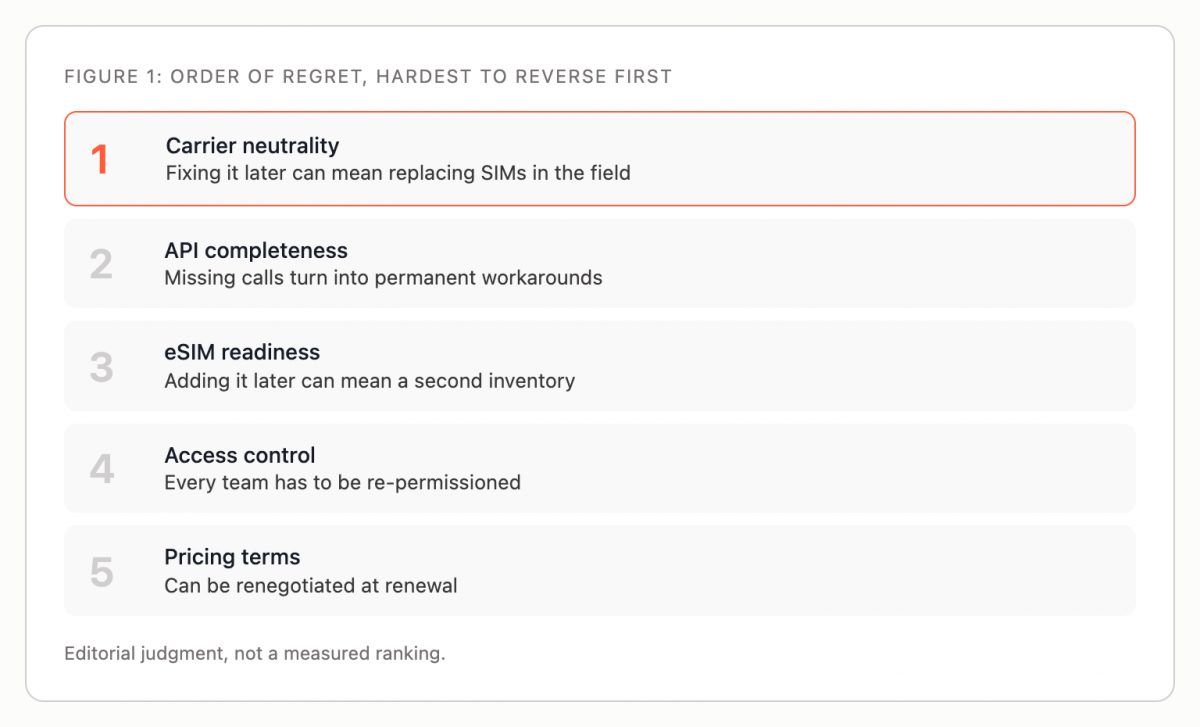
Read that list as a budget for your evaluation time. If you only get two hours with a vendor, spend them at the top. Pricing sits at the bottom for a reason: a bad rate card can be renegotiated at renewal, but a bad architecture follows you home.
Three ways smart buyers still get burned
None of these is about choosing a bad product. They’re about testing the wrong thing.
The demo that goes to eleven. A demo account is pristine, the data is tidy, and every dial goes to eleven. Ask for trial SIMs in your own devices and test the unglamorous paths: a suspended SIM, a capped plan, a device that stops reporting. Ten minutes on a trial SIM teaches more than an hour of slides.
A portal in a platform costume. A carrier portal manages its owner’s SIMs, and that works until you add a second carrier. Then adding a carrier usually means a second tool, your alerts and history stay tied to the first carrier, and leaving means starting over. A carrier-neutral platform manages SIMs from several carriers, treats a new carrier as a new connection in the same inventory, and keeps your records if you switch. The test is simple: ask the vendor to show you a SIM from a carrier they don’t sell. It decides whether adding your second carrier is a configuration change or a procurement project.
The eSIM problem you’ll have next year. If profile state lives in a separate system from subscription state, you’ve rebuilt the two-inventory problem you bought a platform to remove. Ask how the platform will handle your first eSIM before you need it, not after.
The same six, applied to us
Fair is fair. Here is how Simplex answers its own scorecard, with the numbers we can stand behind.
Carrier neutrality. Simplex SIMs reach more than 500 networks across 191 countries, with multiple networks per country, including AT&T and T-Mobile in the US and Rogers, Bell, and TELUS in Canada. Through Bring Your Own Operator (BYOO), you can also keep your own MNO (mobile network operator) contracts and manage them in the same portal. More than 2.1 million BYOO SIMs are under management today.
API. Simplex publishes API documentation, so you can check coverage against your own workflow before you sign anything.
eSIM. The xoSIM eUICC (embedded universal integrated circuit card) carries an IPAe, an IoT Profile Assistant that runs on the SIM itself, and works with the eIM we built in-house in the US. The eIM is sold as a stand-alone service that works with any MNO’s eSIMs. It has been interoperability tested with four eUICC manufacturers, three of which we can name: Kigen, STMicroelectronics, and VALID.
Visibility and access. The portal covers data consumption trending, SIM statistics, real-time usage, on-demand reporting, troubleshooting, user administration, and sub-accounts. Alerts cover sudden foreign roaming, unregulated device usage, rogue device behavior, and wrong-device-type fraud. SimplexAI lets anyone on the team ask about sessions, usage, and coverage in plain English.
Pricing. Three plan structures are available: pay as you go, pooled bundle, and prepaid. The commercial model follows the fleet, not the other way around.
Support. Support, sales, and R&D sit in Atlanta, and escalations reach engineers rather than a queue.
Where we fall short. Verizon access is arranged through our sales team rather than switched on at sign-up, and online enrollment includes a company verification step, so a first order isn’t instant.
Seven questions that make a sales call interesting
Put these to every vendor on your shortlist, Simplex included. The pause before the answer is data too.
- Which of my existing carrier contracts can you manage, and which new carriers can I add without a new agreement?
- Show me one action available in the portal that the API can’t do.
- If I leave, what do I take with me, in what format, and by when?
- What do idle and paused SIMs cost, and what minimums apply?
- How do eSIM profiles appear in my inventory, and who operates the eIM?
- Who answers a severe incident at 2 a.m. in my time zone, and what can they change?
- What was your last platform incident, how long did it last, and where is it written up?
Answers are promises, so ask for proof alongside them:
- A live API call, run on a trial account with your own SIMs
- An alert firing on a test SIM pushed past its cap
- Exit terms and data export format, in writing
- A reference customer running a fleet near your size
- Public status history for the platform
Score the sheet, then test the SIM
Six criteria, three traps, seven questions. Score every vendor on the same sheet, including us, and weigh carrier neutrality and API coverage heavily, because they are the hardest to fix later. If you want to put Simplex on that sheet, ask for a trial SIM (300 MB, valid for three months, with portal access) and run the API and alert checks against your own traffic. Or talk to our engineers about a fleet quote.
This article was curated by Jan Lattunen, CCO Simplex Wireless
About the Author: Jan Lattunen manages Sales and Marketing for Simplex Wireless. Jan has 20 years’ experience in working with SIM card technology and was involved in launching the eSIM in North America with major carriers and OEMs. His expertise in telecommunications is around SIM cards. On a personal note, Jan is a family man and avid cyclist with advocacy for safety in the roads. You can connect with Jan on https://linkedin.com/in/JanLattunen