







Case Study: ezVOLTZ
October 7, 2026
Keeping Public Venue Screens Online: IoT Connectivity for Arenas, Airports and Libraries
How to connect media towers, kiosks, and directories without depending on a network you don’t control.
Picture a media tower in a busy venue concourse. The screen works, the content player works, and the display is still dark. The weak link is the network behind it, and the integrator who installed the tower doesn’t own that network.
The connectivity challenge in public venues
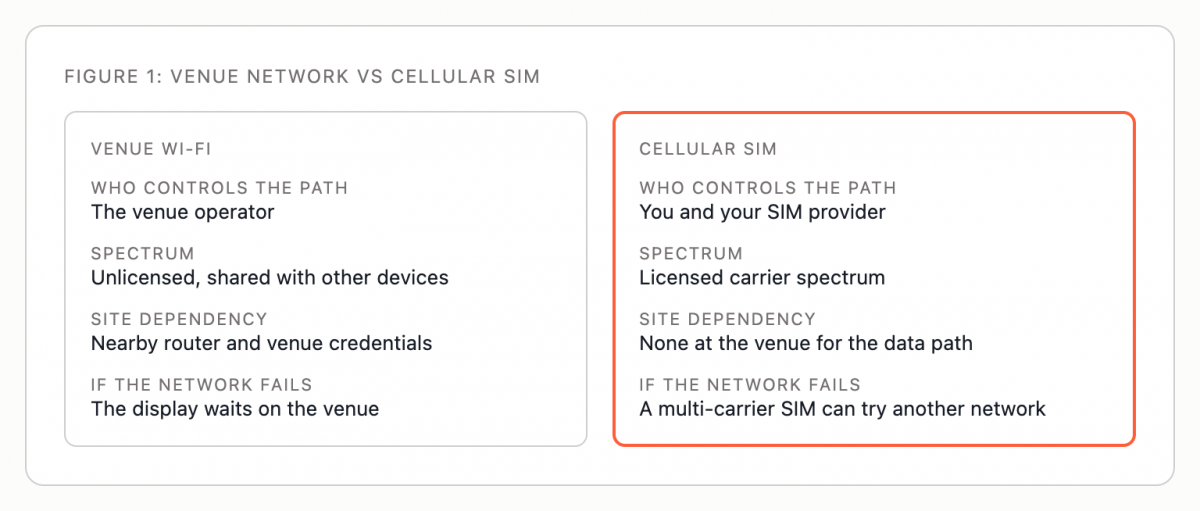
Integrators who build and manage digital signage often reach their displays over the venue’s own network. That makes the venue operator part of your uptime. Simplex’s comparison of cellular versus Wi-Fi makes this point for EV chargers, and it carries over to signage. Wi-Fi usually means joining a network the site operator doesn’t fully control, so someone else’s outages, updates, and security choices become your device’s problem too.
Wi-Fi also runs on unlicensed spectrum shared with every other device on the band. A signal that tested fine on install day can degrade as more devices join around it.
The same logic applies to a kiosk on an airport concourse or a media tower in a library atrium. The display isn’t the variable. The network path is.
Why standard SIMs fail here
The obvious fix is a cellular modem inside the enclosure, which takes the venue network out of the path. But it only helps if the SIM is the right one. A single-carrier SIM ties the display to one network, and Simplex has named that as a common cause of unexplained outages.
Coverage is also local. A carrier that’s strong in one part of a building can be weak in another, which is why coverage maps are a starting point and not proof. When a display drops, you need to know whether the SIM attached and to which network. Without that, the only way to find out is a site visit.
Figure 1 compares the two connection models.
What the right connectivity looks like
Start with a multi-carrier SIM. It can attach to more than one mobile network operator (MNO), so a gap in one carrier’s coverage doesn’t have to take the display down. It improves your odds, but it isn’t a guarantee. Simplex has written about why “multi-network” on a spec sheet isn’t the same promise it sounds like, so ask how a SIM chooses and switches networks, not just how many it lists.
Next, look at how the traffic is routed. An access point name (APN) is the gateway a cellular device uses to reach a network. A private APN can route your display traffic to your own content servers instead of the public internet.
Then plan for the long life of the hardware. A media tower can outlast a carrier contract. SGP.32 is the GSMA’s eSIM IoT specification. It lets an eSIM IoT Remote Manager (eIM) switch carrier profiles over the air, so changing carriers doesn’t mean pulling a physical SIM from the enclosure.
How Simplex fits
Multi-carrier data SIMs. Simplex’s IoT data SIMs offer carrier-redundant connectivity across multiple MNOs. They come as plug-in SIMs (2FF, 3FF, 4FF), as soldered MFF2, or as eSIM, so the form factor can match your kiosk hardware.
Visibility. The dashboard and REST API cover SIM provisioning and reporting. SimplexAI lets you ask about your network in plain English, such as how many devices are online or which SIM used the most data.
eSIM management. Simplex built its eIM in-house and runs it on its own bare metal. Simplex eSIM management is available on its own, so you can keep your existing MNO contracts, or paired with Simplex’s multi-carrier SIMs. It’s built and supported from Atlanta, Georgia.
Four checks before you deploy
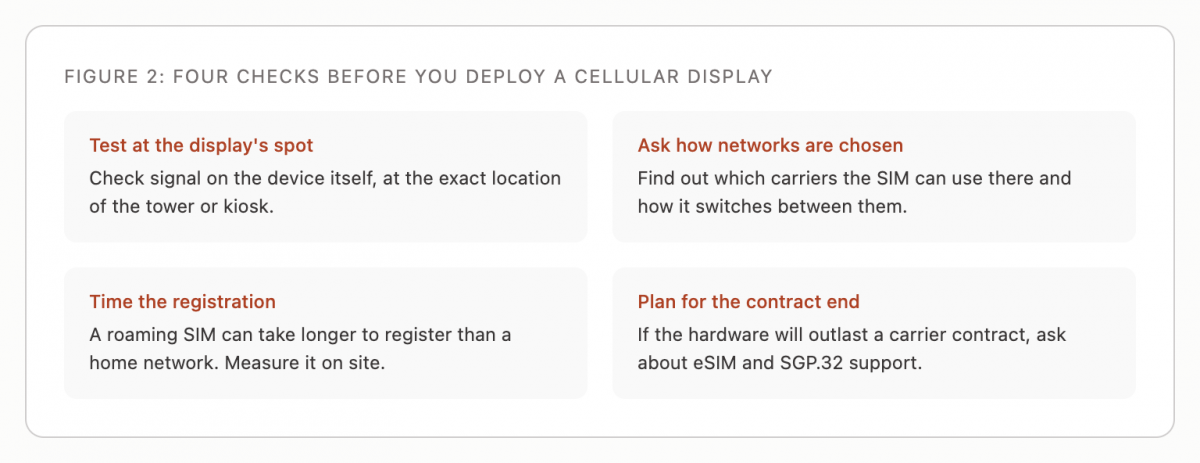
Whichever provider you choose, don’t rely on the datasheet. Test the connection on the actual display, in the actual spot, before the install schedule locks in. Figure 2 lists the four checks we’d run first.
The display was never the weak link. The network path was. Build a path you control, with more than one carrier behind it, and test it before the install date rather than after the first dark screen. To see how Simplex can connect your displays, talk to our engineering team.
This article was curated by Jan Lattunen, CCO Simplex Wireless
About the Author: Jan Lattunen manages Sales and Marketing for Simplex Wireless. Jan has 20 years’ experience in working with SIM card technology and was involved in launching the eSIM in North America with major carriers and OEMs. His expertise in telecommunications is around SIM cards. On a personal note, Jan is a family man and avid cyclist with advocacy for safety in the roads. You can connect with Jan on https://linkedin.com/in/JanLattunen